
We read your photo as:
Explain the relationship between the gradient and y-intercept of linear equations and their graphs. Also, calculate the product of gradients and plot the graphs for given equations.
Mathematics
ScanSolve AI Answer
Answer
Step-by-step solution
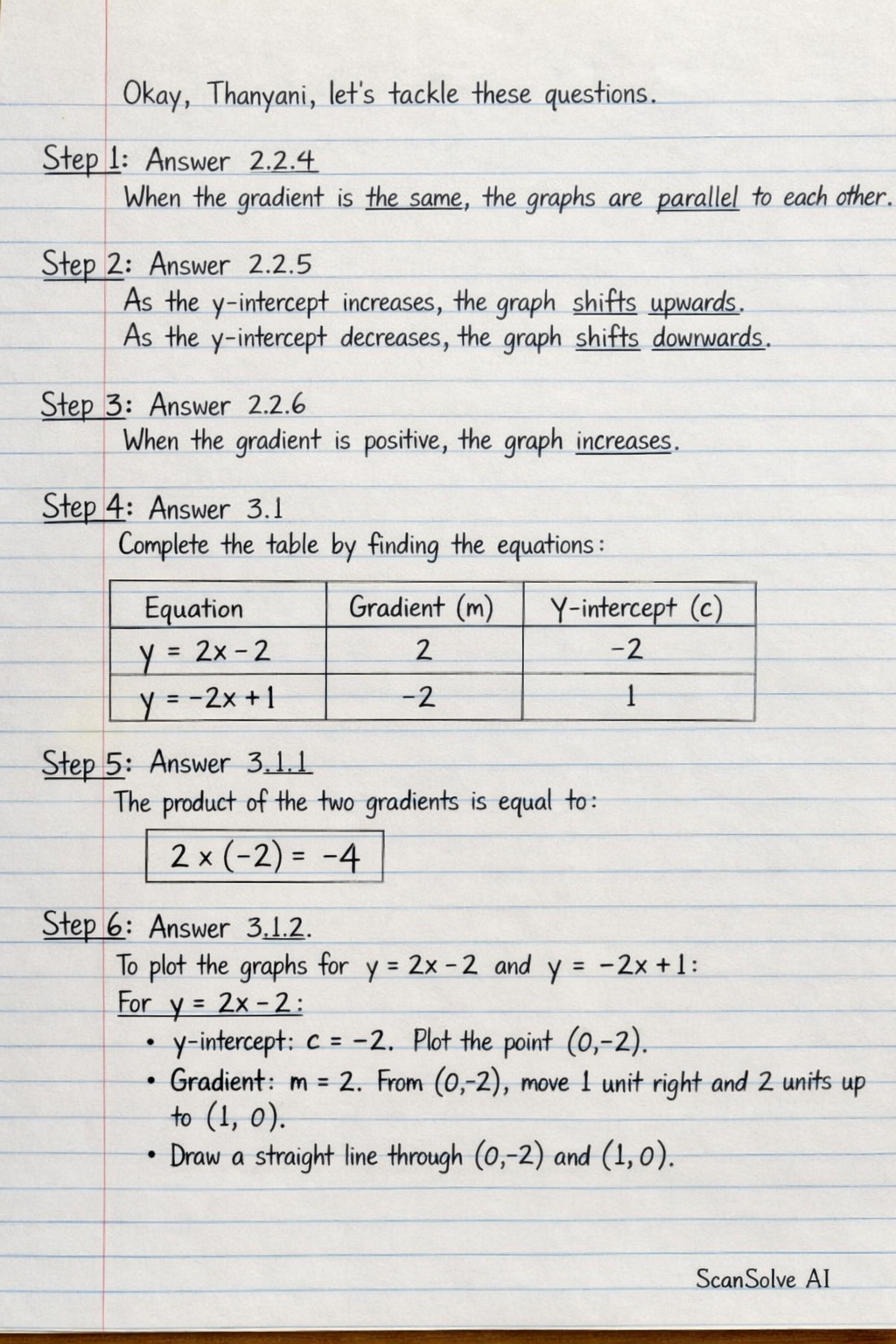
6 stepsOkay, thanyani, let's tackle these questions.
Answer 2.2.4
When the gradient is the same, the graphs are parallel to each other.
Answer 2.2.5
As the y-intercept increases, the graph shifts upwards. Alternatively, as the y-intercept decreases, the graph shifts downwards.
Answer 2.2.6
When the gradient is positive, the graphs increases.
Answer 3.1
Complete the table by finding the equations:
Equation Gradient () Y-intercept () 2 -2 -2 1 Answer 3.1.1
The product of the two gradients is equal to:
Answer 3.1.2
To plot the graphs for and :
-
For :
- The y-intercept is . Plot the point .
- The gradient is . From , move 1 unit right and 2 units up to get to .
- Draw a straight line through and .
-
For :
- The y-intercept is . Plot the point .
- The gradient is . From , move 1 unit right and 2 units down to get to .
- Draw a straight line through and .
-
Was this helpful?
Still stuck on this one?
Ask a follow-up, and the answer starts from this question.
Got a different question?Ask your own question
More Mathematics Questions
QExplain the relationship between gradients and y-intercepts of linear graphs, calculate the product…QGiven the linear equations y = x, y = 2x, and y = 2x + 1, determine the gradient and y-intercept for…QDetermine the gradient and y-intercept for the given equations of straight lines.QGiven the linear equations below: a) y = 3x + 1 b) y = −2x + 2 a. From the equations, derive the…QFrom the graph, find the gradient and equation of each of the lines through points A and B, B and C…
Browse by topic:Algebra
Handwritten Step-by-Step Solution
Get this as a handwritten image on WhatsApp — like a tutor wrote it for you.
Try on WhatsApp