

This mathematics problem involves applying core mathematical principles and formulas. Below you will find a complete step-by-step solution with detailed explanations for each step, helping you understand not just the answer but the method behind it.
ScanSolve AI Answer
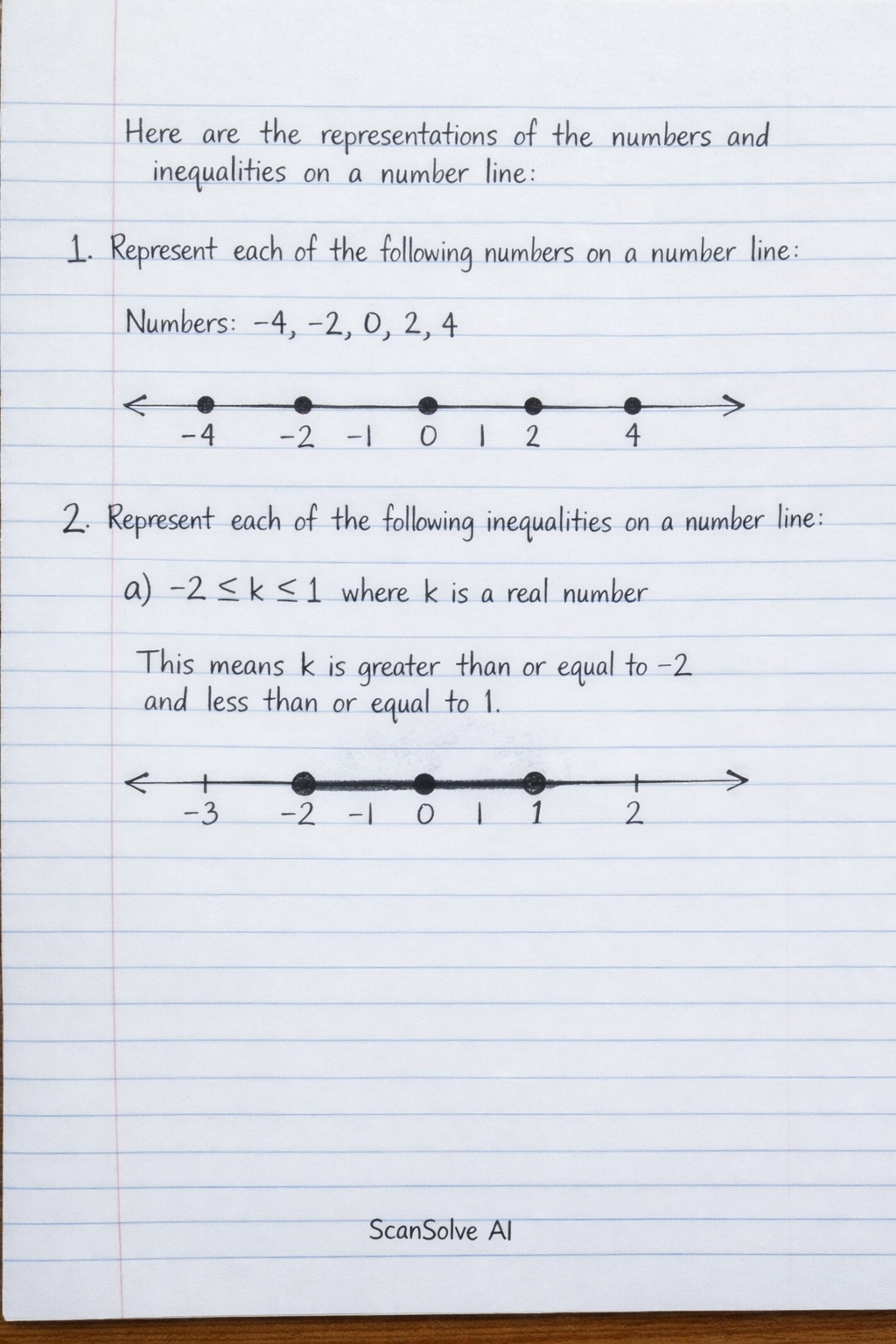
Here are the representations of the numbers and inequalities on a number line: 1. Represent each of the following numbers on a number line: Numbers: -4, -2, 0, 2, 4 [<->] (-5,0) -- (5,0); in -4,-3,-2,-1,0,1,2,3,4 (,0.1) -- (,-0.1) node[below] ; [black] (-4,0) circle (2pt); [black] (-2,0) circle (2pt); [black] (0,0) circle (2pt); [black] (2,0) circle (2pt); [black] (4,0) circle (2pt); 2. Represent each of the following inequalities on a number line: a) -2 k 1 where k is a real number This means k is greater than or equal to -2 and less than or equal to 1. [<->] (-4,0) -- (3,0); in -3,-2,-1,0,1,2 (,0.1) -- (,-0.1) node[below] ; [black] (-2,0) circle (2pt); [black] (1,0) circle (2pt); [line width=1.5pt] (-2,0) -- (1,0); b) -5 < y -2 where y is a real number This means y is greater than -5 and less than or equal to -2. [<->] (-6,0) -- (0,0); in -5,-4,-3,-2,-1 (,0.1) -- (,-0.1) node[below] ; [white, line width=1.5pt] (-5,0) circle (2pt); % White circle for open interval [black] (-5,0) circle (2pt); % Black outline for open interval [black] (-2,0) circle (2pt); [line width=1.5pt] (-5,0) -- (-2,0); c) -2 < x < 4 where x is a real number This means x is greater than -2 and less than 4. [<->] (-3,0) -- (5,0); in -2,-1,0,1,2,3,4 (,0.1) -- (,-0.1) node[below] ; [white, line width=1.5pt] (-2,0) circle (2pt); % White circle for open interval [black] (-2,0) circle (2pt); % Black outline for open interval [white, line width=1.5pt] (4,0) circle (2pt); % White circle for open interval [black] (4,0) circle (2pt); % Black outline for open interval [line width=1.5pt] (-2,0) -- (4,0);