We read your photo as:

Rewrite the Bernoulli differential equation in standard form.

Mathematics

ScanSolve AI Answer

Answer

y=xC−xsin⁡(x)−cos⁡(x)y = \frac{x}{C - x\sin(x) - \cos(x)}

Step-by-step solution

5 steps
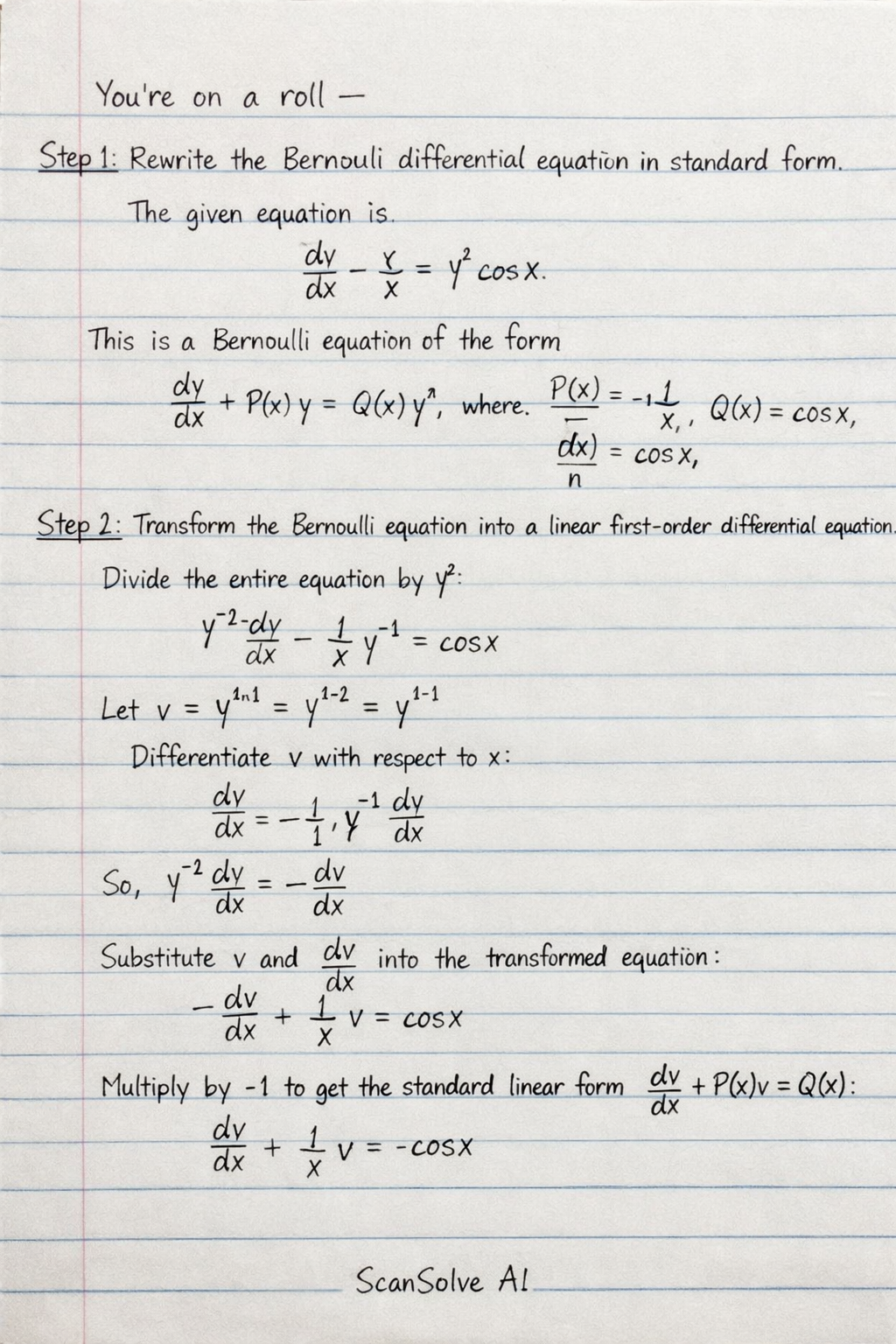
  1. Rewrite the Bernoulli differential equation in standard form.

    The given equation is dydx−yx=y2cos⁡(x)\frac{dy}{dx} - \frac{y}{x} = y^2 \cos(x).
    This is a Bernoulli equation of the form dydx+P(x)y=Q(x)yn\frac{dy}{dx} + P(x)y = Q(x)y^n, where P(x)=−1xP(x) = -\frac{1}{x}, Q(x)=cos⁡(x)Q(x) = \cos(x), and n=2n=2.

  2. Transform the Bernoulli equation into a linear first-order differential equation.

    Divide the entire equation by y2y^2:

    y−2dydx−1xy−1=cos⁡(x)y^{-2}\frac{dy}{dx} - \frac{1}{x}y^{-1} = \cos(x)

    Let v=y1−n=y1−2=y−1v = y^{1-n} = y^{1-2} = y^{-1}.
    Differentiate vv with respect to xx:

    dvdx=−1⋅y−2dydx\frac{dv}{dx} = -1 \cdot y^{-2} \frac{dy}{dx}

    So, y−2dydx=−dvdxy^{-2}\frac{dy}{dx} = -\frac{dv}{dx}.
    Substitute vv and dvdx\frac{dv}{dx} into the transformed equation:

    −dvdx−1xv=cos⁡(x)-\frac{dv}{dx} - \frac{1}{x}v = \cos(x)

    Multiply by −1-1 to get the standard linear form dvdx+P(x)v=Q(x)\frac{dv}{dx} + P(x)v = Q(x):

    dvdx+1xv=−cos⁡(x)\frac{dv}{dx} + \frac{1}{x}v = -\cos(x)
  3. Find the integrating factor.

    For this linear equation, P(x)=1xP(x) = \frac{1}{x}. The integrating factor I(x)I(x) is:

    I(x)=e∫P(x)dx=e∫1xdx=eln⁡∣x∣=xI(x) = e^{\int P(x) dx} = e^{\int \frac{1}{x} dx} = e^{\ln|x|} = x

    (We assume x>0x > 0 for simplicity).

  4. Multiply the linear equation by the integrating factor and integrate.

    Multiply dvdx+1xv=−cos⁡(x)\frac{dv}{dx} + \frac{1}{x}v = -\cos(x) by xx:

    xdvdx+v=−xcos⁡(x)x\frac{dv}{dx} + v = -x\cos(x)

    The left side is the derivative of the product (xv)(xv):

    ddx(xv)=−xcos⁡(x)\frac{d}{dx}(xv) = -x\cos(x)

    Integrate both sides with respect to xx:

    ∫ddx(xv)dx=∫−xcos⁡(x)dx\int \frac{d}{dx}(xv) dx = \int -x\cos(x) dx xv=−∫xcos⁡(x)dxxv = -\int x\cos(x) dx

    To evaluate ∫xcos⁡(x)dx\int x\cos(x) dx, use integration by parts (∫u dv=uv−∫v du\int u\,dv = uv - \int v\,du). Let u=xu=x and dv=cos⁡(x)dxdv=\cos(x)dx. Then du=dxdu=dx and v=sin⁡(x)v=\sin(x).

    ∫xcos⁡(x)dx=xsin⁡(x)−∫sin⁡(x)dx=xsin⁡(x)−(−cos⁡(x))+C1=xsin⁡(x)+cos⁡(x)+C1\int x\cos(x) dx = x\sin(x) - \int \sin(x) dx = x\sin(x) - (-\cos(x)) + C_1 = x\sin(x) + \cos(x) + C_1

    So,

    xv=−(xsin⁡(x)+cos⁡(x))+Cxv = -(x\sin(x) + \cos(x)) + C xv=−xsin⁡(x)−cos⁡(x)+Cxv = -x\sin(x) - \cos(x) + C
  5. Substitute back v=y−1v = y^{-1} and solve for yy.

    x(1y)=−xsin⁡(x)−cos⁡(x)+Cx\left(\frac{1}{y}\right) = -x\sin(x) - \cos(x) + C xy=C−xsin⁡(x)−cos⁡(x)\frac{x}{y} = C - x\sin(x) - \cos(x)

    Solve for yy:

    y=xC−xsin⁡(x)−cos⁡(x)y = \frac{x}{C - x\sin(x) - \cos(x)}
Was this helpful?

Try one yourself

A new problem that tests the same skill.

Still stuck on this one?

Ask a follow-up, and the answer starts from this question.

Got a different question?Ask your own question
Handwritten step-by-step solution preview

Handwritten Step-by-Step Solution

Get this as a handwritten image on WhatsApp — like a tutor wrote it for you.

Try on WhatsApp