
We read your photo as:
Show that cot θ + cosec θ / sin θ + tan θ = cosec θ cot θ
Mathematics
ScanSolve AI Answer
Answer
Shown:
cot θ + cosec θ / sin θ + tan θ = cosec θ cot θ
Step-by-step solution
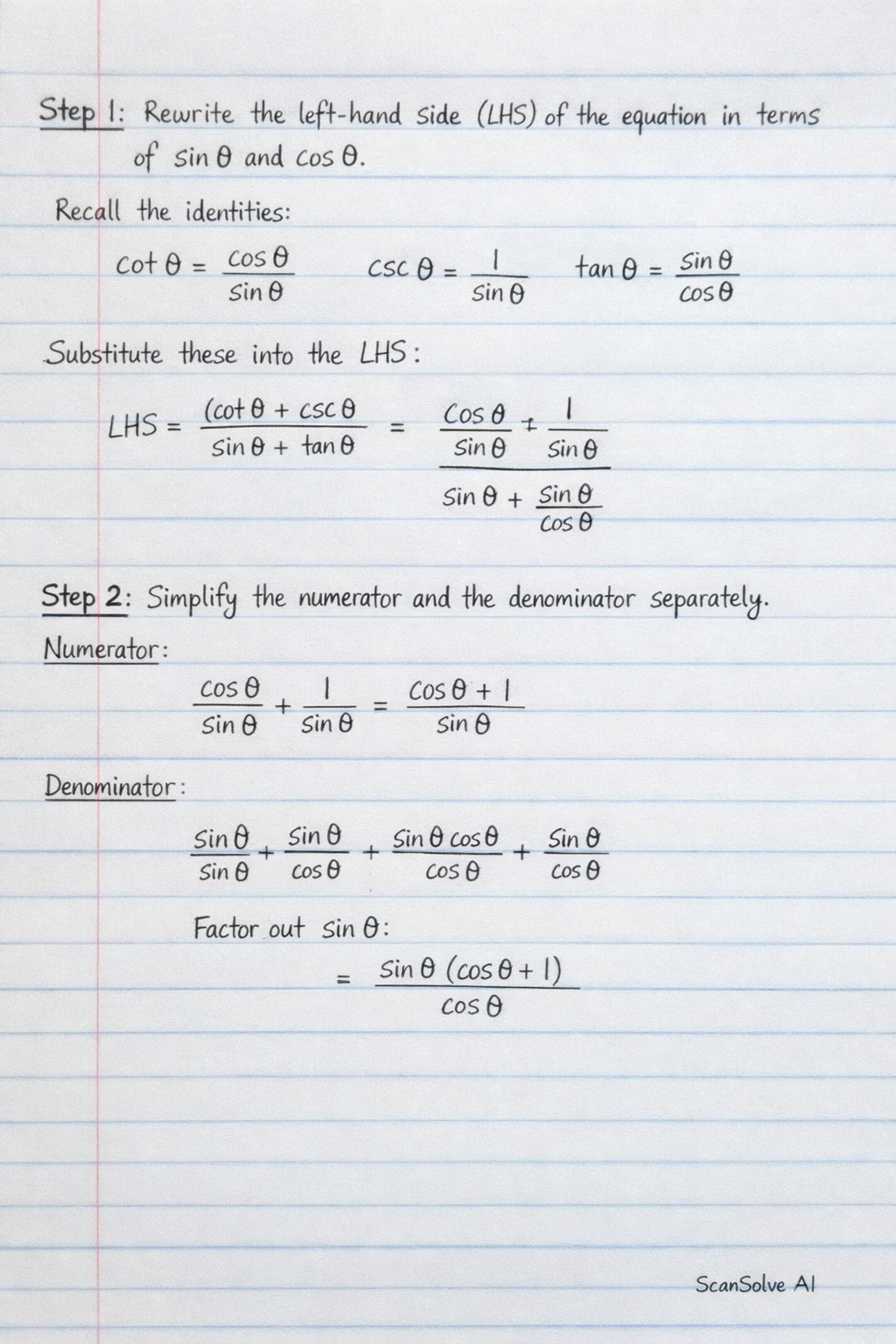
7 stepsRewrite the left-hand side (LHS) of the equation in terms of and .
Recall the identities:
Substitute these into the LHS:
Simplify the numerator and the denominator separately.
Numerator:
Denominator:
Factor out from the denominator:
Substitute the simplified numerator and denominator back into the LHS expression.
Simplify the complex fraction by multiplying the numerator by the reciprocal of the denominator.
Cancel out the common term from the numerator and denominator.
Multiply the remaining terms.
Rewrite the expression in terms of and .
Using the identities and :
This matches the right-hand side (RHS) of the original equation.
Therefore, the identity is proven.
Was this helpful?
Still stuck on this one?
Ask a follow-up, and the answer starts from this question.
Got a different question?Ask your own question
More Mathematics Questions
QProve that (sin(90-θ) cos(90-θ) + tan(90-θ)) / (cos(90-θ) sin(90-θ) + cot(90-θ)) = cosec θQProve that (cos θ) / (1 - sin θ) = sec θ + tan θ.QProve that: secθ⋅cosec(90°-θ)=1QProve the identity: (sin θ + sin 2θ) / (1 + cos θ + cos 2θ) = tan θQProve the trigonometric identity: sin(3θ)/sin θ - cos(3θ)/cos θ = 2
Browse by topic:Trigonometry
Handwritten Step-by-Step Solution
Get this as a handwritten image on WhatsApp — like a tutor wrote it for you.
Try on WhatsApp