

This mathematics problem involves applying core mathematical principles and formulas. Below you will find a complete step-by-step solution with detailed explanations for each step, helping you understand not just the answer but the method behind it.
ScanSolve AI Answer
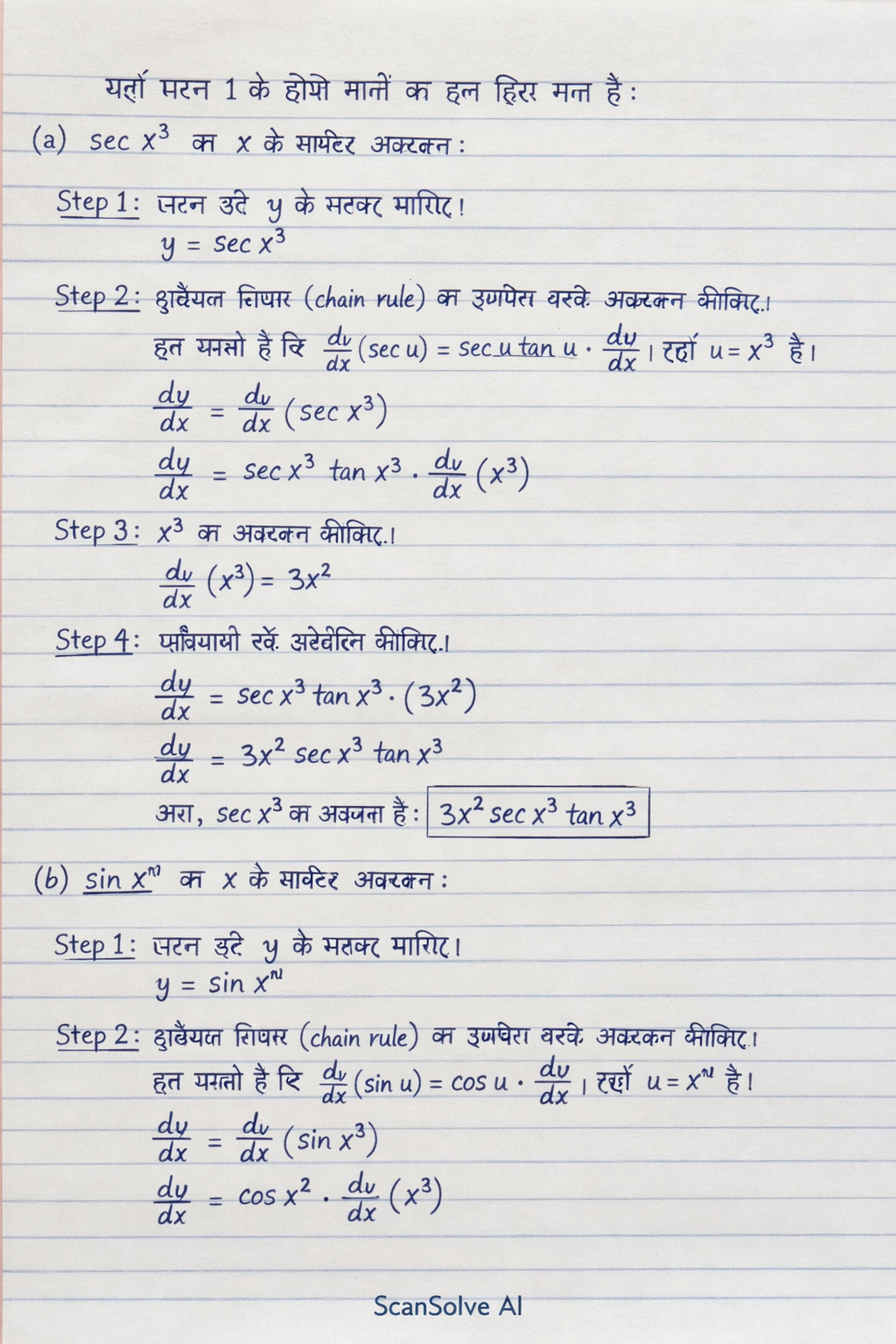
यहाँ प्रश्न 1 के दोनों भागों का हल दिया गया है: a) x^3 का x के सापेक्ष अवकलन: Step 1: फलन को y के बराबर मानिए। y = x^3 Step 2: श्रृंखला नियम (chain rule) का उपयोग करके अवकलन कीजिए। हम जानते हैं कि (d)/(dx)( u) = u u (du)/(dx)। यहाँ u = x^3 है। (dy)/(dx) = (d)/(dx)( x^3) (dy)/(dx) = x^3 x^3 · (d)/(dx)(x^3) Step 3: x^3 का अवकलन कीजिए। (d)/(dx)(x^3) = 3x^2 Step 4: परिणामों को संयोजित कीजिए। (dy)/(dx) = x^3 x^3 · (3x^2) (dy)/(dx) = 3x^2 x^3 x^3 अतः, x^3 का अवकलन है: 3x^2 x^3 x^3 b) x^n का x के सापेक्ष अवकलन: Step 1: फलन को y के बराबर मानिए। y = x^n Step 2: श्रृंखला नियम (chain rule) का उपयोग करके अवकलन कीजिए। हम जानते हैं कि (d)/(dx)( u) = u (du)/(dx)। यहाँ u = x^n है। (dy)/(dx) = (d)/(dx)( x^n) (dy)/(dx) = x^n · (d)/(dx)(x^n) Step 3: x^n का अवकलन कीजिए। (d)/(dx)(x^n) = nx^n-1 Step 4: परिणामों को संयोजित कीजिए। (dy)/(dx) = x^n · (nx^n-1) (dy)/(dx) = nx^n-1 x^n अतः, x^n का अवकलन है: nx^n-1 x^n अगला प्रश्न भेजो 📸