
We read your photo as:
Set up the inequality.
ScanSolve AI Answer
Answer
Step-by-step solution
4 stepsSet up the inequality.
Let be the initial bank balance, be the weekly withdrawal amount, and be the number of weeks. The balance after weeks is . Anna wants to maintain a balance of at least Tshs 200,000.
Given:
Substitute the values into the inequality:
Isolate the term with .
Subtract 500,000 from both sides:
Solve for .
Divide both sides by -40,000. Remember to reverse the inequality sign when dividing by a negative number:
Interpret the result.
Since represents the number of weeks, it must be a whole number. Anna can withdraw money for a maximum of 7 full weeks while maintaining a balance of at least Tshs 200,000. If she withdraws for 8 weeks, her balance will fall below Tshs 200,000.
The maximum number of weeks she can withdraw money is .
Try one yourself
A new problem that tests the same skill.
Still stuck on this one?
Ask a follow-up, and the answer starts from this question.
More Mathematics Questions
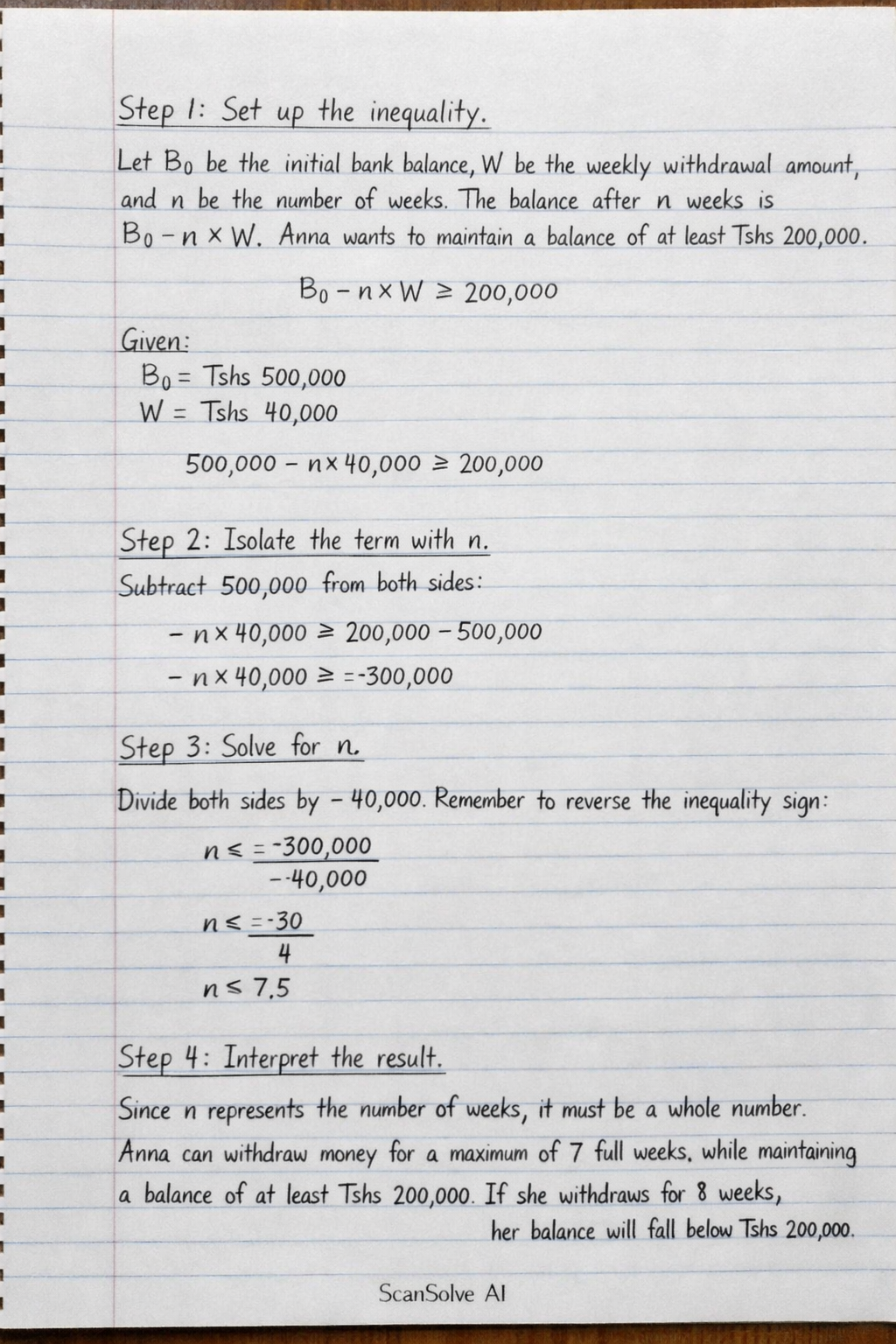
Handwritten Step-by-Step Solution
Get this as a handwritten image on WhatsApp — like a tutor wrote it for you.
Try on WhatsApp