We read your photo as:

Calculate simple and compound interest for the given values.

Mathematics

ScanSolve AI Answer

Answer

C

Step-by-step solution

17 steps

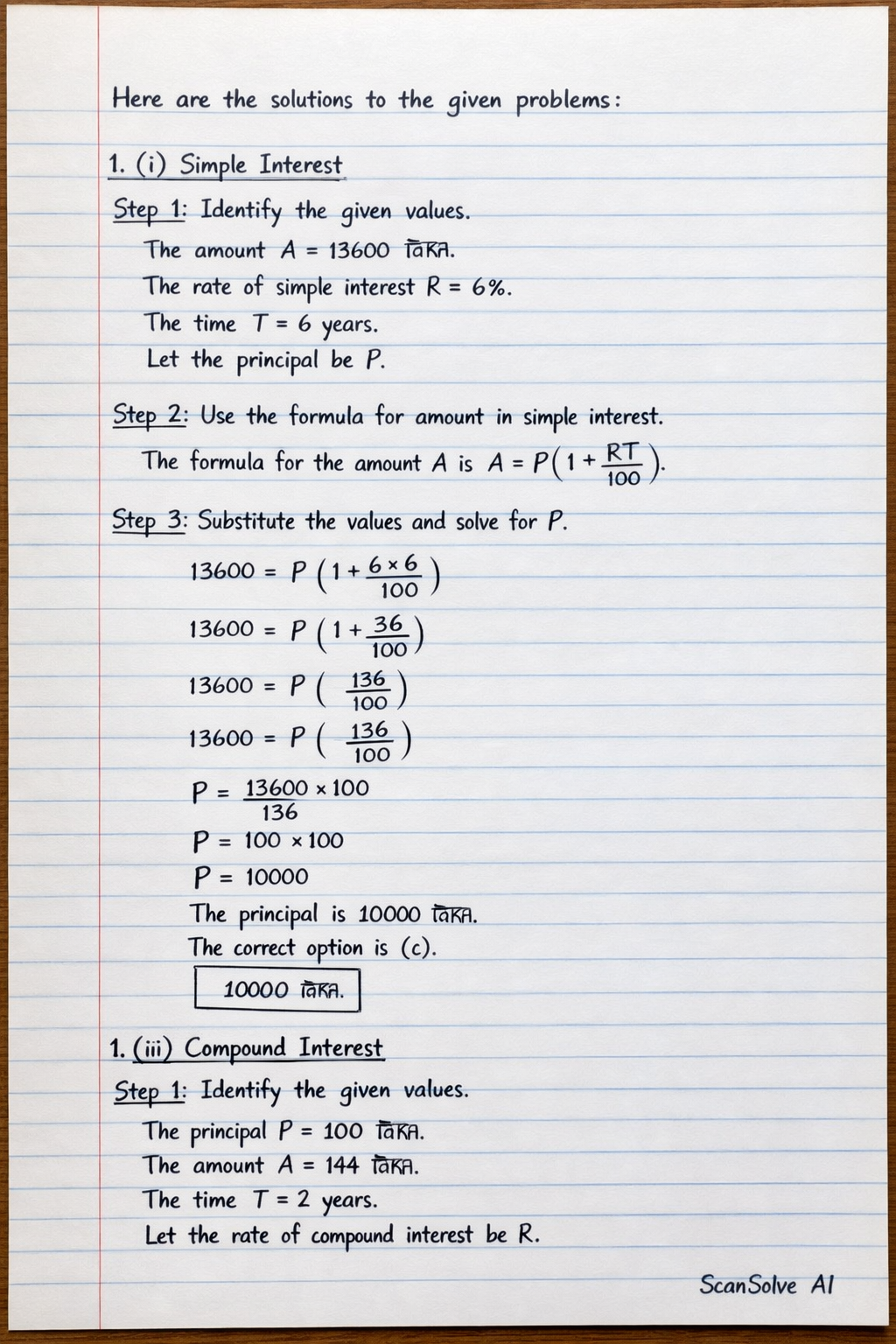
Here are the solutions to the given problems:

1. (i) Simple Interest

  1. Identify the given values.

    The amount A=13600A = 13600 টাকা.
    The rate of simple interest R=6%R = 6\%.
    The time T=6T = 6 years.
    Let the principal be PP.

  2. Use the formula for amount in simple interest.

    The formula for the amount AA is A=P(1+RT100)A = P \left(1 + \frac{RT}{100}\right).

  3. Substitute the values and solve for PP.

    13600=P(1+6×6100)13600 = P \left(1 + \frac{6 \times 6}{100}\right) 13600=P(1+36100)13600 = P \left(1 + \frac{36}{100}\right) 13600=P(100+36100)13600 = P \left(\frac{100 + 36}{100}\right) 13600=P(136100)13600 = P \left(\frac{136}{100}\right) P=13600×100136P = \frac{13600 \times 100}{136} P=100×100P = 100 \times 100 P=10000P = 10000

    The principal is 10000 টাকা.

    The correct option is (c).
    10000 টাকা\boxed{\text{10000 টাকা}}

    1. (ii) Compound Interest

  4. Identify the given values.

    The principal P=100P = 100 টাকা.
    The amount A=144A = 144 টাকা.
    The time T=2T = 2 years.
    Let the rate of compound interest be RR.

  5. Use the formula for amount in compound interest.

    The formula for the amount AA is A=P(1+R100)TA = P \left(1 + \frac{R}{100}\right)^T.

  6. Substitute the values and solve for RR.

    144=100(1+R100)2144 = 100 \left(1 + \frac{R}{100}\right)^2 144100=(1+R100)2\frac{144}{100} = \left(1 + \frac{R}{100}\right)^2 (1210)2=(1+R100)2\left(\frac{12}{10}\right)^2 = \left(1 + \frac{R}{100}\right)^2

    Taking the square root of both sides:

    1210=1+R100\frac{12}{10} = 1 + \frac{R}{100} 1.2=1+R1001.2 = 1 + \frac{R}{100} 1.2−1=R1001.2 - 1 = \frac{R}{100} 0.2=R1000.2 = \frac{R}{100} R=0.2×100R = 0.2 \times 100 R=20%R = 20\%

    The compound interest rate is 20%20\%.

    The correct option is (b).
    20%\boxed{20\%}

    1. (iii) Quadratic Equations

  7. Identify the coefficients of the quadratic equation.

    The given equation is 5x2+2x−3=05x^2 + 2x - 3 = 0.
    Here, a=5a=5, b=2b=2, c=−3c=-3.

  8. Find the sum and product of the roots (α\alpha and β\beta).

    Sum of roots: α+β=−ba=−25\alpha + \beta = -\frac{b}{a} = -\frac{2}{5}
    Product of roots: αβ=ca=−35\alpha\beta = \frac{c}{a} = \frac{-3}{5}

  9. Calculate α2+β2\alpha^2 + \beta^2.

    We use the identity α2+β2=(α+β)2−2αβ\alpha^2 + \beta^2 = (\alpha + \beta)^2 - 2\alpha\beta.
    Substitute the values:

    α2+β2=(−25)2−2(−35)\alpha^2 + \beta^2 = \left(-\frac{2}{5}\right)^2 - 2\left(-\frac{3}{5}\right) α2+β2=425+65\alpha^2 + \beta^2 = \frac{4}{25} + \frac{6}{5}

    To add the fractions, find a common denominator:

    α2+β2=425+6×55×5\alpha^2 + \beta^2 = \frac{4}{25} + \frac{6 \times 5}{5 \times 5} α2+β2=425+3025\alpha^2 + \beta^2 = \frac{4}{25} + \frac{30}{25} α2+β2=4+3025\alpha^2 + \beta^2 = \frac{4 + 30}{25} α2+β2=3425\alpha^2 + \beta^2 = \frac{34}{25}

    The correct option is (a).
    3425\boxed{\frac{34}{25}}

    1. (iv) Mean Proportional

  10. Identify the two terms.

    The two terms are (x−y)2(x-y)^2 and (x+y)2(x+y)^2.

  11. Use the formula for the mean proportional.

    The mean proportional of two numbers aa and bb is ab\sqrt{ab}.

  12. Calculate the mean proportional.

    Mean proportional =(x−y)2(x+y)2= \sqrt{(x-y)^2 (x+y)^2}

    =[(x−y)(x+y)]2= \sqrt{[(x-y)(x+y)]^2} =(x−y)(x+y)= (x-y)(x+y)

    Using the difference of squares formula, (a−b)(a+b)=a2−b2(a-b)(a+b) = a^2 - b^2:

    =x2−y2= x^2 - y^2

    The correct option is (d).
    x2−y2\boxed{x^2 - y^2}

    1. (v) Cyclic Quadrilateral

  13. Recall the property of a cyclic quadrilateral.

    In a cyclic quadrilateral, the sum of opposite angles is 180∘180^\circ.

  14. Apply the property to the given angles.

    Given that ABCD is a cyclic quadrilateral and ∠A=80∘\angle A = 80^\circ.
    Therefore, ∠A+∠C=180∘\angle A + \angle C = 180^\circ.

  15. Solve for ∠C\angle C.

    80∘+∠C=180∘80^\circ + \angle C = 180^\circ ∠C=180∘−80∘\angle C = 180^\circ - 80^\circ ∠C=100∘\angle C = 100^\circ

    The correct option is (b).
    100∘\boxed{100^\circ}

    1. (vi) Angle in a Semicircle

  16. Recall the geometric property of an angle in a semicircle.

    An angle subtended by the diameter at any point on the circumference of a circle (i.e., an angle in a semicircle) is always a right angle.

  17. State the value of a right angle.

    A right angle is 90∘90^\circ.

Was this helpful?

Try one yourself

A new problem that tests the same skill.

Still stuck on this one?

Ask a follow-up, and the answer starts from this question.

Got a different question?Ask your own question
Handwritten step-by-step solution preview

Handwritten Step-by-Step Solution

Get this as a handwritten image on WhatsApp — like a tutor wrote it for you.

Try on WhatsApp