
We read your photo as:
Simplify and factorize the following algebraic expressions: -9x(x2 - 3) - 5x(2x2 - 5), 3(2a - 7)2, (3x - 3)(2x + 2), and -3t2 - 15.
ScanSolve AI Answer
Step-by-step solution
24 stepsHere are the solutions to your math questions.
QUESTION 1
1.1 Simplify the following
1.1.1
Distribute into the first parenthesis and into the second parenthesis.
Combine like terms.
The simplified expression is .
1.1.2
Expand the squared term using the formula .
Multiply the result by 3.
The simplified expression is .
1.1.3
Use the FOIL method (First, Outer, Inner, Last) or distributive property to multiply the binomials.
Combine like terms.
The simplified expression is .
1.2 Factorise the following
1.2.1
Find the greatest common factor (GCF) of and .
The GCF is .
Factor out the GCF.
The factorised expression is .
1.2.2
Identify the common binomial factor, which is .
Factor out the common binomial.
Notice that has a common factor of 5.
The factorised expression is .
1.2.3
This expression does not have a common factor between the two terms and . Therefore, it cannot be factored further in a simple way.
The expression is .1.2.4
Recognize this as a difference of squares, , where and .
The factorised expression is .
QUESTION 2
2.1 Simplify the following
2.1.1
Divide each term in the numerator by the denominator.
Simplify each term.
The simplified expression is .
2.1.2
Factor out the common factor from the numerator.
There are no common factors between the numerator and the denominator to cancel.
The simplified expression is .2.1.3
Factor the quadratic expression in the numerator .
We need two numbers that multiply to -8 and add to 2. These numbers are 4 and -2.
Substitute the factored numerator back into the expression.
Cancel the common factor , assuming .
The simplified expression is .
2.2 Solve for x
2.2.1
Add 19 to both sides of the equation.
The solution is .
2.2.2
Add 10 to both sides of the equation.
Divide both sides by 3.
The solution is .
2.2.3
Move all terms to one side to set the equation to zero.
Factor the quadratic expression.
We need two numbers that multiply to 14 and add to 9. These numbers are 2 and 7.
Set each factor equal to zero and solve for .
The solutions are .
QUESTION 3
3.1 Say whether the following graphs are (increasing, decreasing or constant)
3.1.1 The graph shows a line sloping downwards from left to right.
This graph is decreasing.3.1.2 The graph shows a line sloping upwards from left to right.
This graph is increasing.3.1.3 The graph shows a horizontal line.
This graph is constant.
Still stuck on this one?
Ask a follow-up, and the answer starts from this question.
More Mathematics Questions
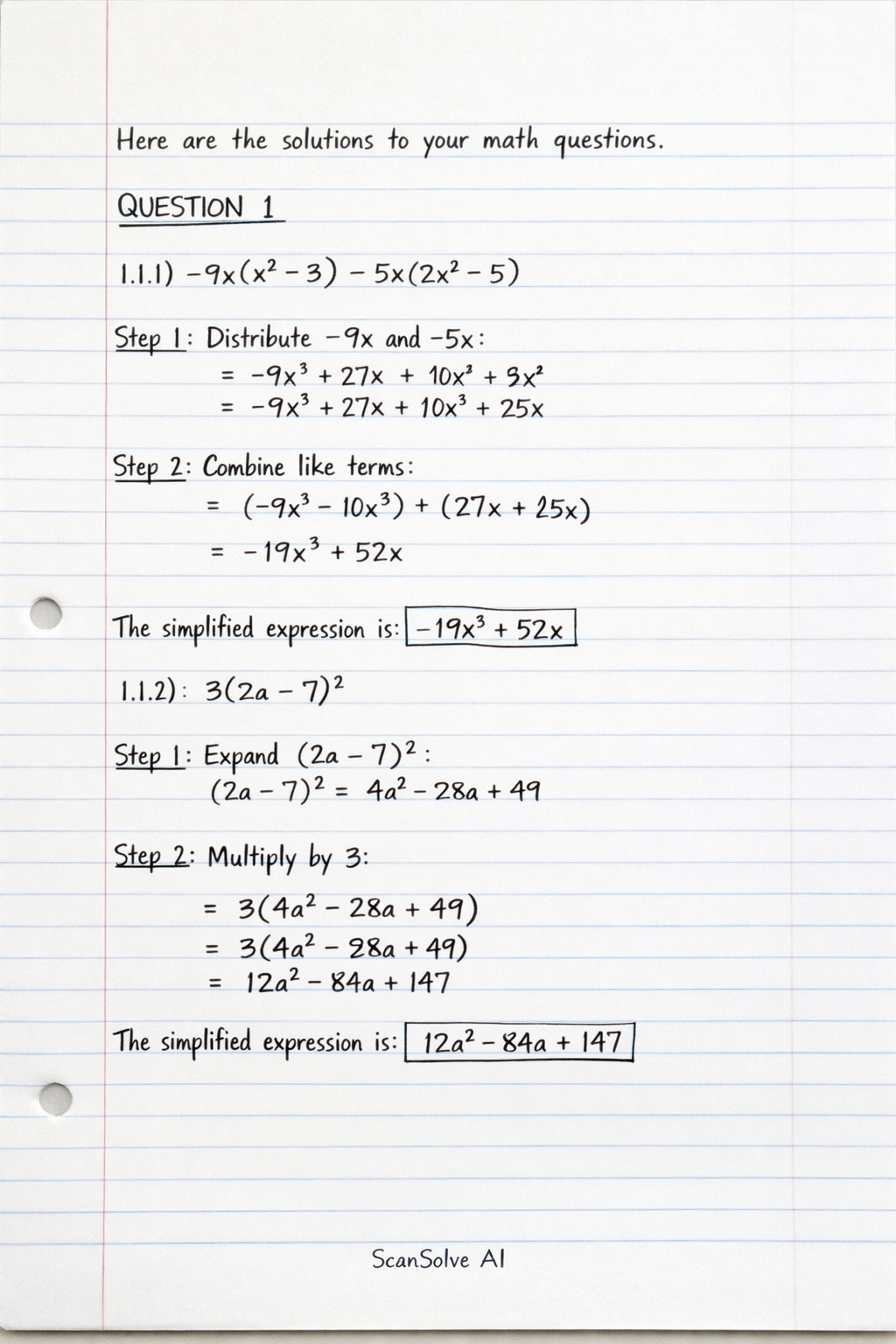
Handwritten Step-by-Step Solution
Get this as a handwritten image on WhatsApp — like a tutor wrote it for you.
Try on WhatsApp