Simplify sqrt(8).

Mathematics
Simplify sqrt(8).

ScanSolve AI Answer

Answer

3227\frac{3\sqrt{2}-2}{7}

Fresh day More, let's solve.

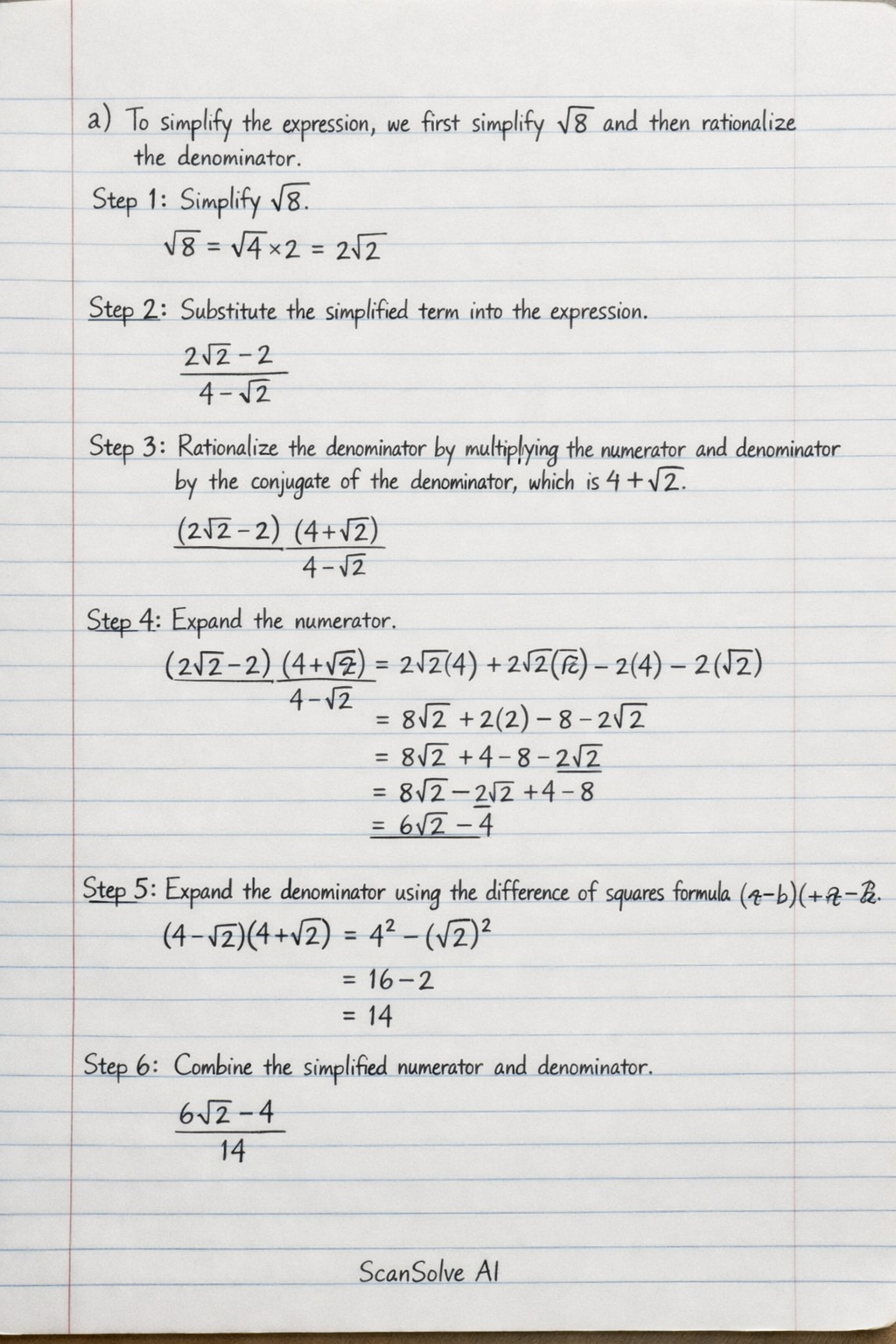
a) To simplify the expression, we first simplify 8\sqrt{8} and then rationalize the denominator.

Step 1: Simplify 8\sqrt{8}. 8=4×2=22\sqrt{8} = \sqrt{4 \times 2} = 2\sqrt{2}

Step 2: Substitute the simplified term into the expression. 22242\frac{2\sqrt{2}-2}{4-\sqrt{2}}

Step 3: Rationalize the denominator by multiplying the numerator and denominator by the conjugate of the denominator, which is 4+24+\sqrt{2}. 22242×4+24+2\frac{2\sqrt{2}-2}{4-\sqrt{2}} \times \frac{4+\sqrt{2}}{4+\sqrt{2}}

Step 4: Expand the numerator. (222)(4+2)=22(4)+22(2)2(4)2(2)(2\sqrt{2}-2)(4+\sqrt{2}) = 2\sqrt{2}(4) + 2\sqrt{2}(\sqrt{2}) - 2(4) - 2(\sqrt{2}) =82+2(2)822= 8\sqrt{2} + 2(2) - 8 - 2\sqrt{2} =82+4822= 8\sqrt{2} + 4 - 8 - 2\sqrt{2} =(8222)+(48)= (8\sqrt{2} - 2\sqrt{2}) + (4 - 8) =624= 6\sqrt{2} - 4

Step 5: Expand the denominator using the difference of squares formula (ab)(a+b)=a2b2(a-b)(a+b) = a^2 - b^2. (42)(4+2)=42(2)2(4-\sqrt{2})(4+\sqrt{2}) = 4^2 - (\sqrt{2})^2 =162= 16 - 2 =14= 14

Step 6: Combine the simplified numerator and denominator. 62414\frac{6\sqrt{2}-4}{14}

Step 7: Simplify the fraction by dividing both the numerator and the denominator by their greatest common factor, which is 2. 2(322)2(7)\frac{2(3\sqrt{2}-2)}{2(7)} =3227= \frac{3\sqrt{2}-2}{7}

The simplified expression is 3227\boxed{\frac{3\sqrt{2}-2}{7}}.

b) To express the given expression as a single fraction, we first factor the denominator of the first term.

Step 1: Factor the denominator y2y2y^2-y-2. We look for two numbers that multiply to -2 and add to -1. These numbers are -2 and 1. y2y2=(y2)(y+1)y^2-y-2 = (y-2)(y+1)

Step 2: Rewrite the expression with the factored denominator. 1(y2)(y+1)1y+1\frac{1}{(y-2)(y+1)} - \frac{1}{y+1}

Step 3: Find a common denominator, which is (y2)(y+1)(y-2)(y+1). To get this common denominator for the second term, multiply its numerator and denominator by (y2)(y-2). 1y+1=1y+1×y2y2=y2(y2)(y+1)\frac{1}{y+1} = \frac{1}{y+1} \times \frac{y-2}{y-2} = \frac{y-2}{(y-2)(y+1)}

Step 4: Perform the subtraction. 1(y2)(y+1)y2(y2)(y+1)\frac{1}{(y-2)(y+1)} - \frac{y-2}{(y-2)(y+1)} =1(y2)(y2)(y+1)= \frac{1 - (y-2)}{(y-2)(y+1)}

Step 5: Simplify the numerator. 1(y2)=1y+2=3y1 - (y-2) = 1 - y + 2 = 3 - y

Step 6: Write the final single fraction. 3y(y2)(y+1)\frac{3-y}{(y-2)(y+1)}

The expression as a single fraction is 3y(y2)(y+1)\boxed{\frac{3-y}{(y-2)(y+1)}}.

a) Let the first term of the Arithmetic Progression (AP) be aa and the common difference be dd. The first three terms are aa, a+da+d, and a+2da+2d.

Step 1: Use the information about the average of the first three terms. The average of the first three terms is 56. a+(a+d)+(a+2d)3=56\frac{a + (a+d) + (a+2d)}{3} = 56 3a+3d3=56\frac{3a + 3d}{3} = 56 a+d=56()a + d = 56 \quad (*)

Step 2: Use the information about the sum of the first two terms. The sum of the first two terms is 96. a+(a+d)=96a + (a+d) = 96 2a+d=96()2a + d = 96 \quad (**)

Step 3: Solve the system of linear equations for aa and dd. Subtract equation ()(*) from equation ()(**): (2a+d)(a+d)=9656(2a + d) - (a + d) = 96 - 56 a=40a = 40

Step 4: Substitute the value of aa into equation ()(*) to find dd. 40+d=5640 + d = 56 d=5640d = 56 - 40 d=16d = 16

The first term is 40\boxed{40} and the common difference is 16\boxed{16}.

Got more? Send 'em.

Was this helpful?

Need help with your own homework?

Get instant step-by-step solutions to any question. Free to start.

Ask Your Question
Handwritten step-by-step solution preview

Handwritten Step-by-Step Solution

Get this as a handwritten image on WhatsApp — like a tutor wrote it for you.

Try on WhatsApp

Still have questions?

Quick Answer

Fresh day More, let's solve. a) To simplify the expression, we first simplify sqrt(8) and then rationalize the denominator.

Simplify sqrt(8).
Mathematics

This mathematics problem involves applying core mathematical principles and formulas. Below you will find a complete step-by-step solution with detailed explanations for each step, helping you understand not just the answer but the method behind it.

ScanSolve AI Answer
Fresh day More, let's solve. a) To simplify the expression, we first simplify sqrt(8) and then rationalize the denominator. Step 1: Simplify sqrt(8). sqrt(8) = sqrt(4 × 2) = 2sqrt(2) Step 2: Substitute the simplified term into the expression. 2sqrt(2)-24-sqrt(2) Step 3: Rationalize the denominator by multiplying the numerator and denominator by the conjugate of the denominator, which is 4+sqrt(2). 2sqrt(2)-24-sqrt(2) × 4+sqrt(2)4+sqrt(2) Step 4: Expand the numerator. (2sqrt(2)-2)(4+sqrt(2)) = 2sqrt(2)(4) + 2sqrt(2)(sqrt(2)) - 2(4) - 2(sqrt(2)) = 8sqrt(2) + 2(2) - 8 - 2sqrt(2) = 8sqrt(2) + 4 - 8 - 2sqrt(2) = (8sqrt(2) - 2sqrt(2)) + (4 - 8) = 6sqrt(2) - 4 Step 5: Expand the denominator using the difference of squares formula (a-b)(a+b) = a^2 - b^2. (4-sqrt(2))(4+sqrt(2)) = 4^2 - (sqrt(2))^2 = 16 - 2 = 14 Step 6: Combine the simplified numerator and denominator. 6sqrt(2)-414 Step 7: Simplify the fraction by dividing both the numerator and the denominator by their greatest common factor, which is 2. 2(3sqrt(2)-2)2(7) = 3sqrt(2)-27 The simplified expression is 3sqrt(2)-27. b) To express the given expression as a single fraction, we first factor the denominator of the first term. Step 1: Factor the denominator y^2-y-2. We look for two numbers that multiply to -2 and add to -1. These numbers are -2 and 1. y^2-y-2 = (y-2)(y+1) Step 2: Rewrite the expression with the factored denominator. (1)/((y-2)(y+1)) - (1)/(y+1) Step 3: Find a common denominator, which is (y-2)(y+1). To get this common denominator for the second term, multiply its numerator and denominator by (y-2). (1)/(y+1) = (1)/(y+1) × (y-2)/(y-2) = (y-2)/((y-2)(y+1)) Step 4: Perform the subtraction. (1)/((y-2)(y+1)) - (y-2)/((y-2)(y+1)) = (1 - (y-2))/((y-2)(y+1)) Step 5: Simplify the numerator. 1 - (y-2) = 1 - y + 2 = 3 - y Step 6: Write the final single fraction. (3-y)/((y-2)(y+1)) The expression as a single fraction is (3-y)/((y-2)(y+1)). a) Let the first term of the Arithmetic Progression (AP) be a and the common difference be d. The first three terms are a, a+d, and a+2d. Step 1: Use the information about the average of the first three terms. The average of the first three terms is 56. (a + (a+d) + (a+2d))/(3) = 56 (3a + 3d)/(3) = 56 a + d = 56 (*) Step 2: Use the information about the sum of the first two terms. The sum of the first two terms is 96. a + (a+d) = 96 2a + d = 96 (**) Step 3: Solve the system of linear equations for a and d. Subtract equation () from equation (*): (2a + d) - (a + d) = 96 - 56 a = 40 Step 4: Substitute the value of a into equation (*) to find d. 40 + d = 56 d = 56 - 40 d = 16 The first term is 40 and the common difference is 16. Got more? Send 'em.