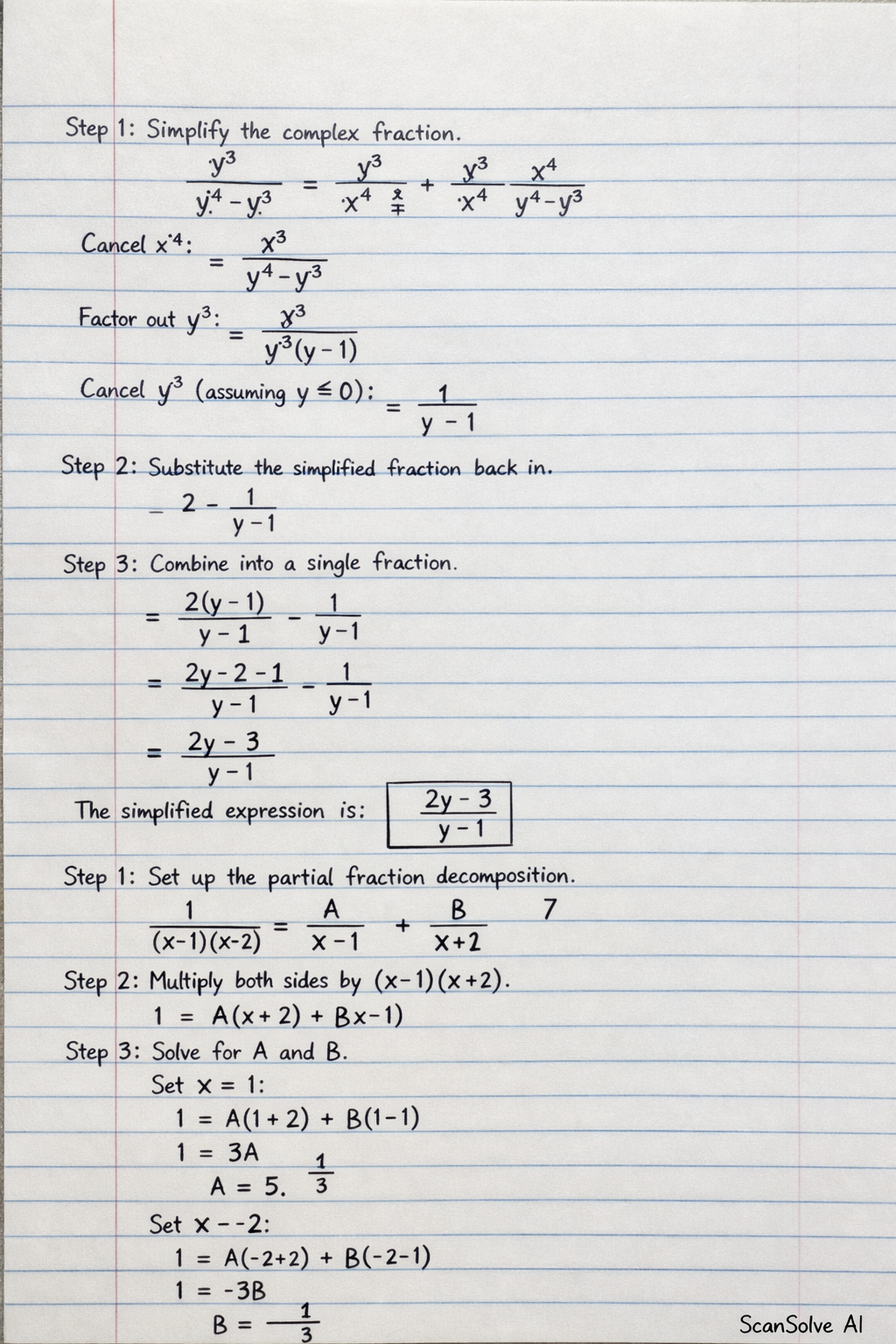
We read your photo as:

Simplify the complex fraction.

Mathematics

ScanSolve AI Answer

Answer

2y−3y−1\frac{2y-3}{y-1}

13(x−1)−13(x+2)\frac{1}{3(x-1)} - \frac{1}{3(x+2)}

−13(x−2)+1(x−2)2+13(x+1)-\frac{1}{3(x-2)} + \frac{1}{(x-2)^2} + \frac{1}{3(x+1)}

Step-by-step solution

11 steps
  1. Simplify the complex fraction.

    y3x4y4−y3x4=y3x4⋅x4y4−y3\frac{\frac{y^3}{x^4}}{\frac{y^4-y^3}{x^4}} = \frac{y^3}{x^4} \cdot \frac{x^4}{y^4-y^3}

    Cancel x4x^4:

    =y3y4−y3= \frac{y^3}{y^4-y^3}

    Factor out y3y^3 from the denominator:

    =y3y3(y−1)= \frac{y^3}{y^3(y-1)}

    Cancel y3y^3 (assuming y≠0y \neq 0):

    =1y−1= \frac{1}{y-1}
  2. Substitute the simplified fraction back into the original expression.

    2−1y−12 - \frac{1}{y-1}
  3. Combine into a single fraction.

    =2(y−1)y−1−1y−1= \frac{2(y-1)}{y-1} - \frac{1}{y-1} =2y−2−1y−1= \frac{2y-2-1}{y-1} =2y−3y−1= \frac{2y-3}{y-1}

    The simplified expression is 2y−3y−1\boxed{\frac{2y-3}{y-1}}.


  4. Set up the partial fraction decomposition.

    1(x−1)(x+2)=Ax−1+Bx+2\frac{1}{(x-1)(x+2)} = \frac{A}{x-1} + \frac{B}{x+2}
  5. Multiply both sides by (x−1)(x+2)(x-1)(x+2).

    1=A(x+2)+B(x−1)1 = A(x+2) + B(x-1)
  6. Solve for AA and BB.

    Set x=1x=1:

    1=A(1+2)+B(1−1)1 = A(1+2) + B(1-1) 1=3A  ⟹  A=131 = 3A \implies A = \frac{1}{3}

    Set x=−2x=-2:

    1=A(−2+2)+B(−2−1)1 = A(-2+2) + B(-2-1) 1=−3B  ⟹  B=−131 = -3B \implies B = -\frac{1}{3}
  7. Write the partial fraction decomposition.

    1(x−1)(x+2)=13x−1+−13x+2\frac{1}{(x-1)(x+2)} = \frac{\frac{1}{3}}{x-1} + \frac{-\frac{1}{3}}{x+2} =13(x−1)−13(x+2)= \frac{1}{3(x-1)} - \frac{1}{3(x+2)}

    The partial fraction decomposition is 13(x−1)−13(x+2)\boxed{\frac{1}{3(x-1)} - \frac{1}{3(x+2)}}.


  8. Set up the partial fraction decomposition.

    3(x−2)2(x+1)=Ax−2+B(x−2)2+Cx+1\frac{3}{(x-2)^2(x+1)} = \frac{A}{x-2} + \frac{B}{(x-2)^2} + \frac{C}{x+1}
  9. Multiply both sides by (x−2)2(x+1)(x-2)^2(x+1).

    3=A(x−2)(x+1)+B(x+1)+C(x−2)23 = A(x-2)(x+1) + B(x+1) + C(x-2)^2
  10. Solve for AA, BB, and CC.

    Set x=2x=2:

    3=A(2−2)(2+1)+B(2+1)+C(2−2)23 = A(2-2)(2+1) + B(2+1) + C(2-2)^2 3=0+3B+0  ⟹  3B=3  ⟹  B=13 = 0 + 3B + 0 \implies 3B = 3 \implies B = 1

    Set x=−1x=-1:

    3=A(−1−2)(−1+1)+B(−1+1)+C(−1−2)23 = A(-1-2)(-1+1) + B(-1+1) + C(-1-2)^2 3=0+0+C(−3)2  ⟹  3=9C  ⟹  C=39=133 = 0 + 0 + C(-3)^2 \implies 3 = 9C \implies C = \frac{3}{9} = \frac{1}{3}

    Set x=0x=0 (or any other value) and substitute B=1B=1, C=13C=\frac{1}{3}:

    3=A(0−2)(0+1)+B(0+1)+C(0−2)23 = A(0-2)(0+1) + B(0+1) + C(0-2)^2 3=A(−2)(1)+B(1)+C(−2)23 = A(-2)(1) + B(1) + C(-2)^2 3=−2A+B+4C3 = -2A + B + 4C 3=−2A+1+4(13)3 = -2A + 1 + 4\left(\frac{1}{3}\right) 3=−2A+1+433 = -2A + 1 + \frac{4}{3} 3−1−43=−2A3 - 1 - \frac{4}{3} = -2A 2−43=−2A2 - \frac{4}{3} = -2A 63−43=−2A\frac{6}{3} - \frac{4}{3} = -2A 23=−2A\frac{2}{3} = -2A A=23⋅(−12)=−13A = \frac{2}{3} \cdot \left(-\frac{1}{2}\right) = -\frac{1}{3}
  11. Write the partial fraction decomposition.

    3(x−2)2(x+1)=−13x−2+1(x−2)2+13x+1\frac{3}{(x-2)^2(x+1)} = \frac{-\frac{1}{3}}{x-2} + \frac{1}{(x-2)^2} + \frac{\frac{1}{3}}{x+1} =−13(x−2)+1(x−2)2+13(x+1)= -\frac{1}{3(x-2)} + \frac{1}{(x-2)^2} + \frac{1}{3(x+1)}

    The partial fraction decomposition is −13(x−2)+1(x−2)2+13(x+1)\boxed{-\frac{1}{3(x-2)} + \frac{1}{(x-2)^2} + \frac{1}{3(x+1)}}.

Was this helpful?

Try one yourself

A new problem that tests the same skill.

Still stuck on this one?

Ask a follow-up, and the answer starts from this question.

Got a different question?Ask your own question
Handwritten step-by-step solution preview

Handwritten Step-by-Step Solution

Get this as a handwritten image on WhatsApp — like a tutor wrote it for you.

Try on WhatsApp