
We read your photo as:
Simplify the numerator of the fraction.
ScanSolve AI Answer
Answer
Step-by-step solution
12 stepsSimplify the numerator of the fraction.
Simplify the denominator of the fraction.
Substitute the simplified numerator and denominator back into the expression.
The expression becomes .
Evaluate the expression.
Division by zero is undefined. Therefore, the entire expression is undefined.
Set up the partial fraction decomposition.
Multiply both sides by the common denominator .
Solve for and using the cover-up method or by equating coefficients.
- To find , set :
- To find , set :
Substitute the values of and back into the partial fraction decomposition.
Set up the partial fraction decomposition.
For a repeated linear factor , the decomposition includes terms and .
Multiply both sides by the common denominator .
Solve for , , and using strategic values of .
- To find , set :
- To find , set :
- To find , choose a convenient value for , such as , and substitute the known values of and : Substitute and :
Substitute the values of , , and back into the partial fraction decomposition.
Try one yourself
A new problem that tests the same skill.
Still stuck on this one?
Ask a follow-up, and the answer starts from this question.
More Mathematics Questions
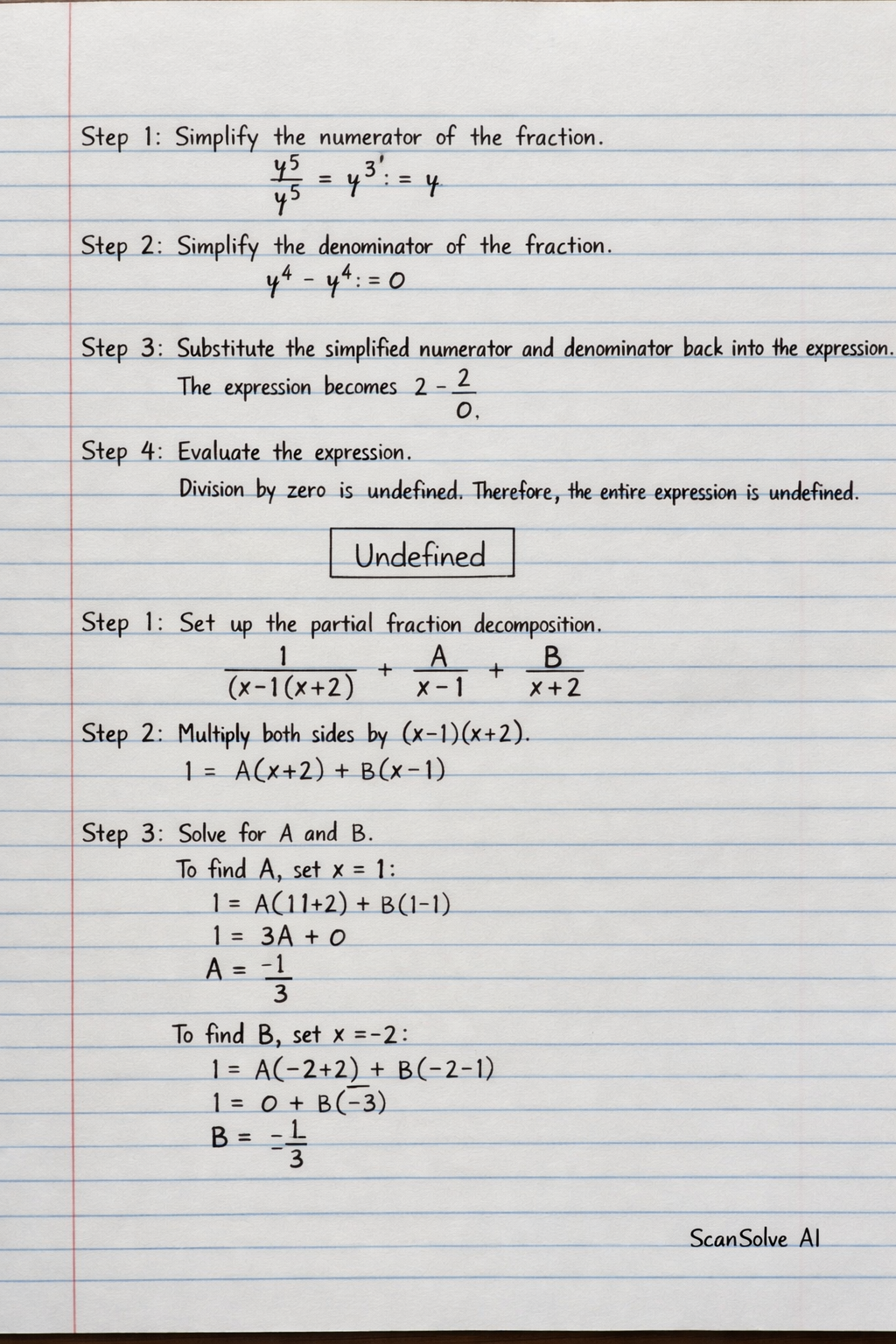
Handwritten Step-by-Step Solution
Get this as a handwritten image on WhatsApp — like a tutor wrote it for you.
Try on WhatsApp