

This mathematics problem involves applying core mathematical principles and formulas. Below you will find a complete step-by-step solution with detailed explanations for each step, helping you understand not just the answer but the method behind it.
ScanSolve AI Answer
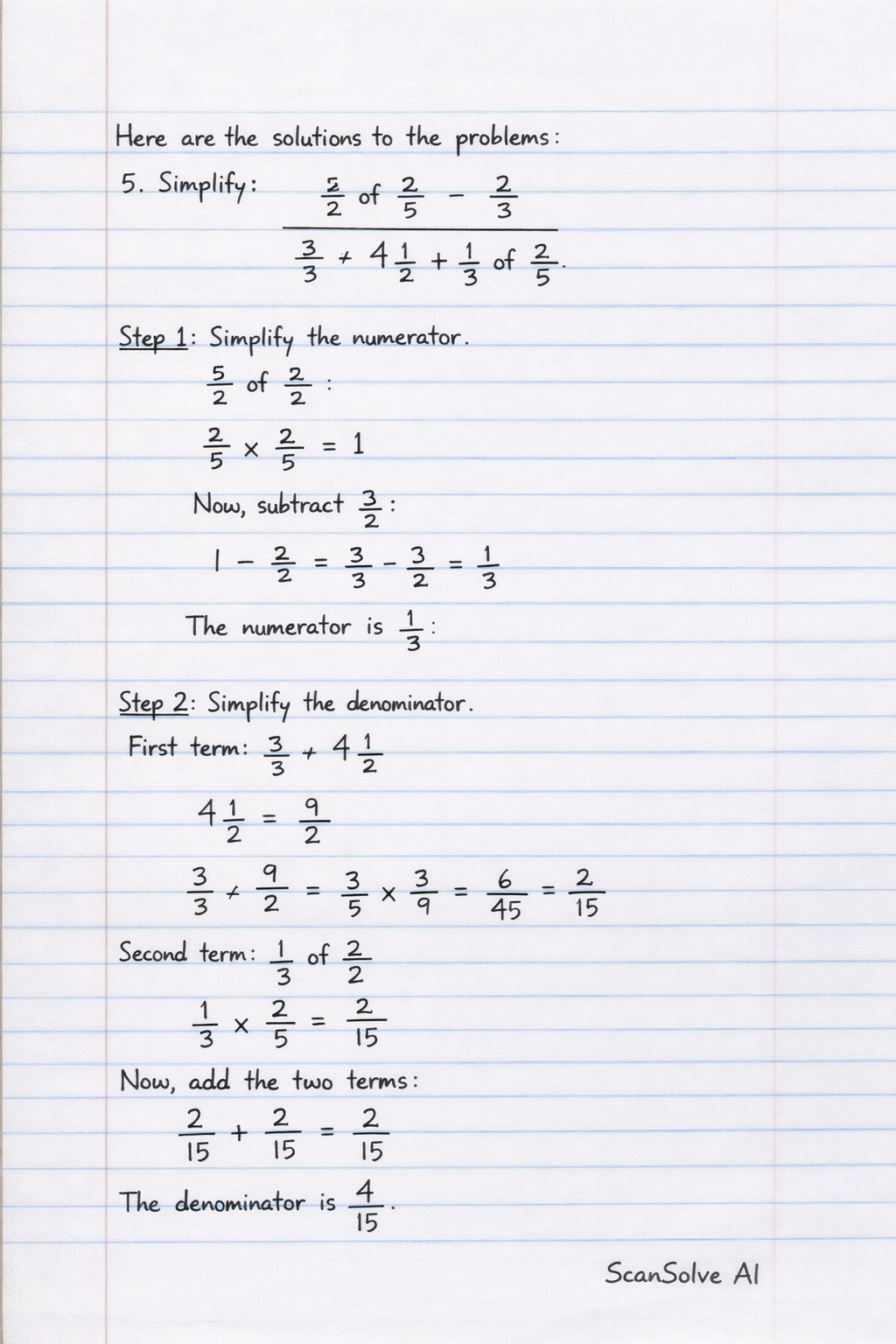
Here are the solutions to the problems: 5. Simplify: (2)/(5) of (5)/(2) - (2)/(3)(3)/(5) ÷ 4(1)/(2) + (1)/(3) of (2)/(5) Step 1: Simplify the numerator. First, calculate (2)/(5) of (5)/(2): (2)/(5) × (5)/(2) = 1 Now, subtract (2)/(3): 1 - (2)/(3) = (3)/(3) - (2)/(3) = (1)/(3) The numerator is (1)/(3). Step 2: Simplify the denominator. First term: (3)/(5) ÷ 4(1)/(2) Convert the mixed number to an improper fraction: 4(1)/(2) = (4 × 2 + 1)/(2) = (9)/(2). Now perform the division: (3)/(5) ÷ (9)/(2) = (3)/(5) × (2)/(9) = (6)/(45) = (2)/(15) Second term: (1)/(3) of (2)/(5) (1)/(3) × (2)/(5) = (2)/(15) Now, add the two terms: (2)/(15) + (2)/(15) = (4)/(15) The denominator is (4)/(15). Step 3: Divide the simplified numerator by the simplified denominator. (1)/(3)(4)/(15) = (1)/(3) × (15)/(4) = (15)/(12) = (5)/(4) The simplified expression is (5)/(4). 6. Find the equation of a line which passes through the point (2, 3) and is perpendicular to y = 3x - 1. Giving your answer in the double intercepts form. Step 1: Find the slope of the given line. The given line is y = 3x - 1. The slope of this line, m_1, is 3. Step 2: Find the slope of the perpendicular line. If two lines are perpendicular, the product of their slopes is -1. Let the slope of the required line be m_2. m_1 × m_2 = -1 3 × m_2 = -1 m_2 = -(1)/(3) Step 3: Find the equation of the line using the point-slope form. The line passes through (2, 3) and has a slope of m_2 = -(1)/(3). The point-slope form is y - y_1 = m(x - x_1). y - 3 = -(1)/(3)(x - 2) Multiply both sides by 3 to eliminate the fraction: 3(y - 3) = -1(x - 2) 3y - 9 = -x + 2 Rearrange the terms to get the standard form Ax + By = C: x + 3y = 2 + 9 x + 3y = 11 Step 4: Convert the equation to the double intercepts form. The double intercepts form is (x)/(a) + (y)/(b) = 1. To achieve this, divide the entire equation by the constant term (11): (x)/(11) + (3y)/(11) = (11)/(11) (x)/(11) + (y)/(11)3 = 1 The equation of the line in double intercepts form is (x)/(11) + (y)/(11)3 = 1. 7. George received 10,000 Euros from his brother who stays in France. He sent to his brother who stays in Japan 10,000 Yen. In addition, George bought a car worth sh. 200,000. Exchange rates are given: 1 Euro: Buying 73.4226, Selling 73.52953; 100 Japanese yen: Buying 62.8011, Selling 62.8822. How much was left? Assume "sh." refers to Kenyan Shillings (KES). Step 1: Calculate the amount George received in KES from Euros. George received 10,000 Euros. This means George is selling Euros to the bank, so the bank is buying Euros from George. We use the bank's buying rate for Euros. Amount received = 10,000 Euros × 73.4226 KES/Euro Amount received = 734,226 KES Step 2: Calculate the cost in KES to send 10,000 Japanese Yen. George is sending 10,000 Yen. This means George needs to buy Yen from the bank, so the bank is selling Yen to George. We use the bank's selling rate for Yen. The rate is 62.8822 KES for 100 Japanese Yen. Cost per 1 Japanese Yen = 62.8822 KES100 JPY = 0.628822 KES/JPY Cost to send 10,000 JPY = 10,000 JPY × 0.628822 KES/JPY Cost to send 10,000 JPY = 6,288.22 KES Step 3: Calculate the total amount George spent. Cost of sending Yen = 6,288.22 KES Cost of buying car = 200,000 KES Total spent = 6,288.22 + 200,000 = 206,288.22 KES Step 4: Calculate the amount of money left. Money left = Amount received - Total spent Money left = 734,226 KES - 206,288.22 KES Money left = 527,937.78 KES The amount of money left is 527,937.78 KES.