

This mathematics problem involves applying core mathematical principles and formulas. Below you will find a complete step-by-step solution with detailed explanations for each step, helping you understand not just the answer but the method behind it.
ScanSolve AI Answer
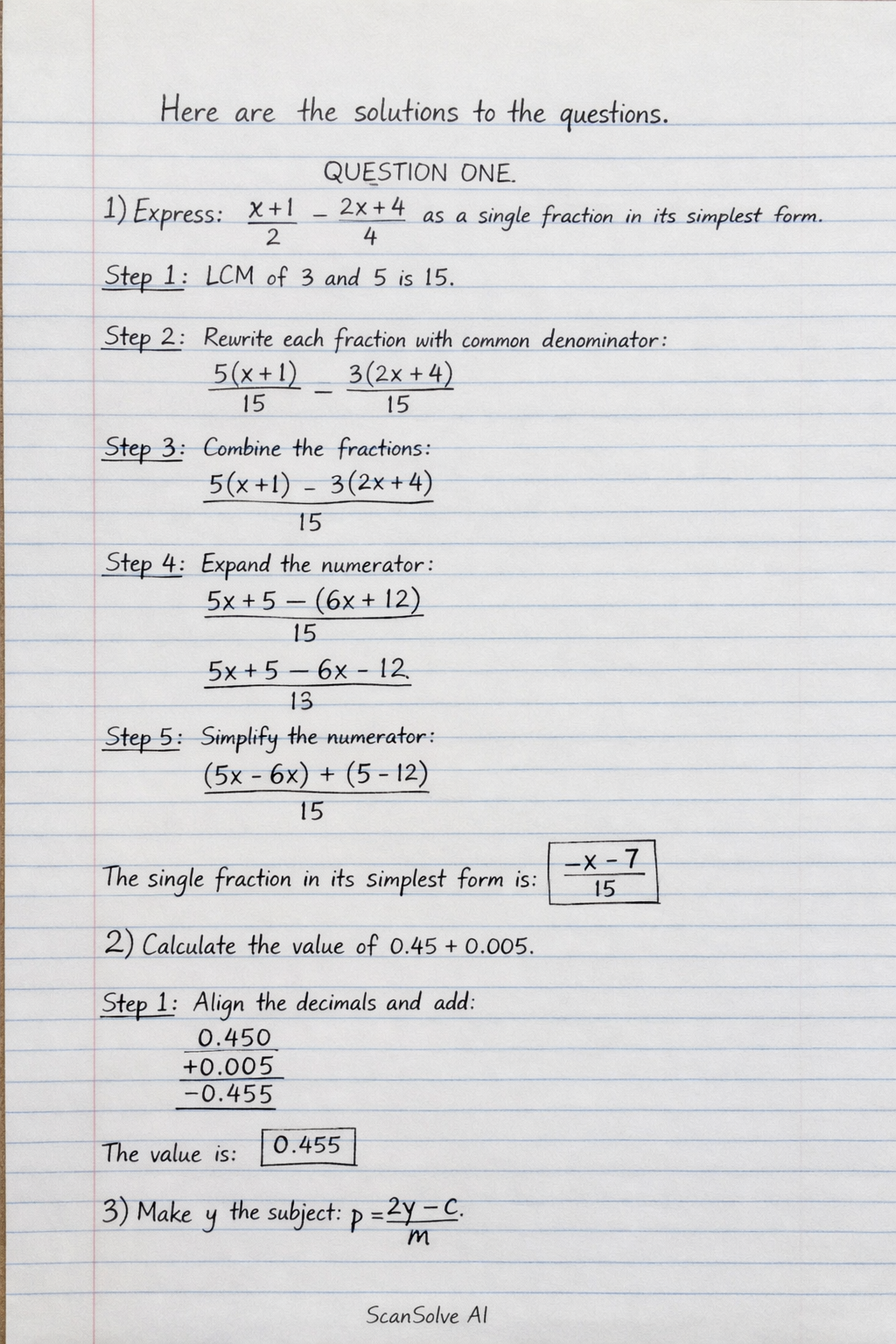
Here are the solutions to the questions. QUESTION ONE 1) Express: (x+1)/(3) - (2x+4)/(5) as a single fraction in its simplest form. Step 1: Find the least common multiple (LCM) of the denominators 3 and 5, which is 15. Step 2: Rewrite each fraction with the common denominator. (5(x+1))/(15) - (3(2x+4))/(15) Step 3: Combine the fractions over the common denominator. (5(x+1) - 3(2x+4))/(15) Step 4: Expand the terms in the numerator. (5x+5 - (6x+12))/(15) (5x+5 - 6x-12)/(15) Step 5: Simplify the numerator by combining like terms. ((5x-6x) + (5-12))/(15) (-x-7)/(15) The single fraction in its simplest form is (-x-7)/(15). 2) Calculate the value of 0.45 + 0.005. Step 1: Align the decimal points and add the numbers. 0.450 + 0.005 ----- 0.455 The value is 0.455. 3) Make y the subject: p = (2y-c)/(m) Step 1: Multiply both sides of the equation by m. pm = 2y-c Step 2: Add c to both sides of the equation. pm+c = 2y Step 3: Divide both sides by 2. y = (pm+c)/(2) Making y the subject gives y = (pm+c)/(2). 4) The ratio of female to male student at NACE is 5:4. If the number of male students is 1000. Find the total number of students at NACE. Step 1: Set up the ratio of female (F) to male (M) students. (F)/(M) = (5)/(4) Step 2: Substitute the given number of male students, M=1000. (F)/(1000) = (5)/(4) Step 3: Solve for the number of female students, F. F = (5)/(4) × 1000 F = 5 × 250 F = 1250 Step 4: Calculate the total number of students. Total students = F + M = 1250 + 1000 = 2250 The total number of students at NACE is 2250. 5) The diagram below shows the position of town P and town Q. a) Find the bearing of town P from Q. Step 1: Identify the North line at Q. Step 2: Bearings are measured clockwise from the North line. Step 3: The angle given in the diagram from the North line at Q to the line segment QP is 70^. The bearing of town P from Q is 070^. b) Find the bearing of town Q from P. Step 1: Draw a North line at town P, parallel to the North line at town Q. Step 2: The angle between the North line at Q and the line QP is 70^. Step 3: Due to parallel North lines, the alternate interior angle formed by the line PQ and the North line at P (if extended to the left) would be 70^. Step 4: The angle between the line PQ and the South line at P (which is 180^ from North) is also 70^ (alternate interior angles with the angle NQP). Step 5: The bearing of Q from P is measured clockwise from the North line at P. This angle is 180^ (to the South line) plus the 70^ angle. Bearing = 180^ + 70^ = 250^ The bearing of town Q from P is 250^. QUESTION TWO 1) Find the equation of the straight line passing through the points P (6,1) and Q (0,-3). Step 1: Calculate the gradient (m) of the line using the formula m = (y_2 - y_1)/(x_2 - x_1). Let (x_1, y_1) = (6,1) and (x_2, y_2) = (0,-3). m = (-3 - 1)/(0 - 6) = (-4)/(-6) = (2)/(3) Step 2: Use the point-slope form of a linear equation, y - y_1 = m(x - x_1), with one of the points (e.g., P(6,1)) and the gradient. y - 1 = (2)/(3)(x - 6) Step 3: Multiply both sides by 3 to eliminate the fraction. 3(y - 1) = 2(x - 6) 3y - 3 = 2x - 12 Step 4: Rearrange the equation into the form y = mx+c or Ax+By+C=0. 3y = 2x - 12 + 3 3y = 2x - 9 Or, in y = mx+c form: y = (2)/(3)x - (9)/(3) y = (2)/(3)x - 3 The equation of the straight line is y = (2)/(3)x - 3 or 3y = 2x - 9. That's 3 down. 2 left today — send the next one.