
We read your photo as:
Simplify the expression \(((2x) ( 1)/((2x)) - 1 )x3\) for the limit as x approaches 0, showing the intermediate step \(((2x) (1 - (2x)))/(x3 (2x))\).
Mathematics
ScanSolve AI Answer
Answer
To go from the first expression to the second, we simplify the term inside the parenthesis in the numerator.
Step-by-step solution
5 stepsFocus on the expression inside the parenthesis
To subtract 1 from , we need a common denominator.
We can rewrite 1 as .
Now that they have a common denominator, we can combine the numerators
Substitute this simplified expression back into the limit.
The original expression was:
Replacing the parenthesis with the simplified form:
Multiply the terms in the numerator.
The from the simplified parenthesis term moves to the denominator of the entire fraction:
This is the step shown in your image.
Was this helpful?
Still stuck on this one?
Ask a follow-up, and the answer starts from this question.
Got a different question?Ask your own question
More Mathematics Questions
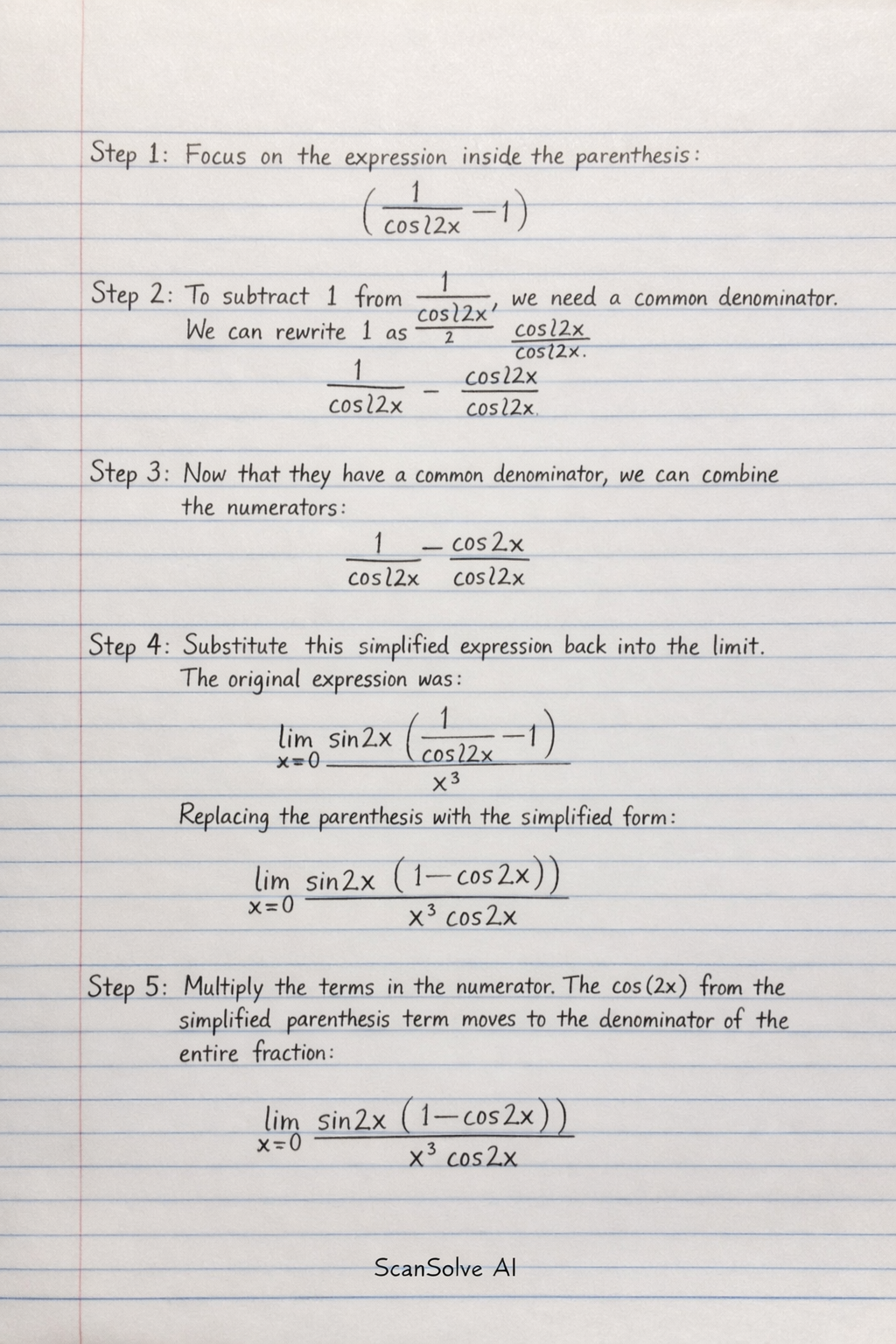
Handwritten Step-by-Step Solution
Get this as a handwritten image on WhatsApp — like a tutor wrote it for you.
Try on WhatsApp