

This mathematics problem involves applying core mathematical principles and formulas. Below you will find a complete step-by-step solution with detailed explanations for each step, helping you understand not just the answer but the method behind it.
ScanSolve AI Answer
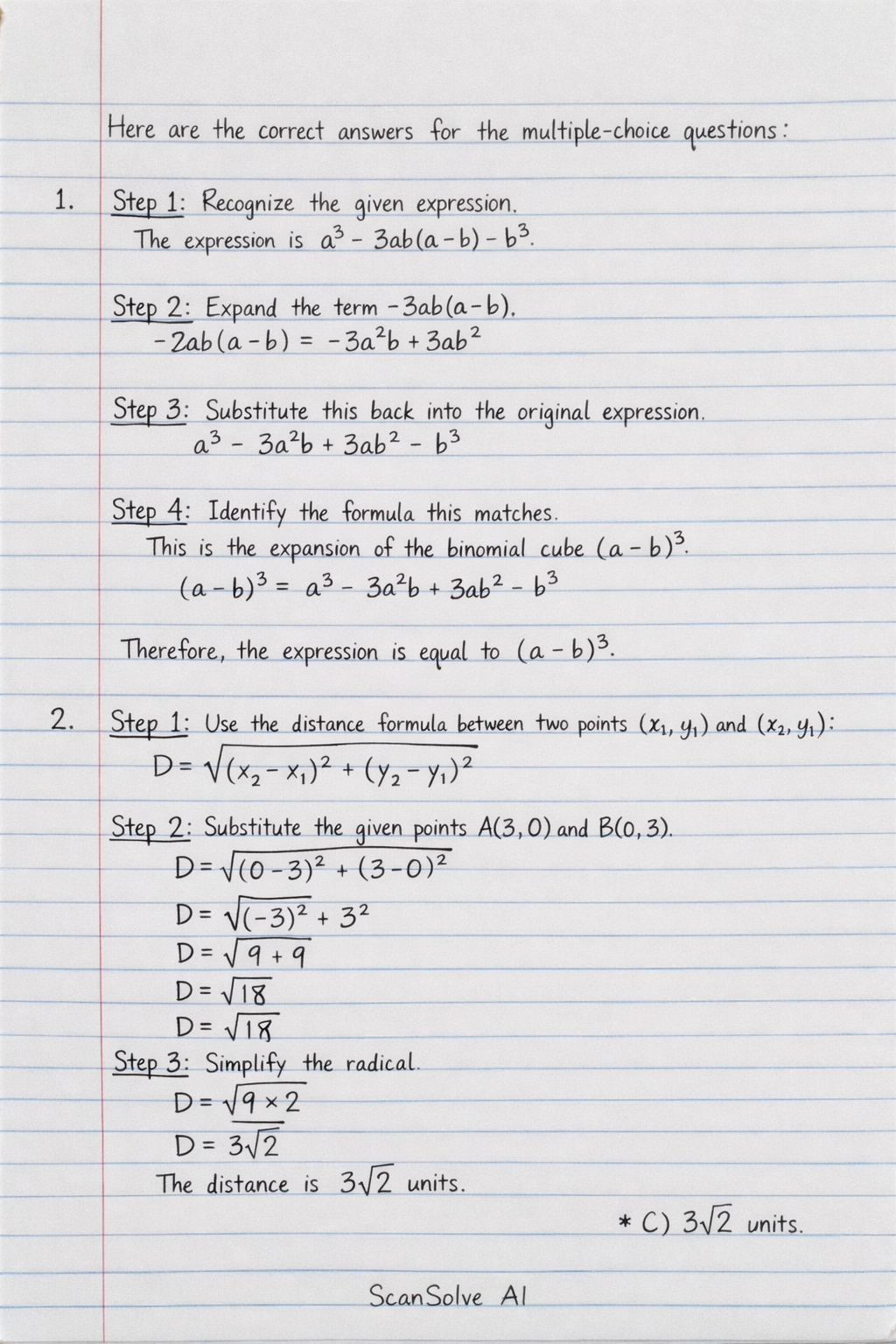
Here are the correct answers for the multiple-choice questions: 1. Step 1: Recognize the given expression. The expression is a^3 - 3ab(a-b) - b^3. Step 2: Expand the term -3ab(a-b). -3ab(a-b) = -3a^2b + 3ab^2 Step 3: Substitute this back into the original expression. a^3 - 3a^2b + 3ab^2 - b^3 Step 4: Identify the formula this matches. This is the expansion of the binomial cube (a-b)^3. (a-b)^3 = a^3 - 3a^2b + 3ab^2 - b^3 Therefore, the expression is equal to (a-b)^3. B) (a-b)^3 2. Step 1: Use the distance formula between two points (x_1, y_1) and (x_2, y_2): D = sqrt((x_2-x_1)^2 + (y_2-y_1)^2) Step 2: Substitute the given points A(3,0) and B(0,3). D = sqrt((0-3)^2 + (3-0)^2) D = sqrt((-3)^2 + (3)^2) D = sqrt(9 + 9) D = sqrt(18) Step 3: Simplify the radical. D = sqrt(9 × 2) D = 3sqrt(2) The distance is 3sqrt(2) units. C) 3sqrt(2) units 3. Step 1: Convert the logarithmic equation to exponential form. If _b x = y, then b^y = x. Step 2: Substitute the given values _10 x = 0. x = 10^0 Step 3: Evaluate the exponential expression. Any non-zero number raised to the power of 0 is 1. x = 1 B) 1 4. Step 1: Recognize the expression as a difference of squares. The formula is (a+b)(a-b) = a^2 - b^2. Step 2: Substitute a=4 and b=sqrt(14). (4 + sqrt(14))(4 - sqrt(14)) = 4^2 - (sqrt(14))^2 = 16 - 14 = 2 A) 2 5. Step 1: Multiply the coefficients and the imaginary units. (-5i)(-2i) = (-5) × (-2) × i × i = 10i^2 Step 2: Substitute the value of i^2. Recall that i^2 = -1. = 10(-1) = -10 A) -10 6. The two coordinate axes, the x-axis and the y-axis, are perpendicular to each other. Perpendicular lines intersect at an angle of 90^. B) 90^ 7. Step 1: Factorize both expressions. x^4 - y^4 = (x^2)^2 - (y^2)^2 = (x^2 - y^2)(x^2 + y^2) The second expression is x^2 - y^2. Step 2: Identify the common and unique factors for the Least Common Multiple (LCM). The factors are (x^2 - y^2) and (x^2 + y^2). The LCM includes all factors raised to their highest power. LCM = (x^2 - y^2)(x^2 + y^2) Step 3: Simplify the LCM. LCM = x^4 - y^4 C) x^4 - y^4 8. A surd is an irrational number that can be expressed as a root of an integer. sqrt(5) is an irrational number because 5 is not a perfect square. Since it consists of a single term, it is a monomial surd. A) Monomial surd 9. The additive identity in the set of real numbers (R) is the number that, when added to any real number, leaves the number unchanged. This number is 0. A) 0 10. In a logarithm, the mantissa is the fractional part of the logarithm. The integer part is called the characteristic. B) Mantissa 11. In the Cartesian coordinate system, a point with both negative x and negative y coordinates (e.g., (-4, -3)) is located in the 3rd quadrant. C) 3rd quadrant 12. The medians of a triangle are line segments joining a vertex to the midpoint of the opposite side. They intersect at the centroid, which divides each median in a 2:1 ratio. D) Medians 13. A horizontal line of the form y = c (where c is a constant, like y=5) is always parallel to the x-axis. A) x-axis 14. A quadratic equation is a polynomial equation where the highest power of the variable is 2. C) 2 15. According to the triangle inequality theorem, the sum of the lengths of any two sides of a triangle must be greater than the length of the third side. B) Greater That's 2 down. 3 left today — send the next one.