
We read your photo as:
Simplify the following expressions and solve the equations: a) e^ x2 b) 4 + 25 2a) 3 2 x + 2 x = 4 2b) 2e^-x + e^x = 3
ScanSolve AI Answer
Step-by-step solution
18 stepsHere are the solutions to the problems:
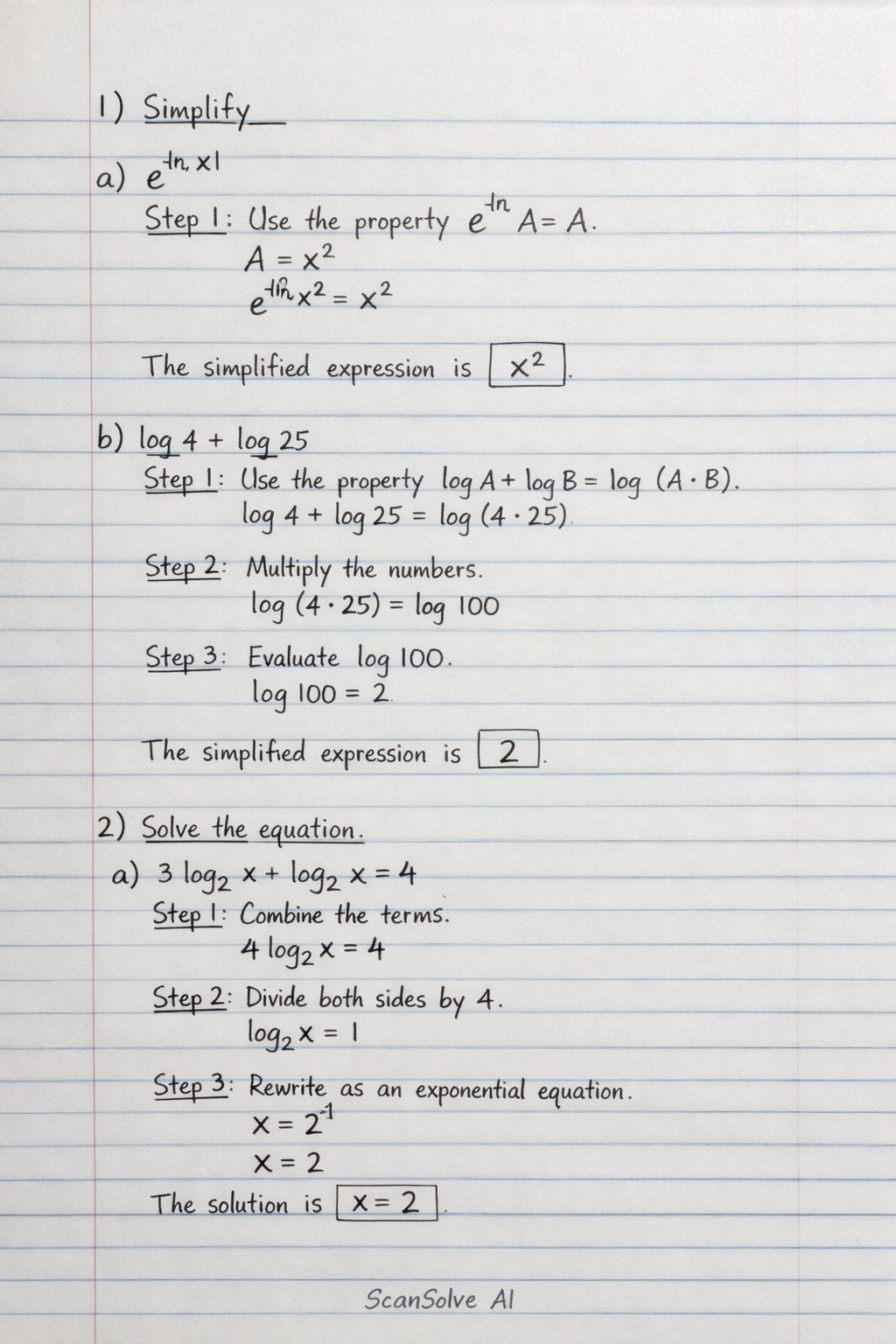
1) Simplify
- a)
Use the property .
In this case, $A = x^2$. $$ e^{\ln x^2} = x^2 $$ The simplified expression is $\boxed{x^2}$.- b)
Use the logarithm property .
$$ \log 4 + \log 25 = \log (4 \times 25) $$Perform the multiplication.
$$ \log (4 \times 25) = \log 100 $$Evaluate .
(Assuming base 10 for when no base is specified). The simplified expression is .
2) Solve for the equation
- a)
Combine the logarithmic terms.
$$ 4 \log_2 x = 4 $$Divide both sides by 4.
$$ \log_2 x = 1 $$Convert the logarithmic equation to an exponential equation using the definition .
$$ x = 2^1 $$ $$ x = 2 $$ The solution is $\boxed{x=2}$.- b)
Rewrite as .
$$ \frac{2}{e^x} + e^x = 3 $$Let .
Substitute into the equation.
Multiply the entire equation by to eliminate the denominator.
$$ 2 + y^2 = 3y $$Rearrange the terms to form a standard quadratic equation.
$$ y^2 - 3y + 2 = 0 $$Factor the quadratic equation.
$$ (y-1)(y-2) = 0 $$Solve for .
$$ y-1 = 0 \implies y = 1 $$ $$ y-2 = 0 \implies y = 2 $$Substitute back and solve for .
For $y=1$: $$ e^x = 1 $$ $$ x = \ln 1 $$ $$ x = 0 $$ For $y=2$: $$ e^x = 2 $$ $$ x = \ln 2 $$ The solutions are $\boxed{x=0, \ln 2}$.3) Given that , , and are the first 3 consecutive terms of an AP.
- a) Find the value of and the common difference.
In an arithmetic progression (AP), the common difference between consecutive terms is constant.
Therefore, we can equate the differences between the terms.
Simplify both sides of the equation.
$$ x+1-x+2 = 7x-2-x-1 $$ $$ 3 = 6x-3 $$Solve for .
$$ 3+3 = 6x $$ $$ 6 = 6x $$ $$ x = 1 $$Find the common difference () by substituting into the expression for the difference between terms.
$$ d = (x+1) - (x-2) $$ $$ d = (1+1) - (1-2) $$ $$ d = 2 - (-1) $$ $$ d = 3 $$ The value of $x$ is $\boxed{1}$ and the common difference is $\boxed{3}$.- b) Find the range of values of . In this problem, is a specific value that makes the given terms an arithmetic progression. There is no range of values for . The value of is the single value found in part (a). The value of is .
Still stuck on this one?
Ask a follow-up, and the answer starts from this question.
More Mathematics Questions
Handwritten Step-by-Step Solution
Get this as a handwritten image on WhatsApp — like a tutor wrote it for you.
Try on WhatsApp