We read your photo as:

Simplify the following surds. 2. Rationalize these surds.

Mathematics

ScanSolve AI Answer

Answers

5 parts
b

626\sqrt{2}

c

53−325\sqrt{3} - 3\sqrt{2}

d

757\sqrt{5}

e

(x−1)x(x-1)\sqrt{x}

f

166−4516\sqrt{6} - 4\sqrt{5}

455\frac{4\sqrt{5}}{5}

7\sqrt{7}

Step-by-step solution

19 steps

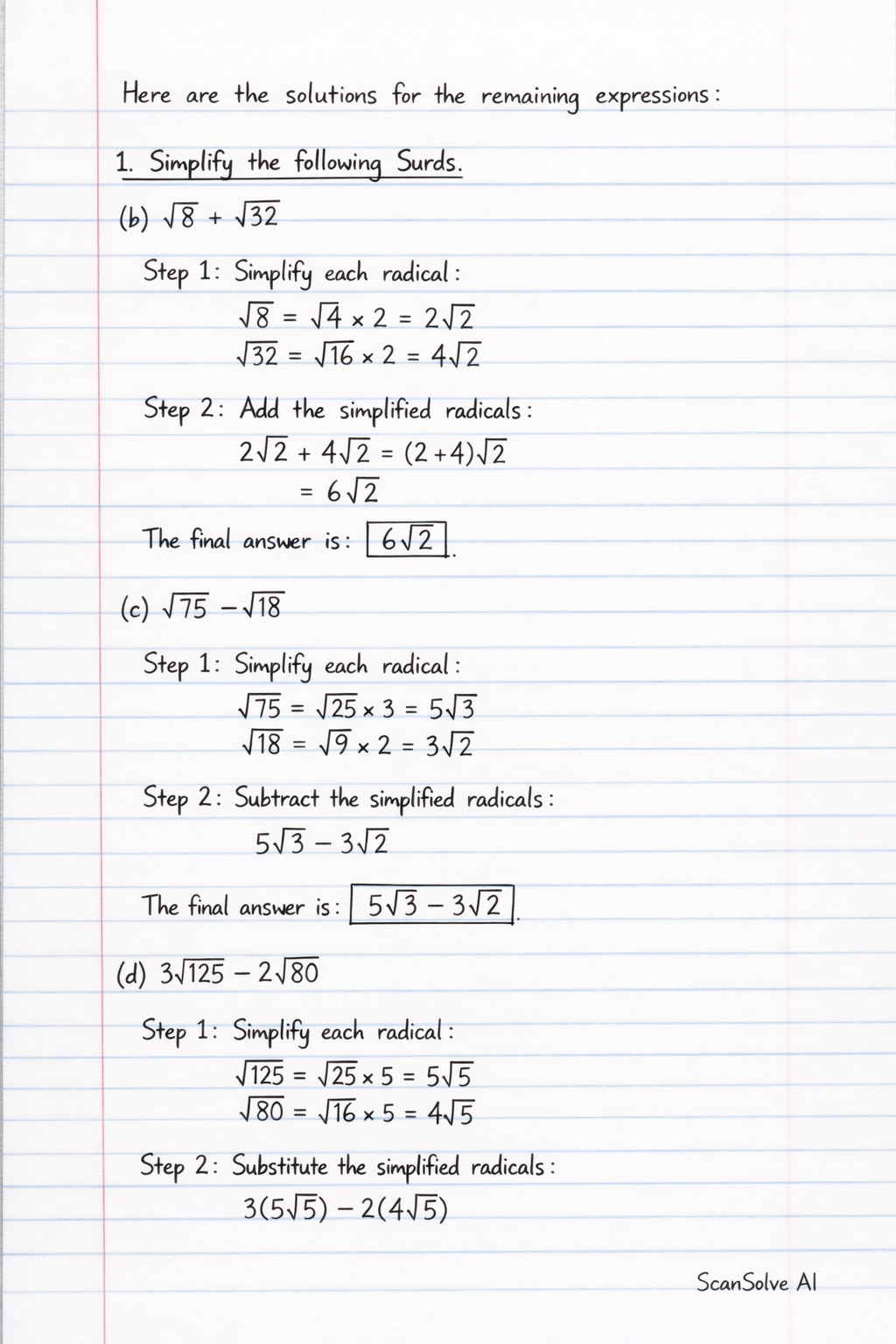
Here are the solutions for the remaining expressions:

1. Simplify the following Surds

Part b· 2 steps

8+32\sqrt{8} + \sqrt{32}

  1. Simplify each radical by finding the largest perfect square factor.

    8=4×2=22\sqrt{8} = \sqrt{4 \times 2} = 2\sqrt{2} 32=16×2=42\sqrt{32} = \sqrt{16 \times 2} = 4\sqrt{2}
  2. Add the simplified radicals.

    22+42=(2+4)2=622\sqrt{2} + 4\sqrt{2} = (2+4)\sqrt{2} = 6\sqrt{2}

    The final answer is 62\boxed{6\sqrt{2}}.

Part c

53−325\sqrt{3} - 3\sqrt{2}

75−18\sqrt{75} - \sqrt{18}

  1. Simplify each radical.

    75=25×3=53\sqrt{75} = \sqrt{25 \times 3} = 5\sqrt{3} 18=9×2=32\sqrt{18} = \sqrt{9 \times 2} = 3\sqrt{2}
  2. Subtract the simplified radicals.

    Since the radicals are different (3\sqrt{3} and 2\sqrt{2}), they cannot be combined further.

    53−325\sqrt{3} - 3\sqrt{2}

    The final answer is 53−32\boxed{5\sqrt{3} - 3\sqrt{2}}.

Part d

757\sqrt{5}

3125−2803\sqrt{125} - 2\sqrt{80}

  1. Simplify each radical.

    125=25×5=55\sqrt{125} = \sqrt{25 \times 5} = 5\sqrt{5} 80=16×5=45\sqrt{80} = \sqrt{16 \times 5} = 4\sqrt{5}
  2. Substitute the simplified radicals back into the expression.

    3(55)−2(45)3(5\sqrt{5}) - 2(4\sqrt{5})
  3. Multiply the coefficients.

    155−8515\sqrt{5} - 8\sqrt{5}
  4. Combine the like terms.

    (15−8)5=75(15-8)\sqrt{5} = 7\sqrt{5}

    The final answer is 75\boxed{7\sqrt{5}}.

Part e

(x−1)x(x-1)\sqrt{x}

x3+x−4x\sqrt{x^3} + \sqrt{x} - \sqrt{4x}

  1. Simplify each radical.

    x3=x2×x=xx\sqrt{x^3} = \sqrt{x^2 \times x} = x\sqrt{x} x\sqrt{x} 4x=4×x=2x\sqrt{4x} = \sqrt{4 \times x} = 2\sqrt{x}
  2. Substitute the simplified radicals back into the expression.

    xx+x−2xx\sqrt{x} + \sqrt{x} - 2\sqrt{x}
  3. Combine the like terms (all terms have x\sqrt{x}).

    (x+1−2)x=(x−1)x(x+1-2)\sqrt{x} = (x-1)\sqrt{x}

    The final answer is (x−1)x\boxed{(x-1)\sqrt{x}}.

Part f

166−4516\sqrt{6} - 4\sqrt{5}

724−45+267\sqrt{24} - 4\sqrt{5} + 2\sqrt{6}

  1. Simplify the radical 24\sqrt{24}.

    24=4×6=26\sqrt{24} = \sqrt{4 \times 6} = 2\sqrt{6}
  2. Substitute the simplified radical back into the expression.

    7(26)−45+267(2\sqrt{6}) - 4\sqrt{5} + 2\sqrt{6}
  3. Multiply the coefficients.

    146−45+2614\sqrt{6} - 4\sqrt{5} + 2\sqrt{6}
  4. Combine the like terms (terms with 6\sqrt{6}).

    (14+2)6−45=166−45(14+2)\sqrt{6} - 4\sqrt{5} = 16\sqrt{6} - 4\sqrt{5}

    The final answer is 166−45\boxed{16\sqrt{6} - 4\sqrt{5}}.

    2. Rationalize these surds

    A) 45\frac{4}{\sqrt{5}}

  5. Multiply the numerator and denominator by 5\sqrt{5} to rationalize the denominator.

    45×55\frac{4}{\sqrt{5}} \times \frac{\sqrt{5}}{\sqrt{5}}
  6. Simplify the expression.

    455\frac{4\sqrt{5}}{5}

    The final answer is 455\boxed{\frac{4\sqrt{5}}{5}}.

    B) 77\frac{7}{\sqrt{7}}

  7. Multiply the numerator and denominator by 7\sqrt{7} to rationalize the denominator.

    77×77\frac{7}{\sqrt{7}} \times \frac{\sqrt{7}}{\sqrt{7}}
  8. Simplify the expression.

    777=7\frac{7\sqrt{7}}{7} = \sqrt{7}

    The final answer is 7\boxed{\sqrt{7}}.

Was this helpful?

Try one yourself

A new problem that tests the same skill.

Still stuck on this one?

Ask a follow-up, and the answer starts from this question.

Got a different question?Ask your own question
Handwritten step-by-step solution preview

Handwritten Step-by-Step Solution

Get this as a handwritten image on WhatsApp — like a tutor wrote it for you.

Try on WhatsApp