
We read your photo as:
Simplify the radical in the denominator.
ScanSolve AI Answer
Answers
2 partsStep-by-step solution
9 stepsHere are the solutions to the simplification problems.
Part i· 4 steps
Simplify
Simplify the radical in the denominator.
The expression becomes:
Rationalize the denominator by multiplying the numerator and denominator by the conjugate of the denominator, which is .
Expand the numerator and the denominator.
Numerator:
Denominator (using the difference of squares formula ):
Combine the simplified numerator and denominator.
The simplified expression is:
Part ii
Simplify
Distribute the 2 in the numerator.
The expression becomes:
Rationalize the denominator by multiplying the numerator and denominator by the conjugate of the denominator, which is .
Expand the numerator.
Rearranging the terms:
Expand the denominator (using the difference of squares formula ).
Combine the simplified numerator and denominator, then simplify by dividing each term in the numerator by the denominator.
The simplified expression is:
Try one yourself
A new problem that tests the same skill.
Still stuck on this one?
Ask a follow-up, and the answer starts from this question.
More Mathematics Questions
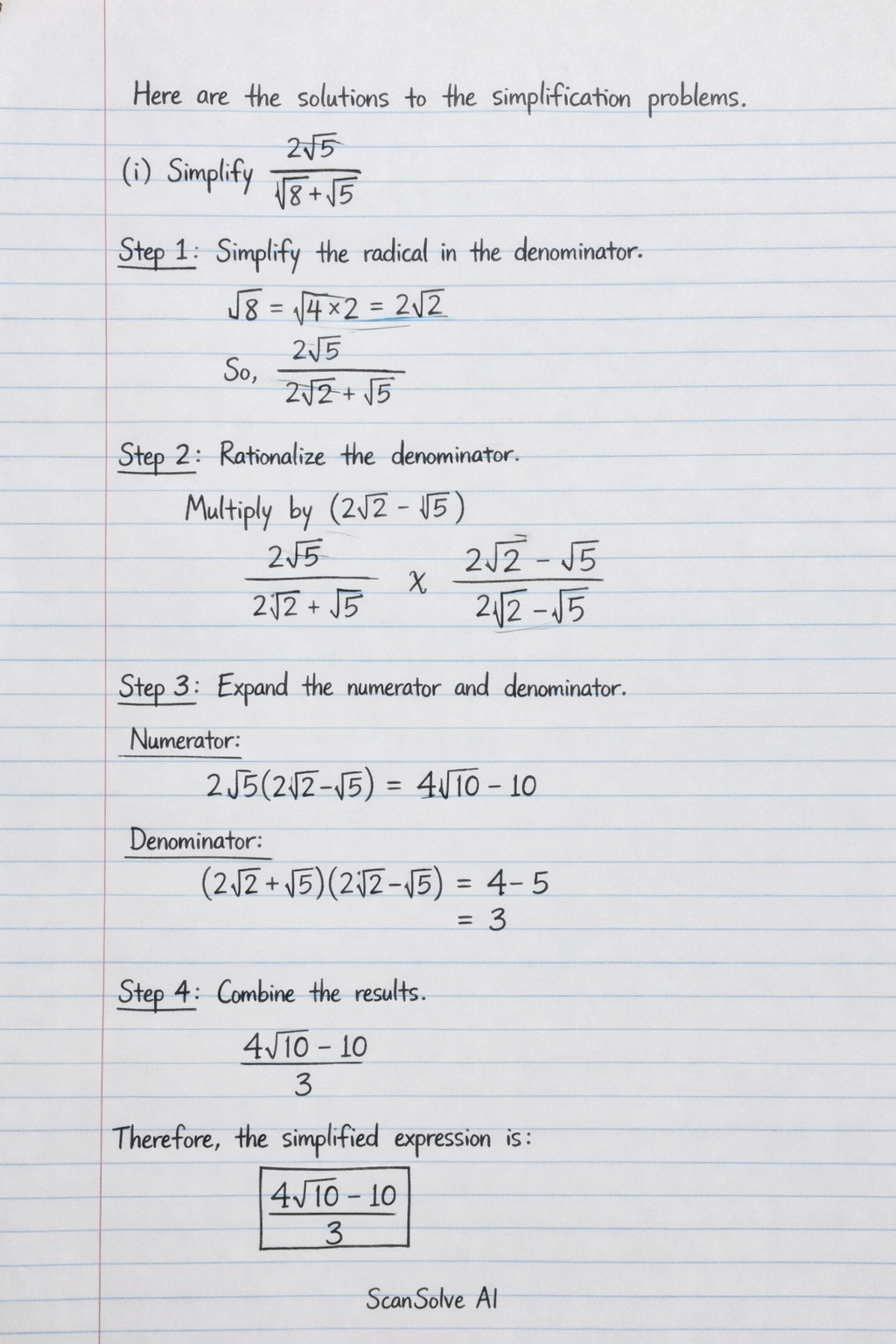
Handwritten Step-by-Step Solution
Get this as a handwritten image on WhatsApp — like a tutor wrote it for you.
Try on WhatsApp