

This mathematics problem involves applying core mathematical principles and formulas. Below you will find a complete step-by-step solution with detailed explanations for each step, helping you understand not just the answer but the method behind it.
ScanSolve AI Answer
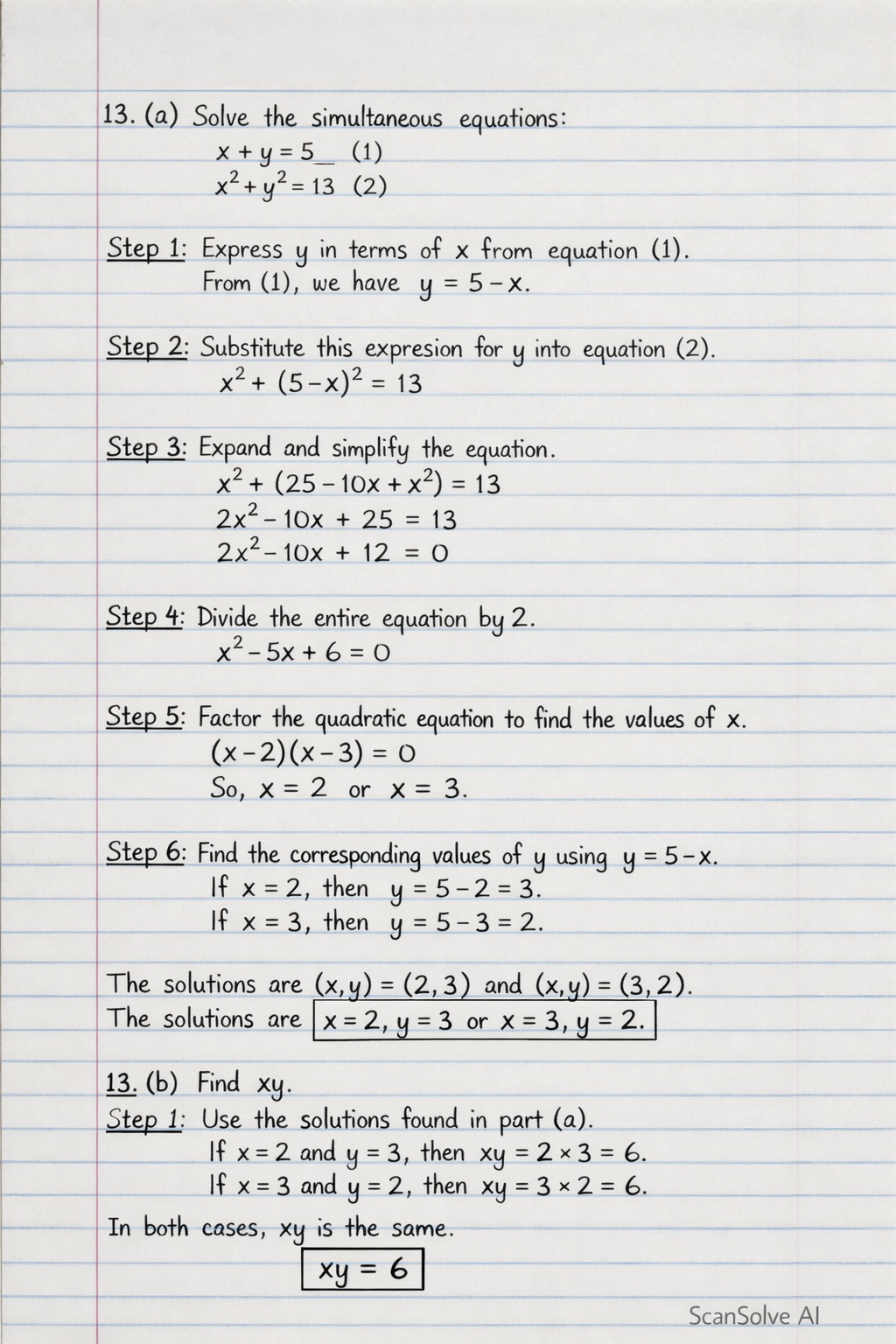
Okay, bazuunelson, let's tackle these. 13. (a) Solve the simultaneous equations: x+y=5 (1) x^2+y^2=13 (2) Step 1: Express y in terms of x from equation (1). From (1), we have y = 5-x. Step 2: Substitute this expression for y into equation (2). x^2 + (5-x)^2 = 13 Step 3: Expand and simplify the equation. x^2 + (25 - 10x + x^2) = 13 2x^2 - 10x + 25 = 13 2x^2 - 10x + 12 = 0 Step 4: Divide the entire equation by 2. x^2 - 5x + 6 = 0 Step 5: Factor the quadratic equation to find the values of x. (x-2)(x-3) = 0 So, x=2 or x=3. Step 6: Find the corresponding values of y using y=5-x. If x=2, then y = 5-2 = 3. If x=3, then y = 5-3 = 2. The solutions are (x,y) = (2,3) and (x,y) = (3,2). The solutions are x=2, y=3 or x=3, y=2. 13. (b) Find xy Step 1: Use the solutions found in part (a). If x=2 and y=3, then xy = 2 × 3 = 6. If x=3 and y=2, then xy = 3 × 2 = 6. In both cases, xy is the same. xy = 6 The value of xy is 6. 14. (a) Find the equation of a line passing through (2,3) and (4,7) Step 1: Calculate the gradient (slope) m of the line. The formula for the gradient is m = (y_2 - y_1)/(x_2 - x_1). Using points (x_1, y_1) = (2,3) and (x_2, y_2) = (4,7): m = (7-3)/(4-2) = (4)/(2) = 2 Step 2: Use the point-slope form of the equation of a line, y - y_1 = m(x - x_1). Using the point (2,3) and m=2: y - 3 = 2(x - 2) Step 3: Simplify the equation to the slope-intercept form y=mx+c. y - 3 = 2x - 4 y = 2x - 4 + 3 y = 2x - 1 The equation of the line is y = 2x - 1. 14. (b) Find the midpoint of the line Step 1: Recall the midpoint formula. For two points (x_1, y_1) and (x_2, y_2), the midpoint M is given by M = ((x_1+x_2)/(2), (y_1+y_2)/(2)). Step 2: Substitute the given points (2,3) and (4,7) into the formula. M = ((2+4)/(2), (3+7)/(2)) Step 3: Calculate the coordinates of the midpoint. M = ((6)/(2), (10)/(2)) M = (3,5) The midpoint of the line is (3,5). That's 2 down. 3 left today — send the next one.