
We read your photo as:
(sin θ + i cos θ)ⁿ is equal to
Mathematics
ScanSolve AI Answer
Answer
Step-by-step solution
3 stepsDe Moivre के प्रमेय का उपयोग करने के लिए, हमें दिए गए व्यंजक को मानक ध्रुवीय रूप में बदलना होगा।
दिए गए व्यंजक को मानक ध्रुवीय रूप में बदलें।
हम जानते हैं कि और ।
इसलिए, को इस प्रकार लिखा जा सकता है:De Moivre के प्रमेय को लागू करें।
De Moivre का प्रमेय कहता है कि ।
यहाँ, है।
तो, हम इसे लागू करते हैं:परिणाम की तुलना विकल्पों से करें।
प्राप्त परिणाम है ।
यह विकल्प (C) से मेल खाता है।The final answer is .
Was this helpful?
Try one yourself
A new problem that tests the same skill.
Still stuck on this one?
Ask a follow-up, and the answer starts from this question.
Got a different question?Ask your own question
More Mathematics Questions
Qy = ln(sqrt(sin θ cos θ) + 1 + 2ln θ)QSimplify the expression (1+cosθ)/sinθ * (cscθ - cotθ)QIf sin θ = 1/√2, find cosec² θQWrite the reciprocal of cosec θ.QShow that cot θ + cosec θ / sin θ + tan θ = cosec θ cot θ
Browse by topic:Trigonometry
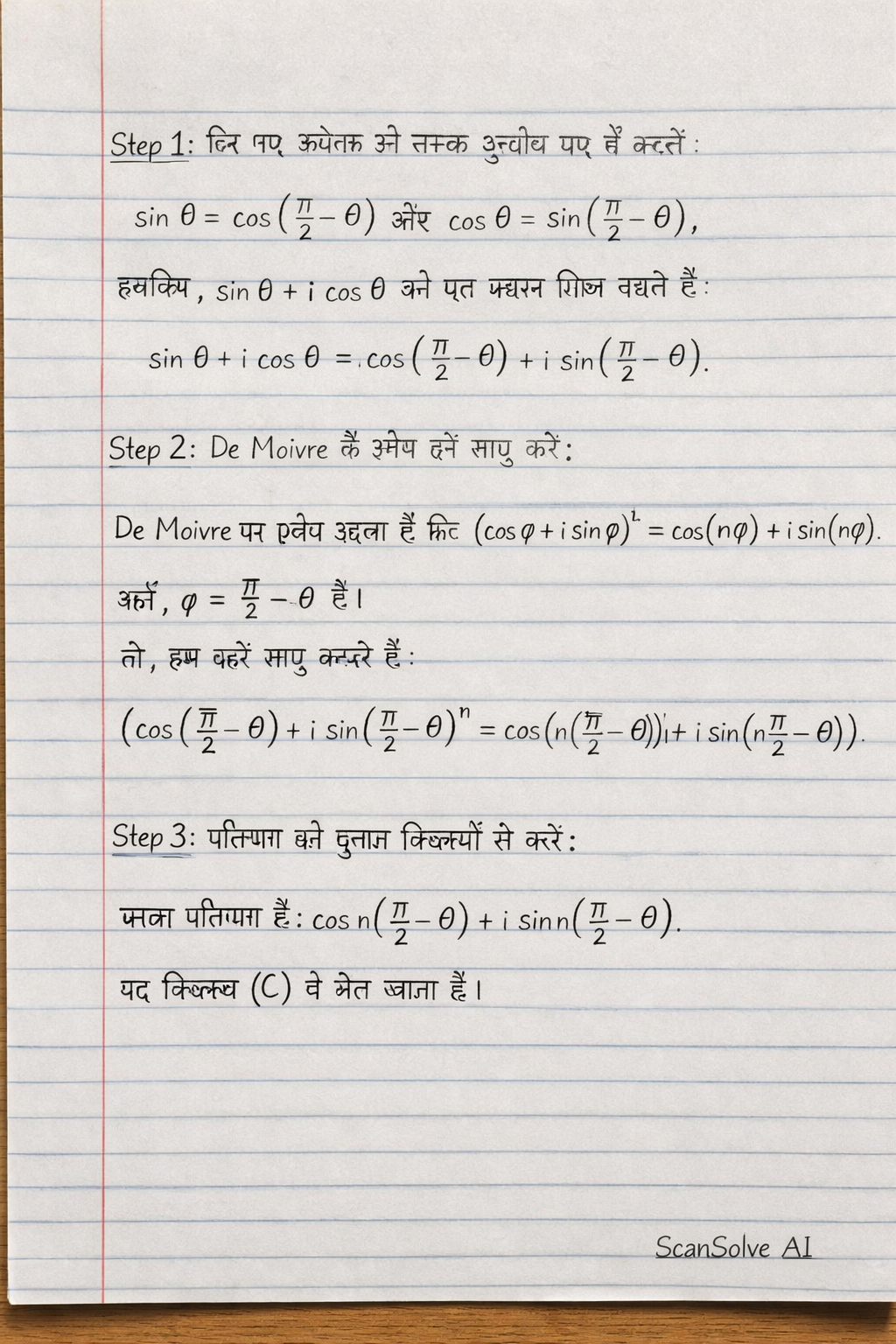
Handwritten Step-by-Step Solution
Get this as a handwritten image on WhatsApp — like a tutor wrote it for you.
Try on WhatsApp