We read your photo as:

y = ln(sqrt(sin θ cos θ) + 1 + 2ln θ)

Mathematics

ScanSolve AI Answer

Graph of y = ln(√(sin(θ)cos(θ)) + 1 + 2ln(θ))

Use the left and right arrow keys to trace the curve, up and down to jump between key points, and plus and minus to zoom.

Key points of y = ln(√(sin(θ)cos(θ)) + 1 + 2ln(θ))
Pointθy
x-intercept0.70
Maximum1.450.74
Maximum4.251.51
Maximum7.261.73
Maximum10.351.85

Step-by-step solution

3 steps

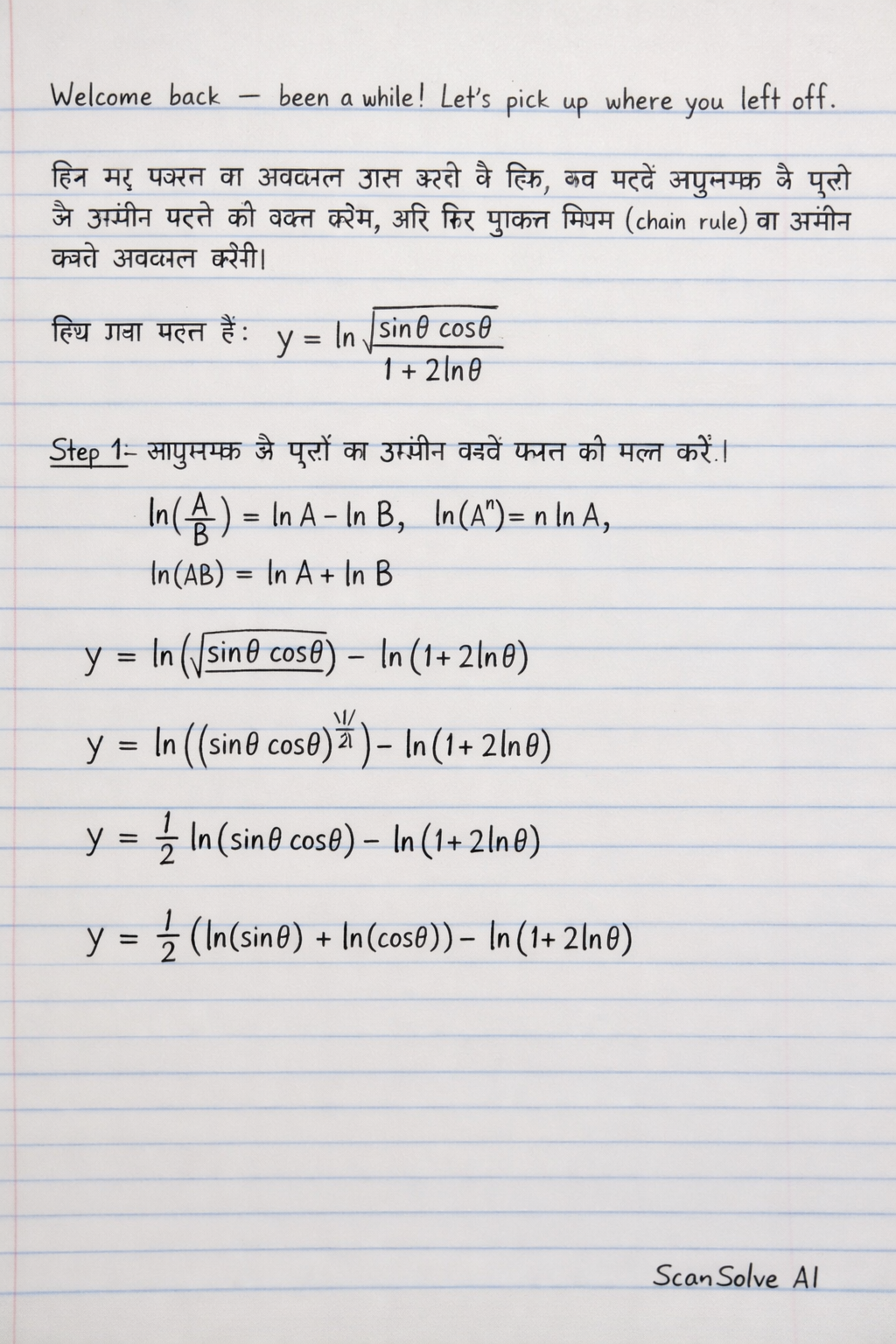
दिए गए फलन का अवकलज ज्ञात करने के लिए, हम पहले लघुगणक के गुणों का उपयोग करके इसे सरल करेंगे, और फिर श्रृंखला नियम (chain rule) का उपयोग करके अवकलन करेंगे।

दिया गया फलन है:

y=ln⁡(sin⁡θcos⁡θ1+2ln⁡θ)y = \ln\left(\frac{\sqrt{\sin\theta \cos\theta}}{1+2\ln\theta}\right)
  1. लघुगणक के गुणों का उपयोग करके फलन को सरल करें।

    हम ln⁡(AB)=ln⁡A−ln⁡B\ln\left(\frac{A}{B}\right) = \ln A - \ln B, ln⁡(An)=nln⁡A\ln(A^n) = n \ln A, और ln⁡(AB)=ln⁡A+ln⁡B\ln(AB) = \ln A + \ln B गुणों का उपयोग करेंगे।
    \begin{align*} y &= \ln(\sqrt{\sin\theta \cos\theta}) - \ln(1+2\ln\theta) \ y &= \ln((\sin\theta \cos\theta)^{1/2}) - \ln(1+2\ln\theta) \ y &= \frac{1}{2}\ln(\sin\theta \cos\theta) - \ln(1+2\ln\theta) \ y &= \frac{1}{2}(\ln(\sin\theta) + \ln(\cos\theta)) - \ln(1+2\ln\theta)\end{align*}

  2. θ\theta के सापेक्ष yy का अवकलन करें।

    हम ddx(ln⁡u)=1ududx\frac{d}{dx}(\ln u) = \frac{1}{u} \frac{du}{dx} सूत्र का उपयोग करेंगे।
    पहले पद का अवकलन:

    ddθ(12ln⁡(sin⁡θ))=12⋅1sin⁡θ⋅ddθ(sin⁡θ)=12⋅1sin⁡θ⋅cos⁡θ=12cot⁡θ\frac{d}{d\theta}\left(\frac{1}{2}\ln(\sin\theta)\right) = \frac{1}{2} \cdot \frac{1}{\sin\theta} \cdot \frac{d}{d\theta}(\sin\theta) = \frac{1}{2} \cdot \frac{1}{\sin\theta} \cdot \cos\theta = \frac{1}{2}\cot\theta

    दूसरे पद का अवकलन:

    ddθ(12ln⁡(cos⁡θ))=12⋅1cos⁡θ⋅ddθ(cos⁡θ)=12⋅1cos⁡θ⋅(−sin⁡θ)=−12tan⁡θ\frac{d}{d\theta}\left(\frac{1}{2}\ln(\cos\theta)\right) = \frac{1}{2} \cdot \frac{1}{\cos\theta} \cdot \frac{d}{d\theta}(\cos\theta) = \frac{1}{2} \cdot \frac{1}{\cos\theta} \cdot (-\sin\theta) = -\frac{1}{2}\tan\theta

    तीसरे पद का अवकलन:

    ddθ(−ln⁡(1+2ln⁡θ))=−11+2ln⁡θ⋅ddθ(1+2ln⁡θ)\frac{d}{d\theta}\left(-\ln(1+2\ln\theta)\right) = -\frac{1}{1+2\ln\theta} \cdot \frac{d}{d\theta}(1+2\ln\theta)

    यहां, ddθ(1+2ln⁡θ)=0+2⋅1θ=2θ\frac{d}{d\theta}(1+2\ln\theta) = 0 + 2 \cdot \frac{1}{\theta} = \frac{2}{\theta}।
    तो, तीसरे पद का अवकलन है:

    −11+2ln⁡θ⋅2θ=−2θ(1+2ln⁡θ)-\frac{1}{1+2\ln\theta} \cdot \frac{2}{\theta} = -\frac{2}{\theta(1+2\ln\theta)}
  3. सभी अवकलजों को एक साथ जोड़ें।

    dydθ=12cot⁡θ−12tan⁡θ−2θ(1+2ln⁡θ)\frac{dy}{d\theta} = \frac{1}{2}\cot\theta - \frac{1}{2}\tan\theta - \frac{2}{\theta(1+2\ln\theta)}

    अंतिम उत्तर है:

    dydθ=12cot⁡θ−12tan⁡θ−2θ(1+2ln⁡θ)\boxed{\frac{dy}{d\theta} = \frac{1}{2}\cot\theta - \frac{1}{2}\tan\theta - \frac{2}{\theta(1+2\ln\theta)}}
Was this helpful?

Still stuck on this one?

Ask a follow-up, and the answer starts from this question.

Got a different question?Ask your own question
Handwritten step-by-step solution preview

Handwritten Step-by-Step Solution

Get this as a handwritten image on WhatsApp — like a tutor wrote it for you.

Try on WhatsApp