
We read your photo as:
What single transformation maps 0394A 2B 2C 2 onto 0394A 3B 3C 3?
ScanSolve AI Answer
Step-by-step solution
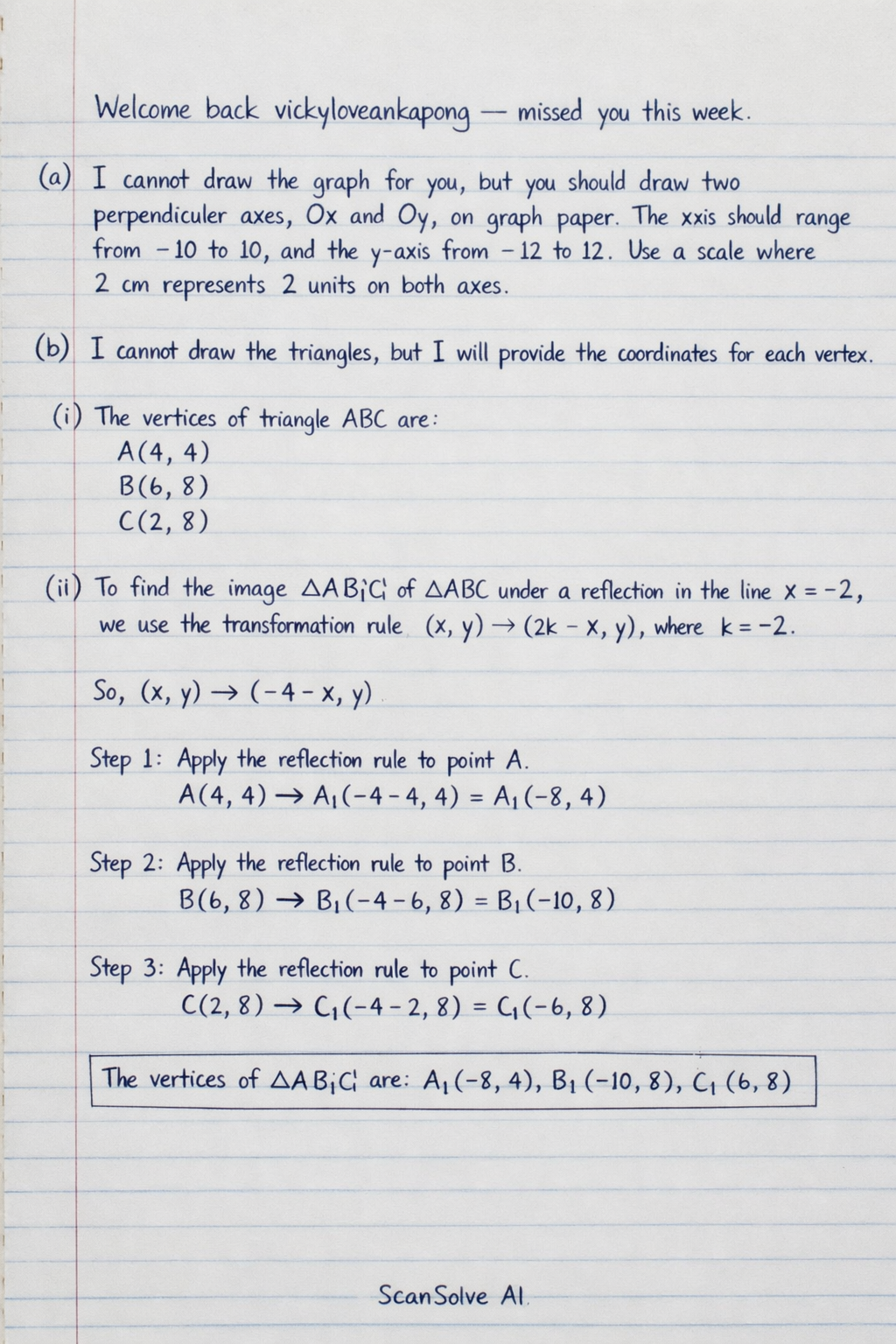
12 stepsa) I cannot draw the graph for you, but you should draw two perpendicular axes, and , on graph paper. The -axis should range from to 10, and the -axis from to 12. Use a scale where represents on both axes.
Part b(i)
The vertices of triangle are given as
I cannot draw the triangles, but I will provide the coordinates for each vertex.
$A(4, 4)$
$B(6, 8)$
$C(2, 8)$
Part b(ii)· 3 steps
To find the image of under a reflection in the line , we use the transformation rule , where .
So, .
Apply the reflection rule to point .
Apply the reflection rule to point .
Apply the reflection rule to point .
The vertices of are .
Part b(iii)· 3 steps
To find the image of under an enlargement with scale factor from the origin, we use the transformation rule , where .
So, .
Apply the enlargement rule to point .
Apply the enlargement rule to point .
Apply the enlargement rule to point .
The vertices of are .
Part b(iv)· 3 steps
To find the image of under a reflection in the line (the -axis), we use the transformation rule , where .
So, .
Apply the reflection rule to point .
Apply the reflection rule to point .
Apply the reflection rule to point .
The vertices of are .
Part c· 3 steps
To find the single transformation that maps onto , we compare their coordinates
maps to
maps to
maps to
Observe the change in coordinates from to .
The -coordinate remains the same (e.g., ), while the -coordinate changes sign (e.g., ).
Confirm this pattern for and .
For : . , .
For : . , .Identify the transformation.
The transformation rule is . This is a reflection in the -axis (the line ).
The single transformation is a .
Still stuck on this one?
Ask a follow-up, and the answer starts from this question.
More Mathematics Questions
Handwritten Step-by-Step Solution
Get this as a handwritten image on WhatsApp — like a tutor wrote it for you.
Try on WhatsApp