

This mathematics problem involves applying core mathematical principles and formulas. Below you will find a complete step-by-step solution with detailed explanations for each step, helping you understand not just the answer but the method behind it.
ScanSolve AI Answer
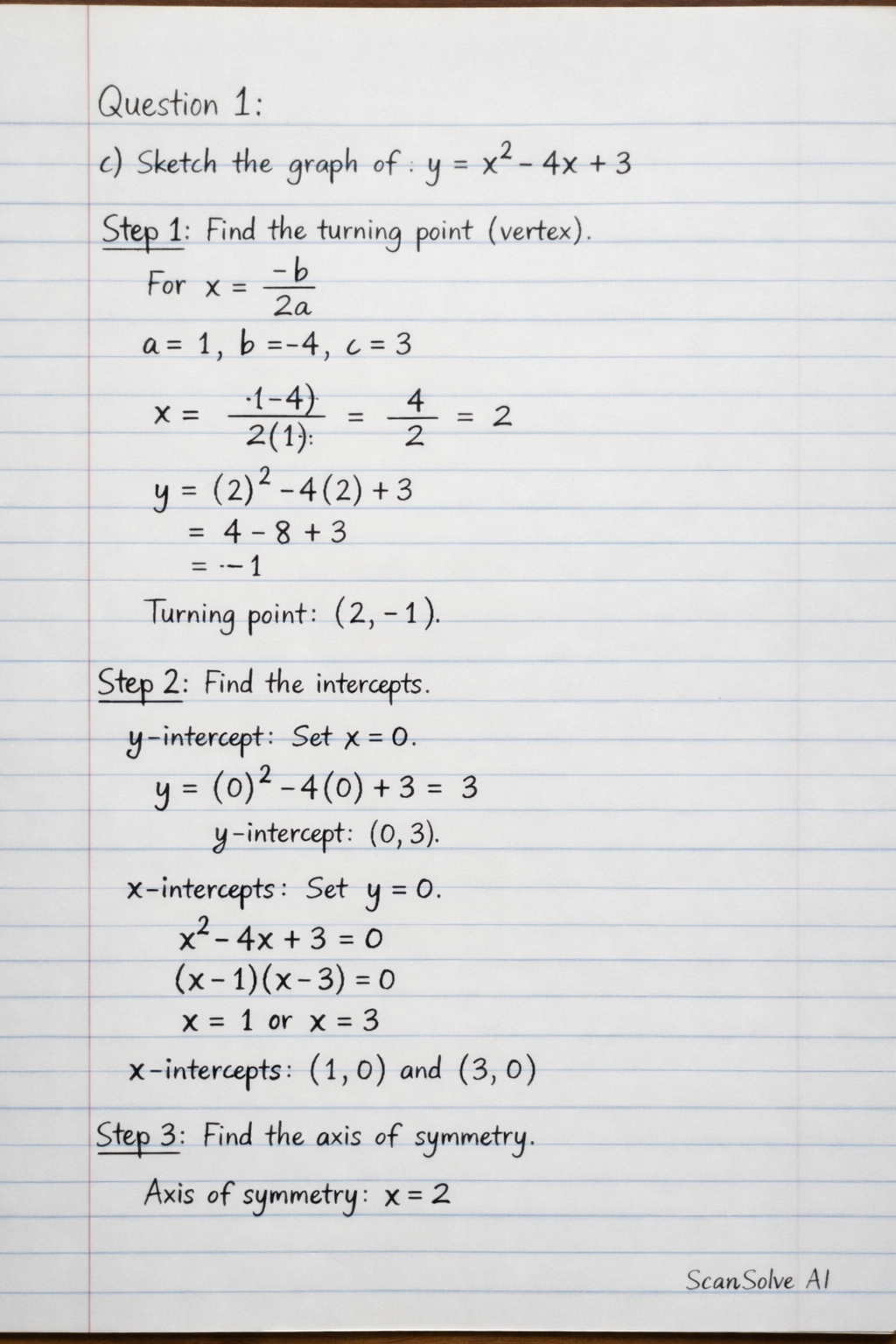
Question 1: c) Sketch the graph of y = x^2 - 4x + 3 To sketch the graph, we find the key features: Step 1: Find the turning point (vertex). For a parabola y = ax^2 + bx + c, the x-coordinate of the vertex is x = -(b)/(2a). Here, a=1, b=-4, c=3. x = -(-4)/(2(1)) = (4)/(2) = 2 Substitute x=2 into the equation to find the y-coordinate: y = (2)^2 - 4(2) + 3 = 4 - 8 + 3 = -1 The turning point is (2, -1). Step 2: Find the intercepts. y-intercept: Set x=0. y = (0)^2 - 4(0) + 3 = 3 The y-intercept is (0, 3). x-intercepts: Set y=0. x^2 - 4x + 3 = 0 Factor the quadratic equation: (x-1)(x-3) = 0 So, x=1 or x=3. The x-intercepts are (1, 0) and (3, 0). Step 3: Find the axis of symmetry. The axis of symmetry is a vertical line passing through the x-coordinate of the turning point. The axis of symmetry is x=2. Summary of features for sketch: • Turning point: (2, -1) • Intercepts: (0, 3), (1, 0), (3, 0) • Axis of symmetry: x=2 (Since I cannot draw a graph, these points and the axis of symmetry define the parabola, which opens upwards because the coefficient of x^2 is positive.) d) State the effect of the coefficient of x^2 on the shape of a parabola. The coefficient of x^2 (denoted as a) determines the direction and width of the parabola. If a > 0, the parabola opens upwards. If a < 0, it opens downwards. The magnitude of a affects the width: a larger |a| results in a narrower parabola, while a smaller |a| results in a wider parabola. Question 2: a) Solve graphically: x^2 - 4x = 0 To solve x^2 - 4x = 0 graphically, you would plot the graph of y = x^2 - 4x and find the x-coordinates where the graph intersects the x-axis (i.e., where y=0). Algebraically: x^2 - 4x = 0 Factor out x: x(x-4) = 0 Set each factor to zero: x = 0 or x-4 = 0 x = 0 or x = 4 The solutions are x=0, x=4. b) Find the point(s) of intersection between y = x^2 - 2x and y = x + 2 Step 1: Set the two equations equal to each other to find the x-coordinates of the intersection points. x^2 - 2x = x + 2 Step 2: Rearrange the equation into a standard quadratic form ax^2 + bx + c = 0. x^2 - 2x - x - 2 = 0 x^2 - 3x - 2 = 0 Step 3: Use the quadratic formula x = -b ± sqrt(b^2 - 4ac)2a to solve for x. Here, a=1, b=-3, c=-2. x = -(-3) ± sqrt((-3)^2 - 4(1)(-2))2(1) x = 3 ± sqrt(9 + 8)2 x = 3 ± sqrt(17)2 Step 4: Substitute the x-values back into one of the original equations (e.g., y = x+2) to find the corresponding y-values. For x_1 = 3 + sqrt(17)2: y_1 = (3 + sqrt(17)2) + 2 = 3 + sqrt(17) + 42 = 7 + sqrt(17)2 For x_2 = 3 - sqrt(17)2: y_2 = (3 - sqrt(17)2) + 2 = 3 - sqrt(17) + 42 = 7 - sqrt(17)2 The points of intersection are (3 + sqrt(17)2, 7 + sqrt(17)2) and (3 - sqrt(17)2, 7 - sqrt(17)2). Question 3: a) Given A = 2 & 3 \\ 1 & 4 and B = 5 & 1 \\ 2 & 0 . Compute A+B and A-B. Step 1: Compute A+B by adding corresponding elements. A+B = 2+5 & 3+1 \\ 1+2 & 4+0 = 7 & 4 \\ 3 & 4 Step 2: Compute A-B by subtracting corresponding elements. A-B = 2-5 & 3-1 \\ 1-2 & 4-0 = -3 & 2 \\ -1 & 4 b) Find AB. Step 1: Multiply matrix A by matrix B. AB = 2 & 3 \\ 1 & 4 5 & 1 \\ 2 & 0 AB = (2)(5)+(3)(2) & (2)(1)+(3)(0) \\ (1)(5)+(4)(2) & (1)(1)+(4)(0) AB = 10+6 & 2+0 \\ 5+8 & 1+0 AB = 16 & 2 \\ 13 & 1 c) Calculate the determinant of 3 & 2 \\ 7 & 5 . For a 2 × 2 matrix a & b \\ c & d , the determinant is ad - bc. 3 & 2 \\ 7 & 5 = (3)(5) - (2)(7) = 15 - 14 = 1 d) Given vectors u = (2,3) and v = (-1,4), find u+v and 2u. Step 1: Compute u+v by adding corresponding components. u+v = (2 + (-1), 3 + 4) = (1, 7) Step 2: Compute 2u by multiplying each component of u by the scalar 2. 2u = (2 × 2, 2 × 3) = (4, 6) Send me the next one 📸