
So find the second derivative of that same question
ScanSolve AI Answer
Answer
Step-by-step solution
5 stepsTo find the second derivative of the function , we will differentiate the first derivative, which we found to be .
Identify and for the second derivative and find their derivatives.
Let .
Let .Find the derivative of :
Find the derivative of using the chain rule:
Let , so . Then and .
Apply the quotient rule to find .
The quotient rule states that if , then .
Substitute into the formula:Simplify the expression.
Factor out from the numerator:
Cancel from the numerator and denominator:
Expand and combine terms in the numerator.
Expand the first product:
Expand the second product:
Combine these two expanded parts for the numerator:
Factor out the common factor from the numerator (24):
Write the final expression for the second derivative.
Still stuck on this one?
Ask a follow-up, and the answer starts from this question.
More Mathematics Questions
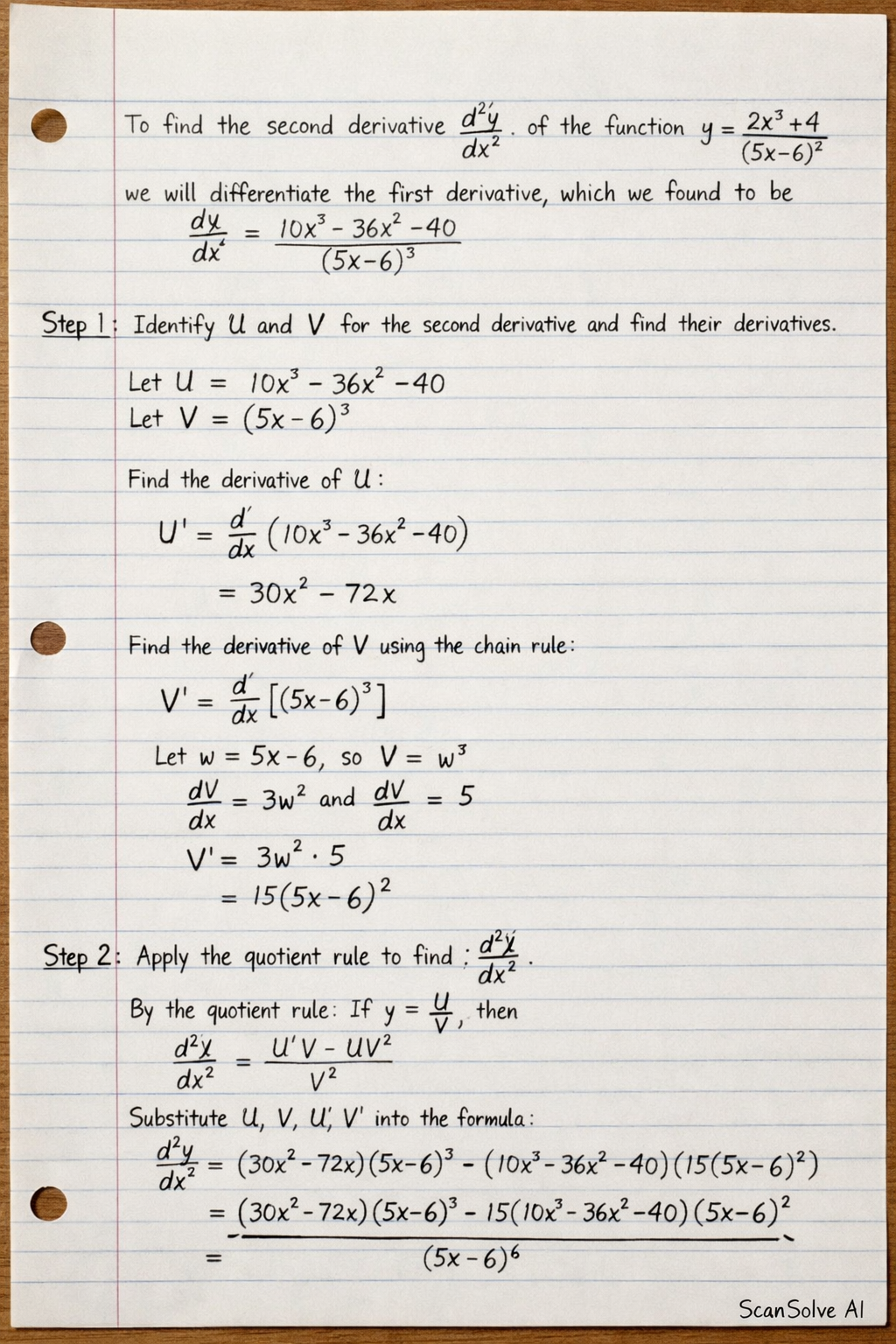
Handwritten Step-by-Step Solution
Get this as a handwritten image on WhatsApp — like a tutor wrote it for you.
Try on WhatsApp