
We read your photo as:
Define statistical inference, explaining the relationship between sample and population in this process.
Mathematics
ScanSolve AI Answer
Step-by-step solution
3 stepsThe question asks about the definition of statistical inference.
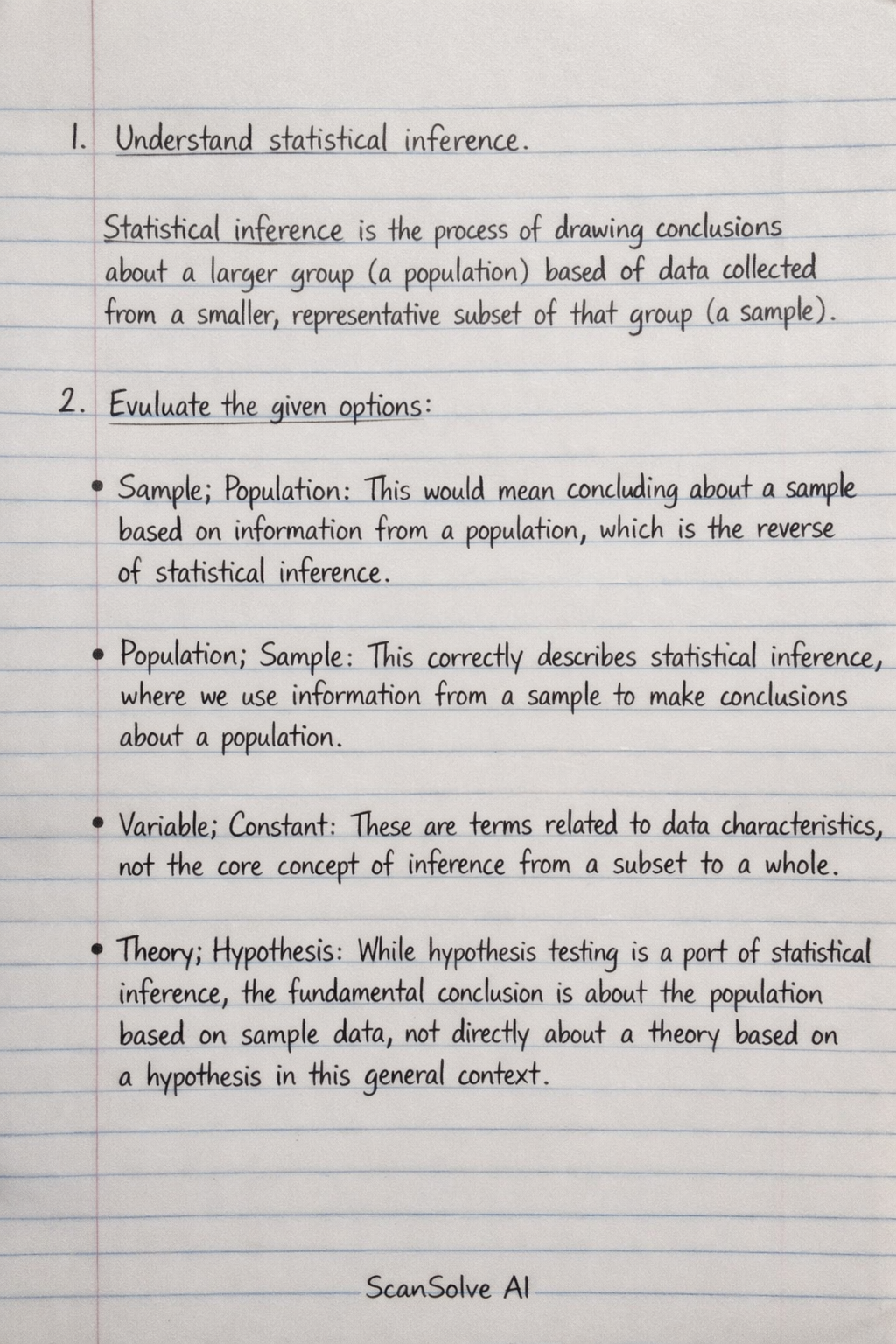
Understand statistical inference.
Statistical inference is the process of drawing conclusions about a larger group (a population) based on data collected from a smaller, representative subset of that group (a sample).
Evaluate the given options.
- Sample; Population: This would mean concluding about a sample based on information from a population, which is the reverse of statistical inference.
- Population; Sample: This correctly describes statistical inference, where we use information from a sample to make conclusions about a population.
- Variable; Constant: These are terms related to data characteristics, not the core concept of inference from a subset to a whole.
- Theory; Hypothesis: While hypothesis testing is a part of statistical inference, the fundamental conclusion is about the population based on sample data, not directly about a theory based on a hypothesis in this general context.
Select the correct option.
Based on the definition, statistical inference allows us to reach a conclusion about a population based on information from a sample.
The correct option is Population; Sample.
Was this helpful?
Still stuck on this one?
Ask a follow-up, and the answer starts from this question.
Got a different question?Ask your own question
More Mathematics Questions
QDifferentiate between population and sample in Statistics?QSummarize the essential topics in statistics, including definitions, sampling methods, parameter vs…QExplain the meaning of the form populationQBiology Discuss population studies by sampling methods and factors affecting populationQI. What is a sample? How does a sample differ from the accessible population? ii. Why should a…
Browse by topic:Statistics
Handwritten Step-by-Step Solution
Get this as a handwritten image on WhatsApp — like a tutor wrote it for you.
Try on WhatsApp