
I. What is a sample? How does a sample differ from the accessible population? ii. Why should a sample be representative of its parent population? iii. Briefly explain probability and non-probability sampling techniques. iv (a) Define simple random sampling
ScanSolve AI Answer
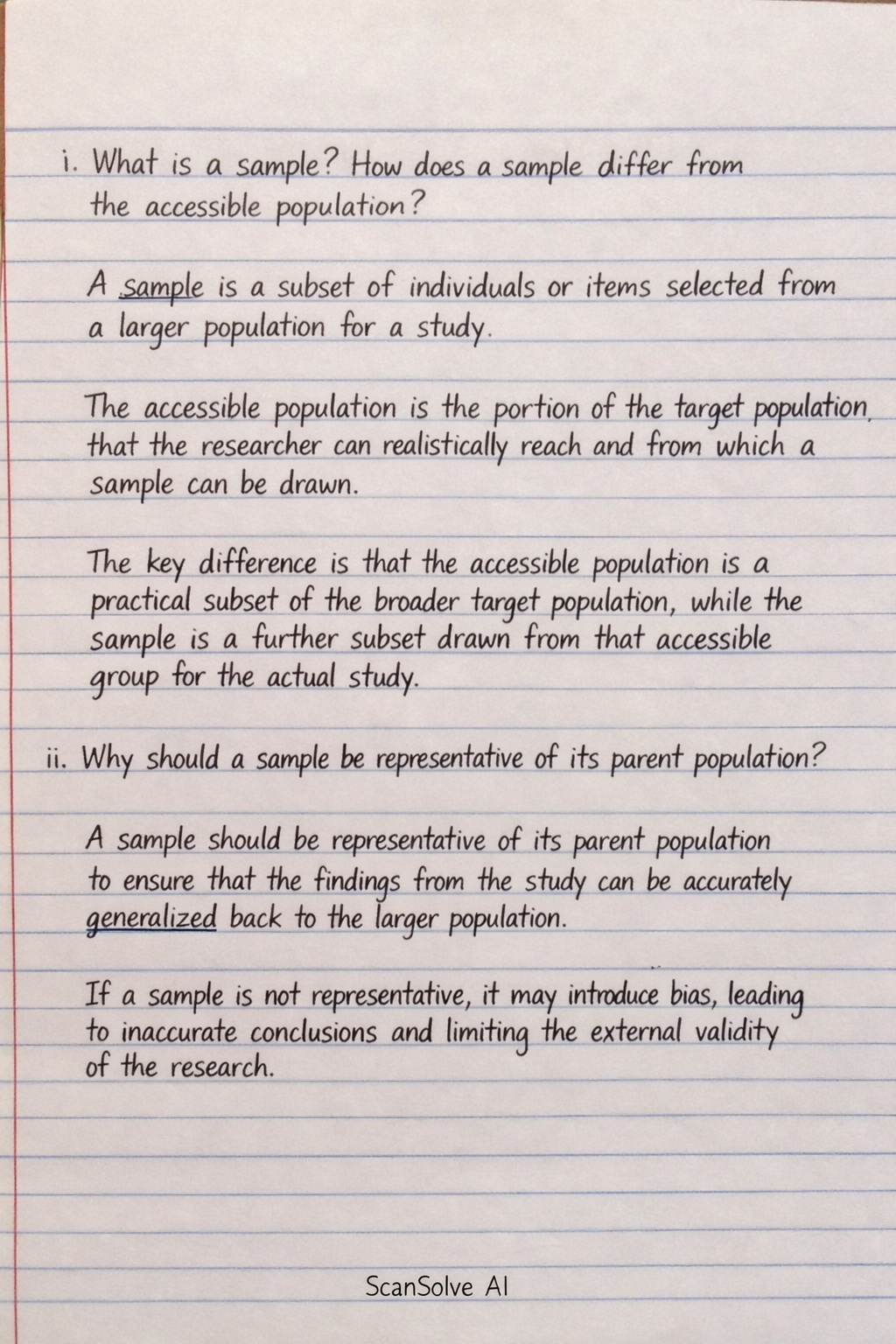
i. What is a sample? How does a sample differ from the accessible population?
A sample is a subset of individuals or items selected from a larger population for a study. The accessible population is the portion of the target population that the researcher can realistically reach and from which a sample can be drawn. The key difference is that the accessible population is a practical subset of the broader target population, while the sample is a further subset drawn from that accessible group for the actual study.
ii. Why should a sample be representative of its parent population?
A sample should be representative of its parent population to ensure that the findings from the study can be accurately generalized back to the larger population. If a sample is not representative, it may introduce bias, leading to inaccurate conclusions and limiting the external validity of the research.
iii. Briefly explain probability and non-probability sampling techniques.
Probability sampling techniques involve selecting participants in a way that every member of the population has a known, non-zero chance of being selected. This allows for statistical inference and generalization to the population. Examples include simple random, stratified, and cluster sampling.
Non-probability sampling techniques involve selecting participants based on convenience, judgment, or specific criteria, meaning not every member of the population has an equal chance of selection. These methods are often used for exploratory research or when probability sampling is impractical, but they limit the generalizability of findings. Examples include convenience, purposive, and snowball sampling.
iv (a) Define simple random sampling
Simple random sampling is a probability sampling technique where every individual in the population has an equal and independent chance of being selected for the sample. This is typically achieved by using a random number generator or drawing names from a hat, ensuring that the selection of one individual does not influence the selection of another.
Still stuck on this one?
Ask a follow-up, and the answer starts from this question.
More Mathematics Questions
Handwritten Step-by-Step Solution
Get this as a handwritten image on WhatsApp — like a tutor wrote it for you.
Try on WhatsApp