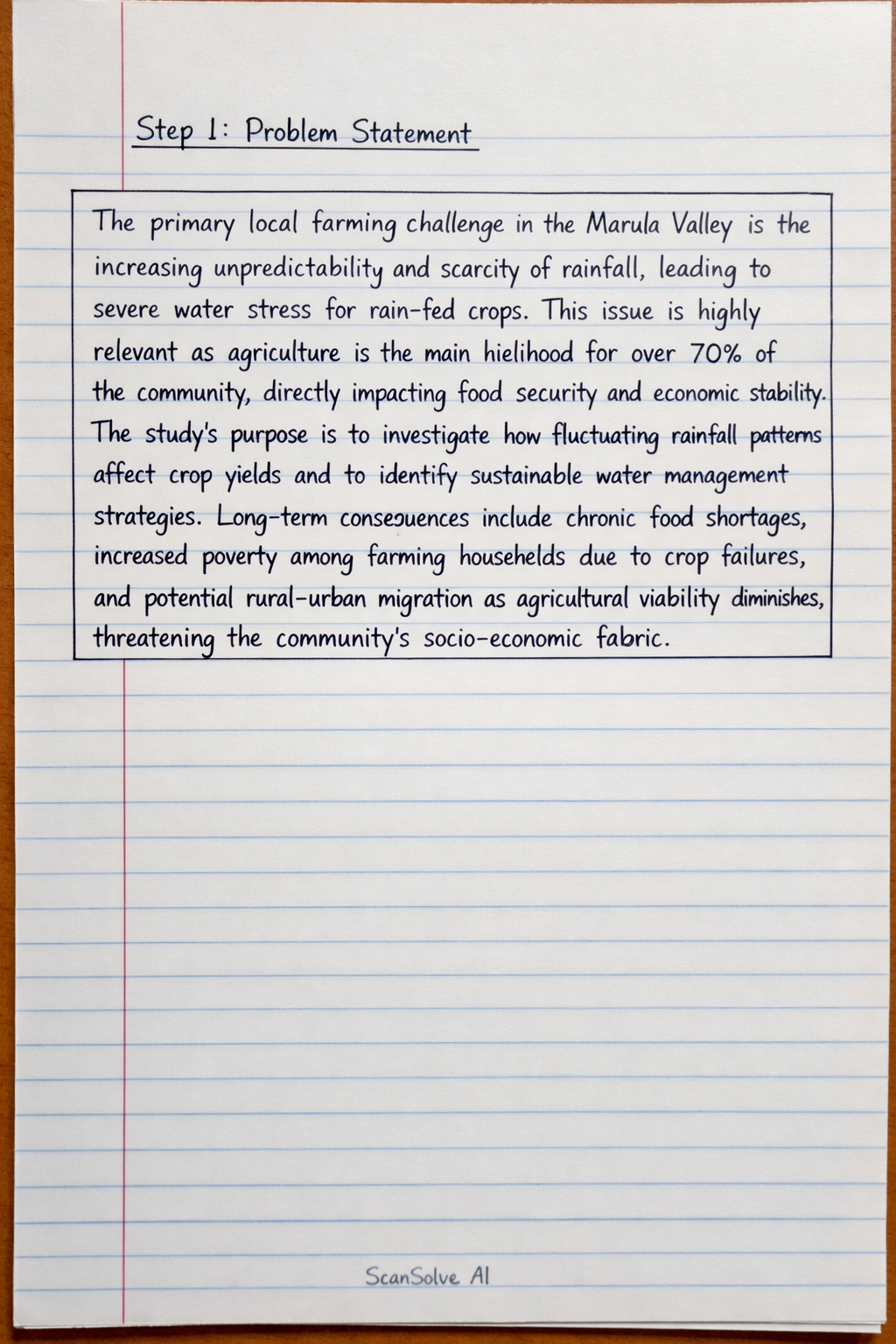
Step 1: Problem Statement (100-120 words)
TheprimarylocalfarmingchallengeintheMarulaValleyistheincreasingunpredictabilityandscarcityofrainfall,leadingtoseverewaterstressforrain−fedcrops.Thisissueishighlyrelevantasagricultureisthemainlivelihoodforover70%ofthecommunity,directlyimpactingfoodsecurityandeconomicstability.Thestudy′spurposeistoinvestigatehowfluctuatingrainfallpatternsaffectcropyieldsandtoidentifysustainablewatermanagementstrategies.Long−termconsequencesincludechronicfoodshortages,increasedpovertyamongfarminghouseholdsduetocropfailures,andpotentialrural−urbanmigrationasagriculturalviabilitydiminishes,threateningthecommunity′ssocio−economicfabric.
Step 2: Background Research (150-250 words)
TheresearchwillbeconductedintheMarula Valley, a rural agricultural community situated in the semi-arid region of Limpopo Province, South Africa.
Physical Environment: The valley experiences a sub-tropical climate characterized by hot summers and mild winters. Rainfall is highly seasonal, primarily occurring between November and March, but has become increasingly erratic, with frequent droughts and occasional intense downpours. The topography is generally undulating, with fertile alluvial soils along the riverbanks transitioning to sandy loams on higher ground, which are susceptible to erosion. Water sources are limited, relying mainly on a seasonal river and boreholes.
Social Environment: The community is predominantly rural, with a high dependency on subsistence farming for food and income. Traditional farming methods are common, though some farmers are adopting modern techniques. Access to education and healthcare facilities is moderate.
Economic Environment: The local economy is largely agrarian, with maize, beans, and groundnuts being the primary crops. Farmers often face challenges such as limited access to formal markets, high input costs for seeds and fertilizers, and inadequate transport infrastructure. Unemployment rates are high, and many households rely on remittances.
Step 4: Research/Data Collection Methods (150-250 words)
Tocollectqualitativedata,amixed−methodsapproachwillbeemployed,combiningprimaryandsecondarysourcesforcomprehensiveinsights.
Primary Sources:
•Questionnaires/Interviews: Structured questionnaires and semi-structured interviews will be conducted with local farmers and agricultural extension officers. This method is crucial for gathering firsthand accounts of farming challenges (e.g., unreliable rainfall, pest outbreaks, input costs), current practices, and perceived impacts on crop yields. Extension officers will provide expert perspectives on regional agricultural trends and interventions.
•Field Observations: Direct observations will be made across various farms to assess physical conditions like soil erosion, nutrient deficiency signs, and irrigation effectiveness. This method allows for visual verification of reported issues and provides contextual understanding of the farming landscape.
•Photographs and Maps: Photographs will document visual evidence of stunted crops, dry soil, and infrastructure challenges. A detailed map will illustrate distances between farms and markets, highlighting transport difficulties. These visual aids enhance data interpretation.
Secondary Sources:
•Literature Review: An extensive review of existing agricultural reports, local farming records, and academic textbooks will be conducted. This provides historical data on soil types, past crop yields, and how climate change has affected the region, offering a foundational understanding.
•Internet Sources: Official agricultural websites, weather databases, and news articles will be utilized to research current market prices for seeds/fertilizers, modern pest control techniques, and government subsidies. This ensures access to up-to-date information and broader agricultural trends.
That's 2 down. 3 left today — send the next one.