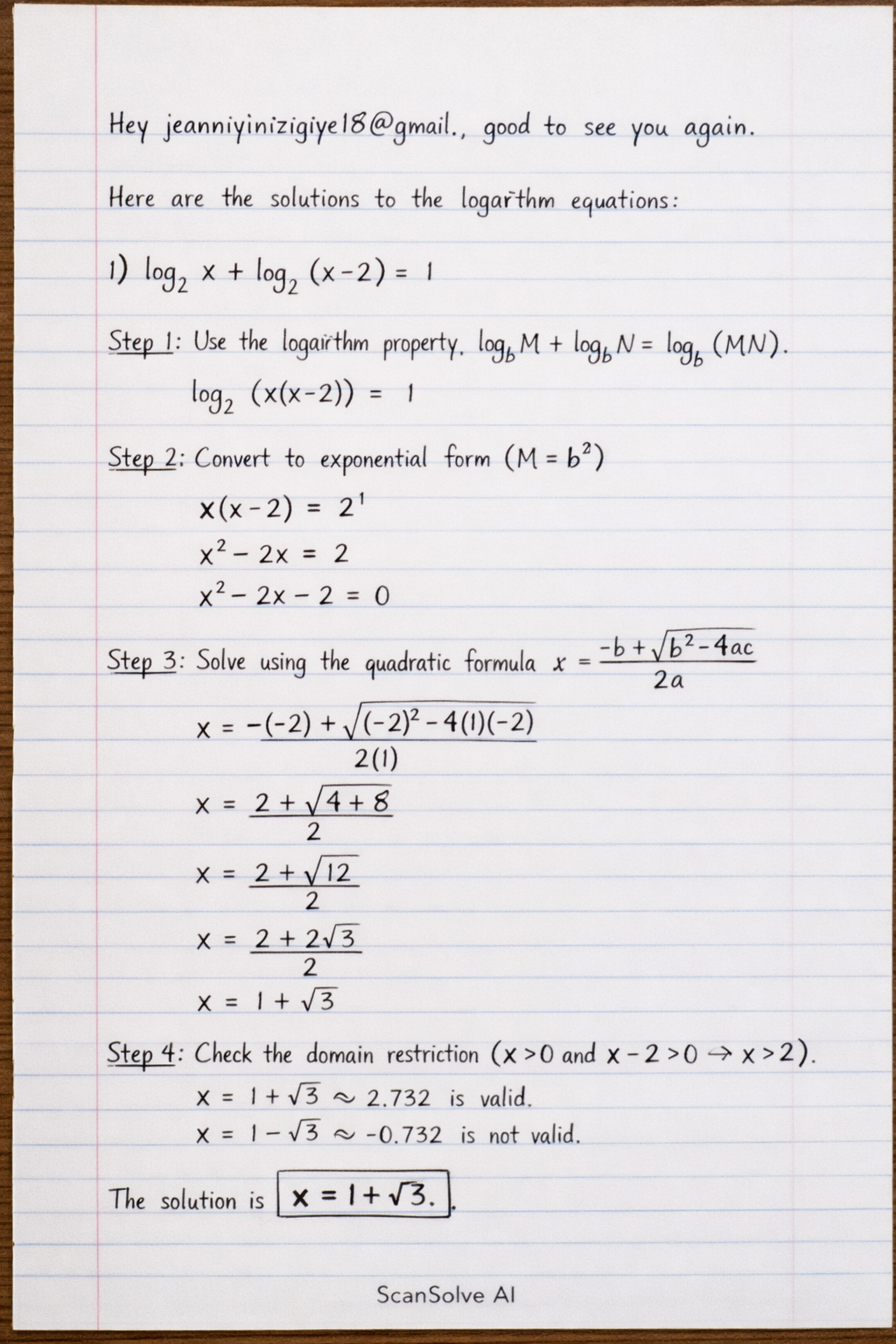
Here are the solutions to the logarithm equations:
1) log2x+log2(x−2)=1
Step 1: Use the logarithm property logbM+logbN=logb(MN).
log2(x(x−2))=1
Step 2: Convert the logarithmic equation to an exponential equation (M=bN).
x(x−2)=21x2−2x=2x2−2x−2=0
Step 3: Solve the quadratic equation using the quadratic formula x=2a−b±b2−4ac.
x=2(1)−(−2)±(−2)2−4(1)(−2)x=22±4+8x=22±12x=22±23x=1±3
Step 4: Check the domain restriction (x>0 and x−2>0⟹x>2).
x=1+3≈2.732 is valid.
x=1−3≈−0.732 is not valid.
The solution is x=1+3.
2) log5(x+1)−log5(x−1)=1
Step 1: Use the logarithm property logbM−logbN=logb(NM).
log5(x−1x+1)=1
Step 2: Convert to an exponential equation.
x−1x+1=51x+1=5(x−1)x+1=5x−5
Step 3: Solve for x.
6=4xx=46x=23
Step 4: Check the domain restriction (x+1>0⟹x>−1 and x−1>0⟹x>1, so x>1).
x=23=1.5 is valid.
The solution is x=23.
3) log3x+2⋅log3x=6
Step 1: Combine like terms.
3⋅log3x=6
Step 2: Isolate log3x.
log3x=36log3x=2
Step 3: Convert to an exponential equation.
x=32x=9
Step 4: Check the domain restriction (x>0).
x=9 is valid.
The solution is x=9.
4) log4(x2−4)−log4(x+2)=1
Step 1: Use the logarithm property logbM−logbN=logb(NM).
log4(x+2x2−4)=1
Step 2: Factor the numerator x2−4=(x−2)(x+2).
log4(x+2(x−2)(x+2))=1
Step 3: Simplify the expression inside the logarithm. The domain requires x>2, so x+2=0.
log4(x−2)=1
Step 4: Convert to an exponential equation.
x−2=41x−2=4x=6
Step 5: Check the domain restriction (x2−4>0⟹x<−2orx>2, and x+2>0⟹x>−2. Combined, x>2).
x=6 is valid.
The solution is x=6.
5) log2x+log4x=3
Step 1: Change the base of log4x to base 2 using logbM=logcblogcM.
log4x=log24log2x=2log2x
Step 2: Substitute this into the original equation.
log2x+2log2x=3
Step 3: Combine the terms with log2x.
(1+21)log2x=323log2x=3
Step 4: Isolate log2x.
log2x=3⋅32log2x=2
Step 5: Convert to an exponential equation.
x=22x=4
Step 6: Check the domain restriction (x>0).
x=4 is valid.
The solution is x=4.
6) log(x2−1)=2⋅log(x+1)
Step 1: Use the logarithm property klogbM=logb(Mk) on the right side.
log(x2−1)=log((x+1)2)
Step 2: If logbM=logbN, then M=N.
x2−1=(x+1)2
Step 3: Expand the right side and solve for x.
x2−1=x2+2x+1−1=2x+1−2=2xx=−1
Step 4: Check the domain restriction (x2−1>0⟹x<−1orx>1, and x+1>0⟹x>−1. Combined, x>1).
x=−1 is not greater than 1. Also, log(x+1) would be log(0), which is undefined.
The equation has nosolution.
7) log3x+log3(x−2)+log3(x−4)=log3(15)
Step 1: Use the logarithm property logbM+logbN=logb(MN) on the left side.
log3(x(x−2)(x−4))=log3(15)
Step 2: If logbM=logbN, then M=N.
x(x−2)(x−4)=15
Step 3: Expand the left side.
x(x2−4x−2x+8)=15x(x2−6x+8)=15x3−6x2+8x=15x3−6x2+8x−15=0
Step 4: Find integer roots using the Rational Root Theorem. Test divisors of 15.
Let P(x)=x3−6x2+8x−15.
P(5)=53−6(52)+8(5)−15=125−150+40−15=0. So, x=5 is a root.
Step 5: Perform polynomial division to factor (x−5) out.
(x−5)(x2−x+3)=0
Step 6: Solve the quadratic factor x2−x+3=0. The discriminant is Δ=(−1)2−4(1)(3)=1−12=−11. Since Δ<0, there are no other real roots.
Step 7: Check the domain restriction (x>0, x−2>0⟹x>2, and x−4>0⟹x>4. Combined, x>4).
x=5 is valid.
The solution is x=5.
Send me the next one 📸
Was this helpful?
Need help with your own homework?
Get instant step-by-step solutions to any question. Free to start.
1) _2 x + _2 (x-2) = 1 Step 1: Use the logarithm property _b M + _b N = _b (MN). _2 (x(x-2)) = 1 Step 2: Convert the logarithmic equation to an exponential equation (M = b^N).
This mathematics problem involves applying core mathematical principles and formulas. Below you will find a complete step-by-step solution with detailed explanations for each step, helping you understand not just the answer but the method behind it.
ScanSolve AI Answer
Here are the solutions to the logarithm equations: 1) _2 x + _2 (x-2) = 1 Step 1: Use the logarithm property _b M + _b N = _b (MN). _2 (x(x-2)) = 1 Step 2: Convert the logarithmic equation to an exponential equation (M = b^N). x(x-2) = 2^1 x^2 - 2x = 2 x^2 - 2x - 2 = 0 Step 3: Solve the quadratic equation using the quadratic formula x = -b ± sqrt(b^2 - 4ac)2a. x = -(-2) ± sqrt((-2)^2 - 4(1)(-2))2(1) x = 2 ± sqrt(4 + 8)2 x = 2 ± sqrt(12)2 x = 2 ± 2sqrt(3)2 x = 1 ± sqrt(3) Step 4: Check the domain restriction (x > 0 and x-2 > 0 x > 2). x = 1 + sqrt(3) ≈ 2.732 is valid. x = 1 - sqrt(3) ≈ -0.732 is not valid. The solution is x = 1 + sqrt(3). 2) _5 (x+1) - _5 (x-1) = 1 Step 1: Use the logarithm property _b M - _b N = _b ((M)/(N)). _5 ((x+1)/(x-1)) = 1 Step 2: Convert to an exponential equation. (x+1)/(x-1) = 5^1 x+1 = 5(x-1) x+1 = 5x - 5 Step 3: Solve for x. 6 = 4x x = (6)/(4) x = (3)/(2) Step 4: Check the domain restriction (x+1 > 0 x > -1 and x-1 > 0 x > 1, so x > 1). x = (3)/(2) = 1.5 is valid. The solution is x = (3)/(2). 3) _3 x + 2 · _3 x = 6 Step 1: Combine like terms. 3 · _3 x = 6 Step 2: Isolate _3 x. _3 x = (6)/(3) _3 x = 2 Step 3: Convert to an exponential equation. x = 3^2 x = 9 Step 4: Check the domain restriction (x > 0). x = 9 is valid. The solution is x = 9. 4) _4 (x^2-4) - _4 (x+2) = 1 Step 1: Use the logarithm property _b M - _b N = _b ((M)/(N)). _4 ((x^2-4)/(x+2)) = 1 Step 2: Factor the numerator x^2-4 = (x-2)(x+2). _4 (((x-2)(x+2))/(x+2)) = 1 Step 3: Simplify the expression inside the logarithm. The domain requires x > 2, so x+2 ≠ 0. _4 (x-2) = 1 Step 4: Convert to an exponential equation. x-2 = 4^1 x-2 = 4 x = 6 Step 5: Check the domain restriction (x^2-4 > 0 x < -2 or x > 2, and x+2 > 0 x > -2. Combined, x > 2). x = 6 is valid. The solution is x = 6. 5) _2 x + _4 x = 3 Step 1: Change the base of _4 x to base 2 using _b M = (_c M)/(_c b). _4 x = (_2 x)/(_2 4) = (_2 x)/(2) Step 2: Substitute this into the original equation. _2 x + (_2 x)/(2) = 3 Step 3: Combine the terms with _2 x. (1 + (1)/(2)) _2 x = 3 (3)/(2) _2 x = 3 Step 4: Isolate _2 x. _2 x = 3 · (2)/(3) _2 x = 2 Step 5: Convert to an exponential equation. x = 2^2 x = 4 Step 6: Check the domain restriction (x > 0). x = 4 is valid. The solution is x = 4. 6) (x^2-1) = 2 · (x+1) Step 1: Use the logarithm property k _b M = _b (M^k) on the right side. (x^2-1) = ((x+1)^2) Step 2: If _b M = _b N, then M = N. x^2-1 = (x+1)^2 Step 3: Expand the right side and solve for x. x^2-1 = x^2 + 2x + 1 -1 = 2x + 1 -2 = 2x x = -1 Step 4: Check the domain restriction (x^2-1 > 0 x < -1 or x > 1, and x+1 > 0 x > -1. Combined, x > 1). x = -1 is not greater than 1. Also, (x+1) would be (0), which is undefined. The equation has no solution. 7) _3 x + _3 (x-2) + _3 (x-4) = _3 (15) Step 1: Use the logarithm property _b M + _b N = _b (MN) on the left side. _3 (x(x-2)(x-4)) = _3 (15) Step 2: If _b M = _b N, then M = N. x(x-2)(x-4) = 15 Step 3: Expand the left side. x(x^2 - 4x - 2x + 8) = 15 x(x^2 - 6x + 8) = 15 x^3 - 6x^2 + 8x = 15 x^3 - 6x^2 + 8x - 15 = 0 Step 4: Find integer roots using the Rational Root Theorem. Test divisors of 15. Let P(x) = x^3 - 6x^2 + 8x - 15. P(5) = 5^3 - 6(5^2) + 8(5) - 15 = 125 - 150 + 40 - 15 = 0. So, x=5 is a root. Step 5: Perform polynomial division to factor (x-5) out. (x-5)(x^2 - x + 3) = 0 Step 6: Solve the quadratic factor x^2 - x + 3 = 0. The discriminant is = (-1)^2 - 4(1)(3) = 1 - 12 = -11. Since < 0, there are no other real roots. Step 7: Check the domain restriction (x > 0, x-2 > 0 x > 2, and x-4 > 0 x > 4. Combined, x > 4). x = 5 is valid. The solution is x = 5. Send me the next one 📸