We read your photo as:

Evaluate the following logarithmic expressions: 7) 2 5 - 3 2 + 32 8) ( 32 + 128 - 729)/( 32 + 2 - 27)

Mathematics

ScanSolve AI Answer

Answers

3 parts
7
2
8
2
9
-1

Step-by-step solution

11 steps

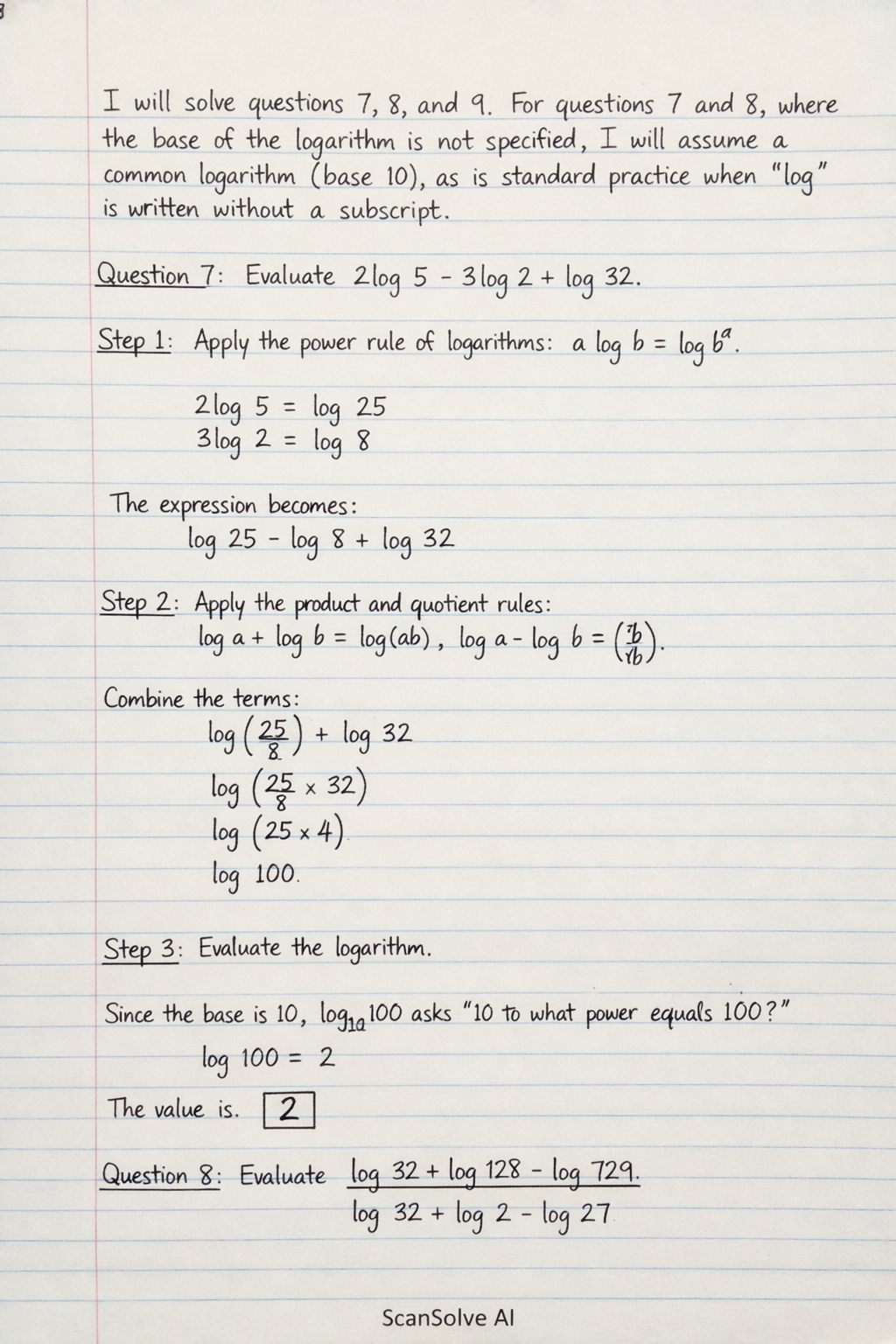
I will solve questions 7, 8, and 9. For questions 7 and 8, where the base of the logarithm is not specified, I will assume a common logarithm (base 10), as is standard practice when "log" is written without a subscript.

Part 7· 3 steps

Evaluate 2log⁡5−3log⁡2+log⁡322\log 5 - 3\log 2 + \log 32.

  1. Apply the power rule of logarithms, alog⁡b=log⁡baa \log b = \log b^a.

    2log⁡5=log⁡52=log⁡252\log 5 = \log 5^2 = \log 25 3log⁡2=log⁡23=log⁡83\log 2 = \log 2^3 = \log 8

    The expression becomes:

    log⁡25−log⁡8+log⁡32\log 25 - \log 8 + \log 32
  2. Apply the product and quotient rules of logarithms, log⁡a+log⁡b=log⁡(ab)\log a + \log b = \log (ab) and log⁡a−log⁡b=log⁡(ab)\log a - \log b = \log \left(\frac{a}{b}\right).

    Combine the terms:

    log⁡(258)+log⁡32\log \left(\frac{25}{8}\right) + \log 32 log⁡(258×32)\log \left(\frac{25}{8} \times 32\right)

    Simplify the expression inside the logarithm:

    log⁡(25×4)\log (25 \times 4) log⁡100\log 100
  3. Evaluate the logarithm.

    Since the base is 10, log⁡10100\log_{10} 100 asks "10 to what power equals 100?".

    log⁡100=2\log 100 = 2

    The value is 2\boxed{2}.

Part 82

Evaluate log⁡32+log⁡128−log⁡729log⁡32+log⁡2−log⁡27\frac{\log 32 + \log 128 - \log 729}{\log 32 + \log 2 - \log 27}.

  1. Simplify the numerator using logarithm rules.

    Identify powers of common bases: 32=2532 = 2^5, 128=27128 = 2^7, 729=36729 = 3^6.

    Numerator=log⁡25+log⁡27−log⁡36\text{Numerator} = \log 2^5 + \log 2^7 - \log 3^6

    Apply the power rule alog⁡b=log⁡baa \log b = \log b^a:

    Numerator=5log⁡2+7log⁡2−6log⁡3\text{Numerator} = 5\log 2 + 7\log 2 - 6\log 3

    Combine like terms:

    Numerator=12log⁡2−6log⁡3\text{Numerator} = 12\log 2 - 6\log 3
  2. Simplify the denominator using logarithm rules.

    Identify powers of common bases: 32=2532 = 2^5, 27=3327 = 3^3.

    Denominator=log⁡25+log⁡2−log⁡33\text{Denominator} = \log 2^5 + \log 2 - \log 3^3

    Apply the power rule:

    Denominator=5log⁡2+log⁡2−3log⁡3\text{Denominator} = 5\log 2 + \log 2 - 3\log 3

    Combine like terms:

    Denominator=6log⁡2−3log⁡3\text{Denominator} = 6\log 2 - 3\log 3
  3. Simplify the entire fraction.

    Substitute the simplified numerator and denominator back into the fraction:

    12log⁡2−6log⁡36log⁡2−3log⁡3\frac{12\log 2 - 6\log 3}{6\log 2 - 3\log 3}

    Factor out common terms from the numerator and denominator:

    6(2log⁡2−log⁡3)3(2log⁡2−log⁡3)\frac{6(2\log 2 - \log 3)}{3(2\log 2 - \log 3)}

    Cancel out the common factor (2log⁡2−log⁡3)(2\log 2 - \log 3):

    63=2\frac{6}{3} = 2

    The value is 2\boxed{2}.

Part 9-1

Find the value of xx that satisfies the equation log⁡(x+5)=log⁡4−log⁡(x+2)\log (x+5) = \log 4 - \log (x+2).

  1. Apply the quotient rule of logarithms to the right side of the equation.

    log⁡(x+5)=log⁡(4x+2)\log (x+5) = \log \left(\frac{4}{x+2}\right)
  2. Equate the arguments of the logarithms.

    Since log⁡A=log⁡B\log A = \log B implies A=BA=B:

    x+5=4x+2x+5 = \frac{4}{x+2}
  3. Solve the algebraic equation for xx.

    Multiply both sides by (x+2)(x+2):

    (x+5)(x+2)=4(x+5)(x+2) = 4

    Expand the left side:

    x2+2x+5x+10=4x^2 + 2x + 5x + 10 = 4 x2+7x+10=4x^2 + 7x + 10 = 4

    Subtract 4 from both sides to set the quadratic equation to zero:

    x2+7x+6=0x^2 + 7x + 6 = 0
  4. Factor the quadratic equation.

    Find two numbers that multiply to 6 and add to 7 (which are 1 and 6):

    (x+1)(x+6)=0(x+1)(x+6) = 0

    This gives two potential solutions for xx:

    x+1=0  ⟹  x=−1x+1 = 0 \implies x = -1 x+6=0  ⟹  x=−6x+6 = 0 \implies x = -6
  5. Check the validity of the solutions based on the domain of logarithms.

    The argument of a logarithm must be positive.
    For log⁡(x+5)\log(x+5), we need x+5>0  ⟹  x>−5x+5 > 0 \implies x > -5.
    For log⁡(x+2)\log(x+2), we need x+2>0  ⟹  x>−2x+2 > 0 \implies x > -2.
    Both conditions must be satisfied, so xx must be greater than −2-2.

    Check x=−1x = -1:
    x+5=−1+5=4>0x+5 = -1+5 = 4 > 0 (Valid)
    x+2=−1+2=1>0x+2 = -1+2 = 1 > 0 (Valid)
    So, x=−1x = -1 is a valid solution.

    Check x=−6x = -6:
    x+5=−6+5=−1x+5 = -6+5 = -1 (Not valid, as the argument must be positive)
    So, x=−6x = -6 is not a valid solution.

    The value of xx that satisfies the equation is −1\boxed{-1}.

Was this helpful?

Try one yourself

A new problem that tests the same skill.

Still stuck on this one?

Ask a follow-up, and the answer starts from this question.

Got a different question?Ask your own question
Handwritten step-by-step solution preview

Handwritten Step-by-Step Solution

Get this as a handwritten image on WhatsApp — like a tutor wrote it for you.

Try on WhatsApp