
We read your photo as:
What are surds and how do you rationalize a denominator with a single surd or a binomial surd?
ScanSolve AI Answer
Answers
5 partsThe whiteboard discusses the topic of Surds, specifically focusing on Division or Rationalization of Surds.
Here's an explanation of the concepts and solutions to the examples shown:
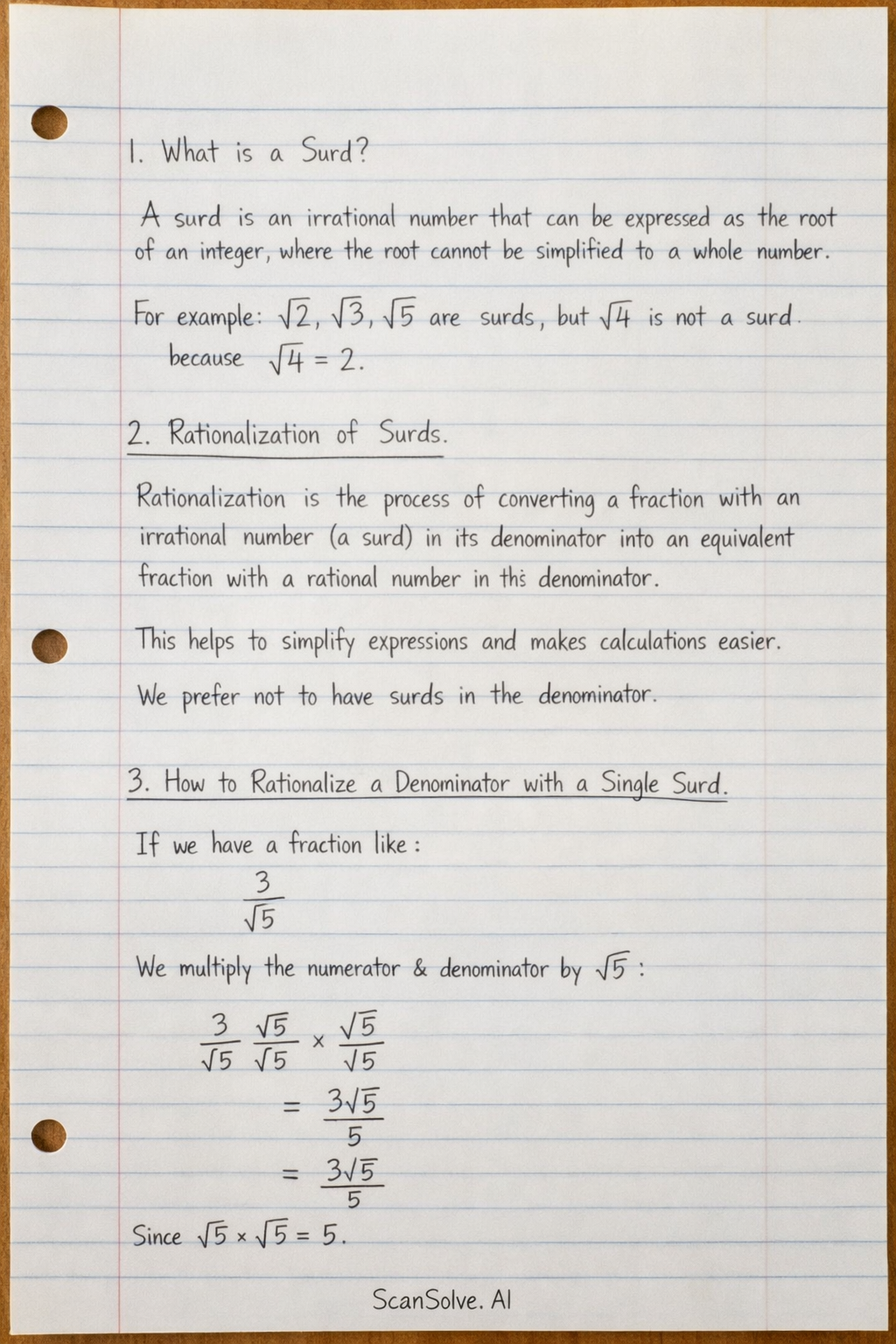
1. What is a Surd?
A surd is an irrational number that can be expressed as the root of an integer, where the root cannot be simplified to a whole number. For example, , , are surds, but is not a surd because .
2. Rationalization of Surds
Rationalization is the process of converting a fraction with an irrational number (a surd) in its denominator into an equivalent fraction with a rational number in its denominator. This is done to simplify expressions and make calculations easier, as it's generally preferred not to have surds in the denominator.
3. How to Rationalize a Denominator with a Single Surd
If the denominator is a single surd, like , you multiply both the numerator and the denominator by that surd. This is because , which is a rational number.
4. Conjugate of a Surd
The conjugate of a surd expression is used when the denominator is a binomial (two terms) involving a surd, such as or . The conjugate is formed by changing the sign between the terms.
- The conjugate of is .
- The conjugate of is . When an expression is multiplied by its conjugate, the result is a rational number, because . For example, .
Examples from the Whiteboard:
Here's how to rationalize the denominators for the given examples:
a)
To rationalize, multiply the numerator and denominator by :
The rationalized form is .
b)
To rationalize, multiply the numerator and denominator by :
The rationalized form is .
c)
To rationalize, multiply the numerator and denominator by :
The rationalized form is .
d)
To rationalize, multiply the numerator and denominator by :
The rationalized form is .
e)
To rationalize, multiply the numerator and denominator by :
The rationalized form is .
Try one yourself
A new problem that tests the same skill.
Still stuck on this one?
Ask a follow-up, and the answer starts from this question.
More Mathematics Questions
Handwritten Step-by-Step Solution
Get this as a handwritten image on WhatsApp — like a tutor wrote it for you.
Try on WhatsApp