We read your photo as:

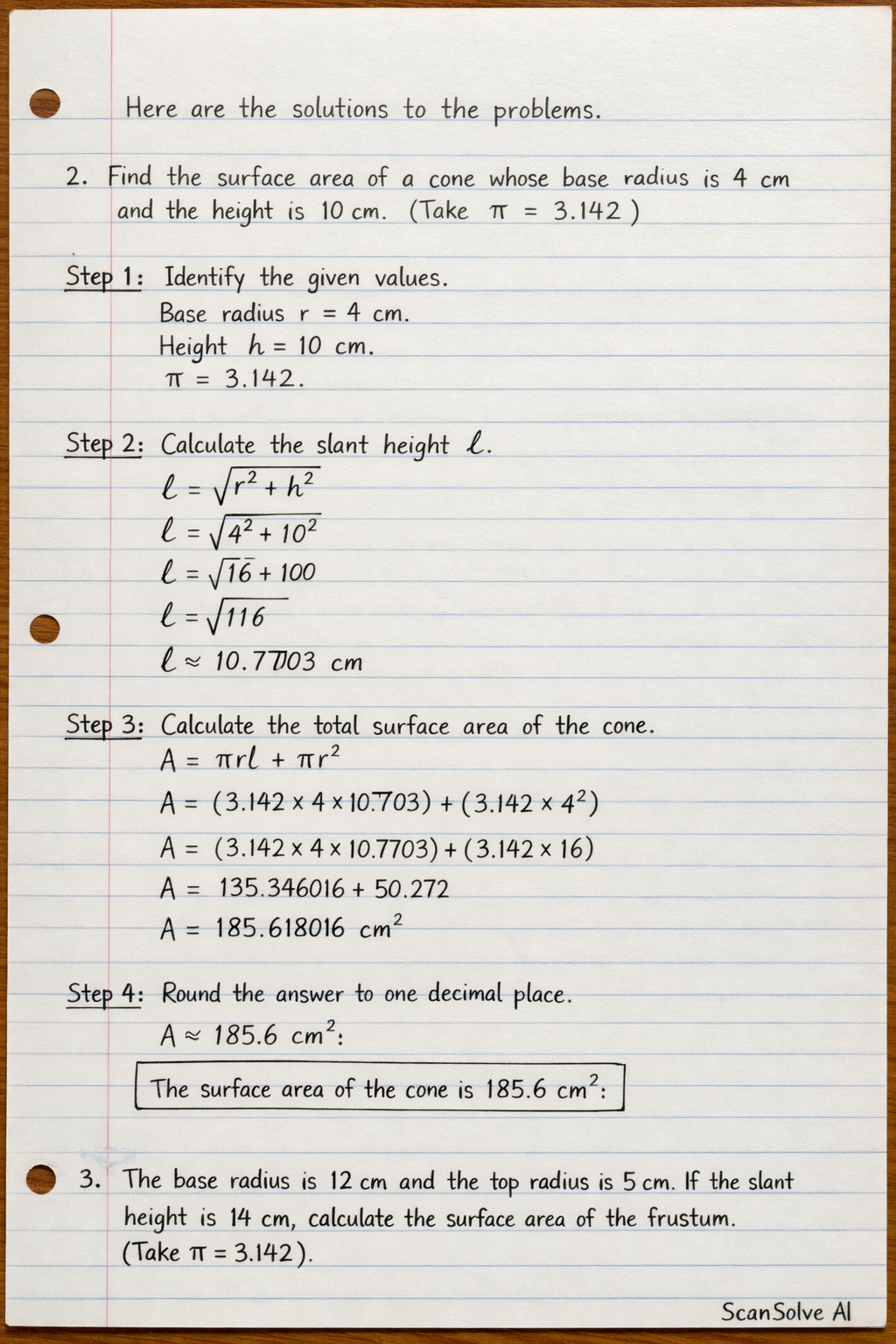
Find the surface area of a cone whose base radius is 4 cm and the height is 10 cm. (Take pi = 3.142)

Mathematics

ScanSolve AI Answer

Step-by-step solution

9 steps

Here are the solutions to the problems.

2. Find the surface area of a cone whose base radius is 4 cm and the height is 10 cm. (Take π=3.142\pi = 3.142)

  1. Identify the given values.

    Base radius r=4r = 4 cm.
    Height h=10h = 10 cm.
    π=3.142\pi = 3.142.

  2. Calculate the slant height ll.

    The slant height ll of a cone is given by the formula l=r2+h2l = \sqrt{r^2 + h^2}.

    l=42+102l = \sqrt{4^2 + 10^2} l=16+100l = \sqrt{16 + 100} l=116l = \sqrt{116} l≈10.7703 cml \approx 10.7703 \text{ cm}
  3. Calculate the total surface area of the cone.

    The total surface area AA of a cone is given by the formula A=πrl+πr2A = \pi r l + \pi r^2.

    A=(3.142×4×10.7703)+(3.142×42)A = (3.142 \times 4 \times 10.7703) + (3.142 \times 4^2) A=(3.142×4×10.7703)+(3.142×16)A = (3.142 \times 4 \times 10.7703) + (3.142 \times 16) A=135.346016+50.272A = 135.346016 + 50.272 A=185.618016 cm2A = 185.618016 \text{ cm}^2
  4. Round the answer to one decimal place.

    A≈185.6 cm2A \approx 185.6 \text{ cm}^2

    The surface area of the cone is 185.6 cm2\boxed{185.6 \text{ cm}^2}.

    3. The base radius is 12 cm and the top radius is 5 cm. If the slant height is 14 cm, calculate the surface area of the frustum. (Take π=3.142\pi = 3.142)

  5. Identify the given values.

    Base radius R=12R = 12 cm.
    Top radius r=5r = 5 cm.
    Slant height of frustum L=14L = 14 cm.
    π=3.142\pi = 3.142.

  6. Calculate the curved surface area of the frustum.

    The curved surface area of a frustum is given by the formula Acurved=π(R+r)LA_{curved} = \pi (R+r)L.

    Acurved=3.142×(12+5)×14A_{curved} = 3.142 \times (12+5) \times 14 Acurved=3.142×17×14A_{curved} = 3.142 \times 17 \times 14 Acurved=3.142×238A_{curved} = 3.142 \times 238 Acurved=747.796 cm2A_{curved} = 747.796 \text{ cm}^2
  7. Calculate the area of the base.

    The area of the base is given by Abase=πR2A_{base} = \pi R^2.

    Abase=3.142×122A_{base} = 3.142 \times 12^2 Abase=3.142×144A_{base} = 3.142 \times 144 Abase=452.448 cm2A_{base} = 452.448 \text{ cm}^2
  8. Calculate the area of the top.

    The area of the top is given by Atop=πr2A_{top} = \pi r^2.

    Atop=3.142×52A_{top} = 3.142 \times 5^2 Atop=3.142×25A_{top} = 3.142 \times 25 Atop=78.55 cm2A_{top} = 78.55 \text{ cm}^2
  9. Calculate the total surface area of the frustum.

    The total surface area AtotalA_{total} of the frustum is the sum of the curved surface area, the base area, and the top area.

    Atotal=Acurved+Abase+AtopA_{total} = A_{curved} + A_{base} + A_{top} Atotal=747.796+452.448+78.55A_{total} = 747.796 + 452.448 + 78.55 Atotal=1278.794 cm2A_{total} = 1278.794 \text{ cm}^2

    The surface area of the frustum is 1278.794 cm2\boxed{1278.794 \text{ cm}^2}.

Was this helpful?

Still stuck on this one?

Ask a follow-up, and the answer starts from this question.

Got a different question?Ask your own question
Handwritten step-by-step solution preview

Handwritten Step-by-Step Solution

Get this as a handwritten image on WhatsApp — like a tutor wrote it for you.

Try on WhatsApp