
We read your photo as:
Prove that (1)/( x - x) - (1)/( x) = (1)/( x) - (1)/( x + x)
Mathematics
ScanSolve AI Answer
This answer stops before the end.
It was cut off when it was first written. Ask ScanSolve this question again for the full working.
Here's the solution for question 30 and 31.
30. Prove that
Step 1: Rearrange the terms to group similar expressions. Move the term to the LHS and the term to the RHS.
Step 2: Simplify the Right Hand Side (RHS).
Step 3: Work on the Left Hand Side (LHS). Find a common denominator for the two fractions.
Step 4: Simplify the numerator and the denominator. The denominator is a difference of squares.
Was this helpful?
Still stuck on this one?
Ask a follow-up, and the answer starts from this question.
Got a different question?Ask your own question
More Mathematics Questions
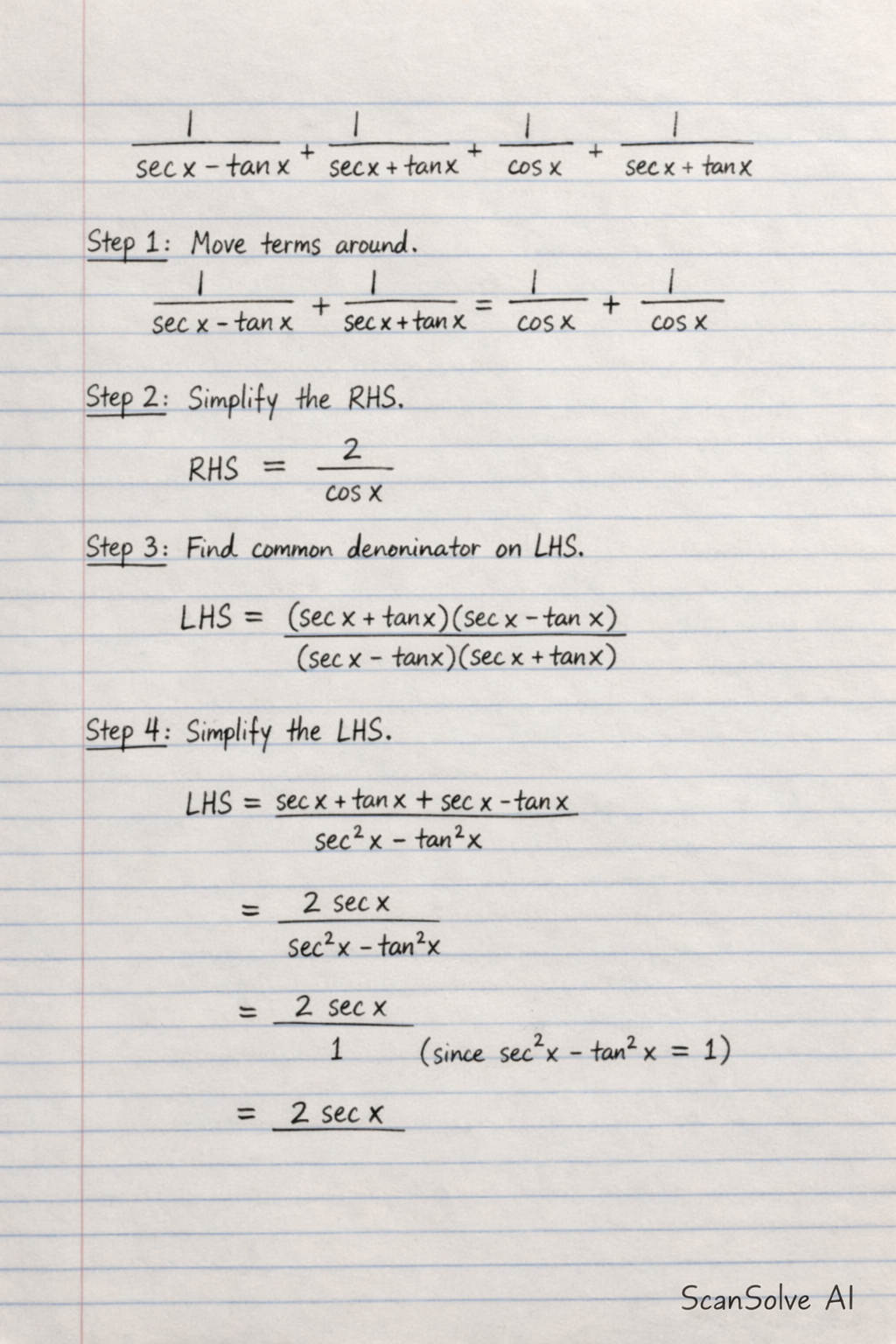
Handwritten Step-by-Step Solution
Get this as a handwritten image on WhatsApp — like a tutor wrote it for you.
Try on WhatsApp