
We read your photo as:
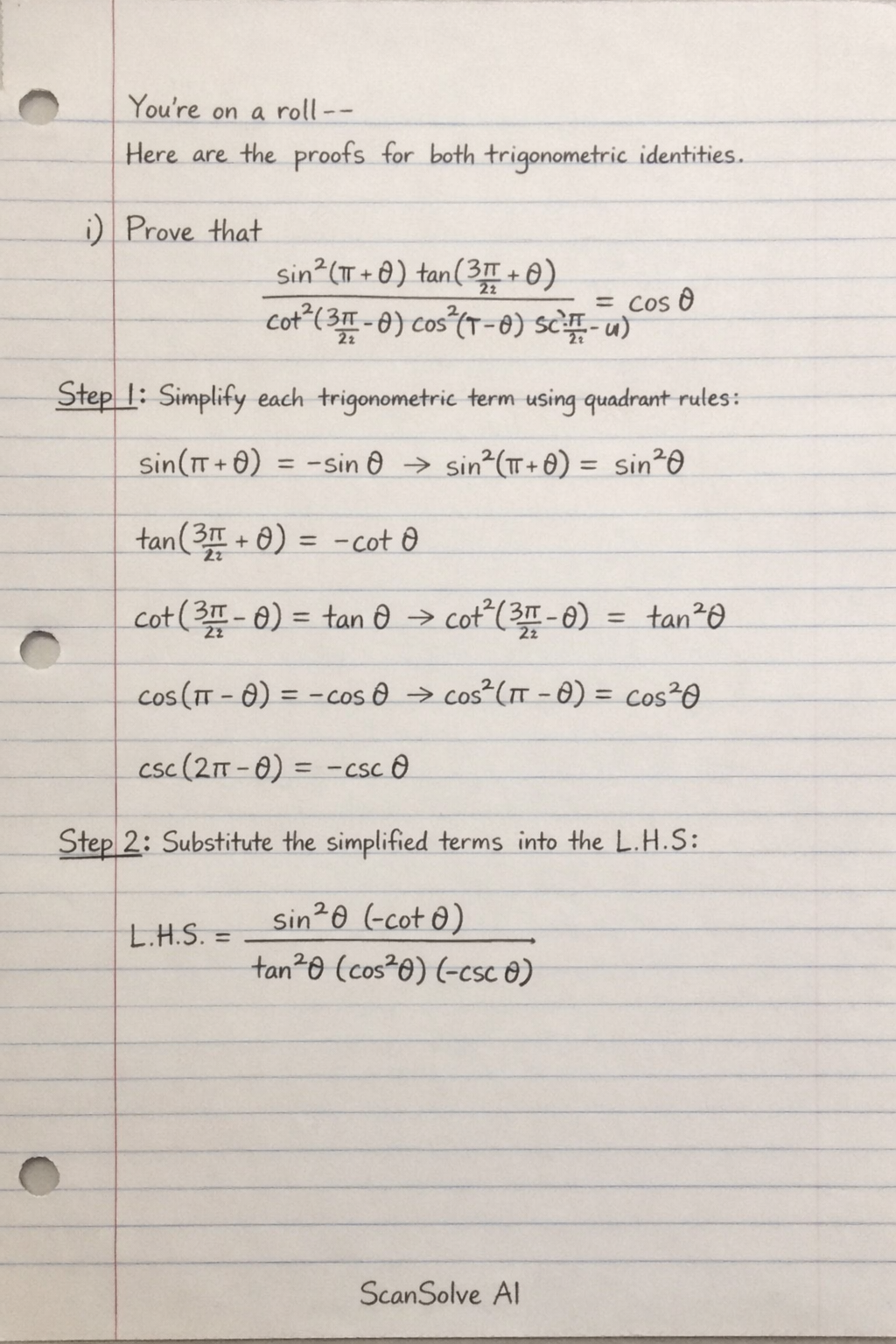
Prove that (2(pi + theta) (3pi)/(2) + theta)2((3pi)/(2) - theta) 2(pi - theta) (2pi - theta) =
Mathematics
ScanSolve AI Answer
Step-by-step solution
9 stepsHere are the proofs for both trigonometric identities.
Part i· 5 steps
Prove that
Simplify each trigonometric term using quadrant rules.
Substitute the simplified terms into the Left Hand Side (L.H.S.).
Simplify the expression.
The negative signs cancel out:
Express , , and in terms of and .
Recall that , , and .
Cancel common terms.
In the numerator: .
In the denominator: .This is equal to the Right Hand Side (R.H.S.).
Therefore, .
Part ii· 4 steps
Prove that
Simplify each trigonometric term using quadrant rules.
- (since is an even function)
Substitute the simplified terms into the Left Hand Side (L.H.S.).
Simplify the expression.
Multiply the terms in the numerator: .
Multiply the terms in the denominator: .Cancel common terms.
Assuming , , and :
This is equal to the Right Hand Side (R.H.S.).
Therefore, .
Was this helpful?
Still stuck on this one?
Ask a follow-up, and the answer starts from this question.
Got a different question?Ask your own question
More Mathematics Questions
QProve the Identity: ( theta + 2theta * theta)/( theta) = thetaQProve (3 A − 3 A)/( A − A) = 1 + (1)/(2) 2A and solve 42 theta = 3 for 0^ <= theta <= (pi^c)/(2).QProve the identity ( theta)/(1- theta) + ( theta)/(1- theta) = theta + theta.QProve the identity ( 3theta - 3theta)/(1 − 2 2theta) = theta + theta. Identify any errors in the…QProve the trigonometric identity: sin(3θ)/sin θ - cos(3θ)/cos θ = 2
Handwritten Step-by-Step Solution
Get this as a handwritten image on WhatsApp — like a tutor wrote it for you.
Try on WhatsApp