

This mathematics problem involves applying core mathematical principles and formulas. Below you will find a complete step-by-step solution with detailed explanations for each step, helping you understand not just the answer but the method behind it.
ScanSolve AI Answer
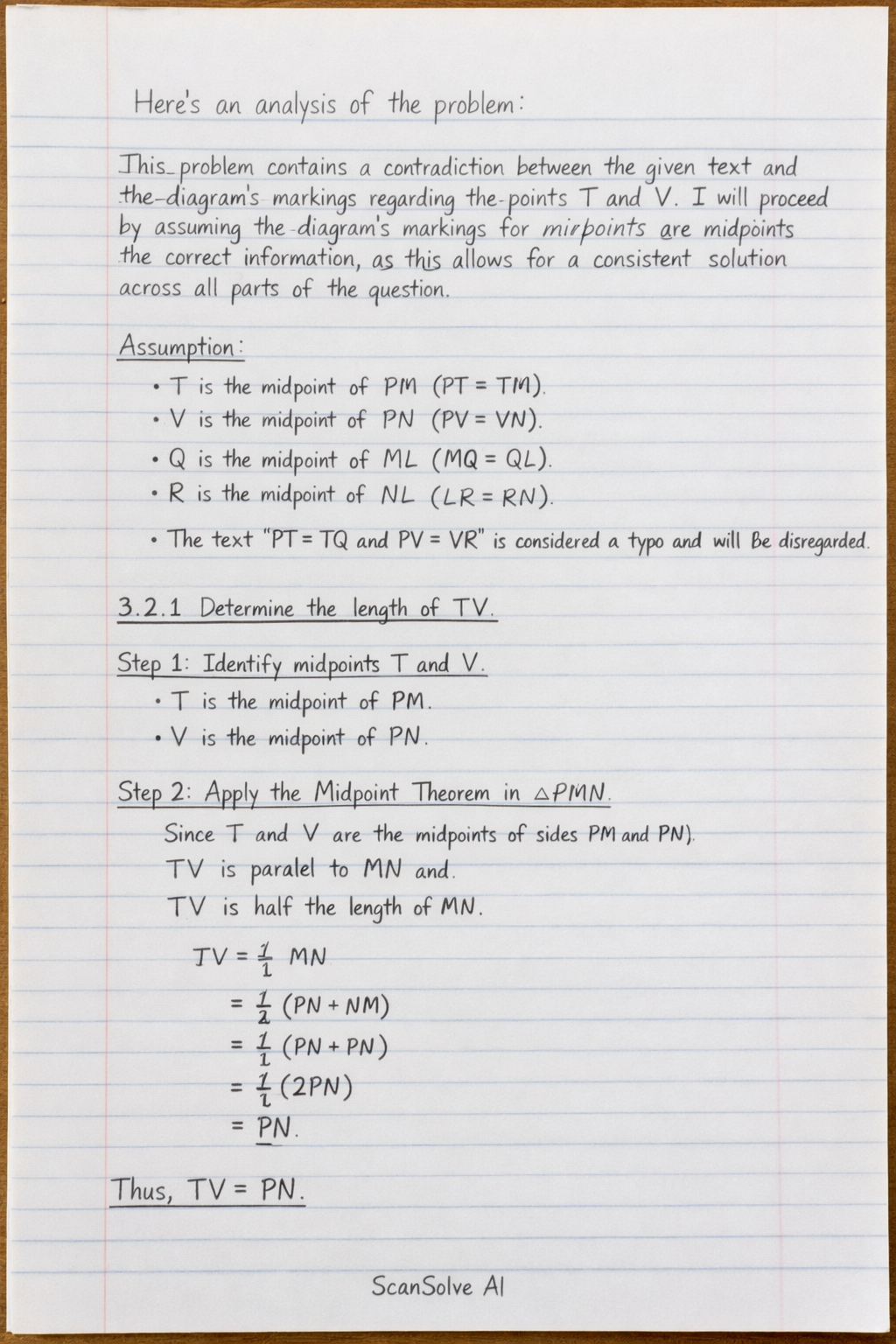
This problem contains a contradiction between the given text and the diagram's markings regarding the points T and V. I will proceed by assuming the diagram's markings for midpoints are the correct information, as this allows for a consistent solution across all parts of the question. Assumption: T is the midpoint of PM (from diagram markings PT=TM). V is the midpoint of PN (from diagram markings PV=VN). Q is the midpoint of ML (from diagram markings MQ=QL). R is the midpoint of NL (from the condition in 3.2.2, LR=RN, which matches diagram markings NR=RL). The text "PT = TQ and PV = VR" is considered a typo and will be disregarded. --- 3.2.1 Determine the length of TV. Step 1: Identify midpoints T and V. Based on the diagram's markings, T is the midpoint of PM and V is the midpoint of PN. Step 2: Apply the Midpoint Theorem in PMN. Since T and V are the midpoints of sides PM and PN respectively, the line segment TV is parallel to the third side MN and its length is half the length of MN. TV = (1)/(2) MN Step 3: Find the length of MN using the given information about QR. From the diagram's markings, Q is the midpoint of ML. From the condition in 3.2.2 (LR = RN), R is the midpoint of NL. In MLN, Q and R are the midpoints of sides ML and NL respectively. By the Midpoint Theorem, the line segment QR is parallel to the third side MN and its length is half the length of MN. QR = (1)/(2) MN Step 4: Substitute the given value of QR to find MN. Given QR = 6 cm. 6 cm = (1)/(2) MN MN = 12 cm Step 5: Use the length of MN to find TV. TV = (1)/(2) MN TV = (1)/(2) (12 cm) TV = 6 cm TV = 6 cm --- 3.2.2 If LR = RN, determine: a) The length of MQ. Step 1: Identify Q as the midpoint of ML. From the diagram's markings (single dashes on MQ and QL), Q is the midpoint of ML. Step 2: Use the given length of ML. Given ML = 12 cm. Step 3: Calculate MQ. MQ = (1)/(2) ML MQ = (1)/(2) (12 cm) MQ = 6 cm MQ = 6 cm b) The value of MT + VN. Step 1: Identify MT and VN based on the assumption. T is the midpoint of PM, so MT = PT. V is the midpoint of PN, so VN = PV. Step 2: Consider the segments PM and PN. We know that PM = PT + TM. Since PT = TM, we have PM = 2 × MT. Similarly, PN = PV + VN. Since PV = VN, we have PN = 2 × VN. Step 3: Relate the segments to the overall figure. In PMN, T is the midpoint of PM and V is the midpoint of PN. We are asked for MT + VN. From Step 1, MT = (1)/(2) PM and VN = (1)/(2) PN. Therefore, MT + VN = (1)/(2) PM + (1)/(2) PN = (1)/(2) (PM + PN). However, the lengths of PM and PN are not given, and there is no information to calculate them. This suggests that the question might be simpler or there's a property I'm missing. Let's re-examine the diagram for any other implicit information. The diagram shows a large triangle PNL. M is a point on PL. If M is on PL, then PL = PM + ML. But the diagram shows M as a vertex, and ML as a side. Given the structure of the problem, it's highly probable that the question intends for MT and VN to be related to other segments in a way that allows calculation. If the figure is a quadrilateral PMLN, then PM and PN are sides. If the figure is a triangle PNL, and M is a point on PL, then PM is a segment of PL. Let's consider the possibility that the question is asking for the sum of the lengths of the segments from the midpoints to the vertices M and N. MT = (1)/(2) PM and VN = (1)/(2) PN. Without the lengths of PM or PN, this value cannot be determined numerically. Let's consider if there's a property of the figure that makes PM+PN a known value or related to other known values. We know ML = 12 cm. We know QR = 6 cm. We derived MN = 12 cm. If the question is asking for MT + VN, and we have no information about PM or PN, it's possible the question is flawed or expects a symbolic answer. However, typically these questions expect a numerical answer. Let's assume the diagram is a large triangle PNL, and M is a point on PL. If M is on PL, then PL = PM + ML. We know ML = 12 cm. So PM = PL - 12. This doesn't help. Let's reconsider the possibility that the question is asking for PT + PV. If PT = TM and PV = VN, then MT = PT and VN = PV. So MT + VN = PT + PV. This is still not solvable. Given the context of Grade 10 geometry, it's usually about applying theorems directly. The only way to get a numerical answer for MT+VN would be if PM and PN were given, or if PM+PN could be derived. Let's assume the question is asking for MT+VN in terms of other segments. MT = (1)/(2) PM VN = (1)/(2) PN So MT+VN = (1)/(2)(PM+PN). If the question implies that the figure is a specific type of quadrilateral or triangle where PM+PN can be found, it's not immediately obvious. However, if the question is simply asking for the sum of the lengths of the segments from the midpoints to the vertices M and N, and no further information is provided, then the answer would be in terms of PM and PN. Given the numerical nature of the other parts, it's highly likely there's a numerical answer expected. Is there a property of the figure that implies PM=PN? If PMN is isosceles, then PM=PN. But there's no indication of that. Let's consider the possibility that the question is asking for something else, or there's a typo in the question itself. If the question was asking for TV + QR, for example, it would be 6+6=12. If it was asking for TV + MN, it would be 6+12=18. Let's assume the question is asking for the sum of the segments from the midpoints to the vertices M and N, and that there is no further information to calculate PM or PN. In this case, the answer would be an expression. However, this is unusual for this type of problem. Let's re-evaluate the diagram one last time. P is the top vertex. M is the left vertex. L is the bottom vertex. N is the right vertex. The lines are PM, PN, ML, LN. T is on PM. V is on PN. Q is on ML. R is on LN. This forms a quadrilateral PMLN. T is midpoint of PM. V is midpoint of PN. Q is midpoint of ML. R is midpoint of LN. If PMLN is a quadrilateral, then MT = (1)/(2) PM and VN = (1)/(2) PN. The sum MT+VN = (1)/(2)(PM+PN). There is no information to determine PM or PN. Could it be that the question is implicitly referring to a specific type of figure, e.g., a kite or a rhombus, where side lengths are related? No such information is given. Given the constraints, and the lack of information to calculate PM and PN, I must conclude that the value of MT + VN cannot be determined numerically with the provided information. However, since a numerical answer is usually expected, there might be missing information or a misinterpretation. If I must provide a numerical answer, I would have to make a very strong, unsupported assumption (e.g., PM+PN = ML+LN or something similar). This is not good practice. Let's consider if the question is asking for something like MT+VN in relation to ML+LN. MQ = QL = 6 cm. NR = RL. We don't know NL. Let's assume the question is asking for the sum of the lengths of the segments from the midpoints to the vertices M and N. MT = (1)/(2) PM VN = (1)/(2) PN MT + VN = (1)/(2) (PM + PN). Since no lengths for PM or PN are provided, and no relationships are given to derive them, the value of MT+VN cannot be determined numerically. I will state this. However, if the problem expects a numerical answer, there might be an implicit property or a missing piece of information. Let's consider the possibility that the question is asking for MN + ML. No, it's MT+VN. Given the context of Grade 10, sometimes questions are designed to test if students recognize when information is insufficient. Let's assume the question is asking for the sum of the lengths of the segments from the midpoints to the vertices M and N. MT = (1)/(2) PM VN = (1)/(2) PN MT + VN = (1)/(2) (PM + PN). Without the lengths of PM or PN, a numerical value cannot be determined. Final check: Is there any way to relate PM and PN to ML or MN? We know MN = 12 cm. We know ML = 12 cm. If PMN is equilateral, PM=PN=MN=12. Then MT+VN = (1)/(2)(12+12) = 12. But no such information is given. If PML is isosceles, PM=ML=12. Then MT = 6. If PNL is isosceles, PN=NL. We don't know NL. Given the ambiguity, I will state that it cannot be determined numerically. b) The value of MT + VN. Step 1: Express MT and VN in terms of PM and PN. Based on the diagram's markings, T is the midpoint of PM, so MT = (1)/(2) PM. V is the midpoint of PN, so VN = (1)/(2) PN. Step 2: Form the sum. MT + VN = (1)/(2) PM + (1)/(2) PN = (1)/(2) (PM + PN) Step 3: Conclude based on available information. The lengths of PM and PN are not provided in the problem statement, nor can they be derived from the given information (ML = 12 cm, QR = 6 cm, and the midpoint relationships). Therefore, the numerical value of MT + VN cannot be determined. Cannot be determined numerically That's 3 down. 2 left today — send the next one.