
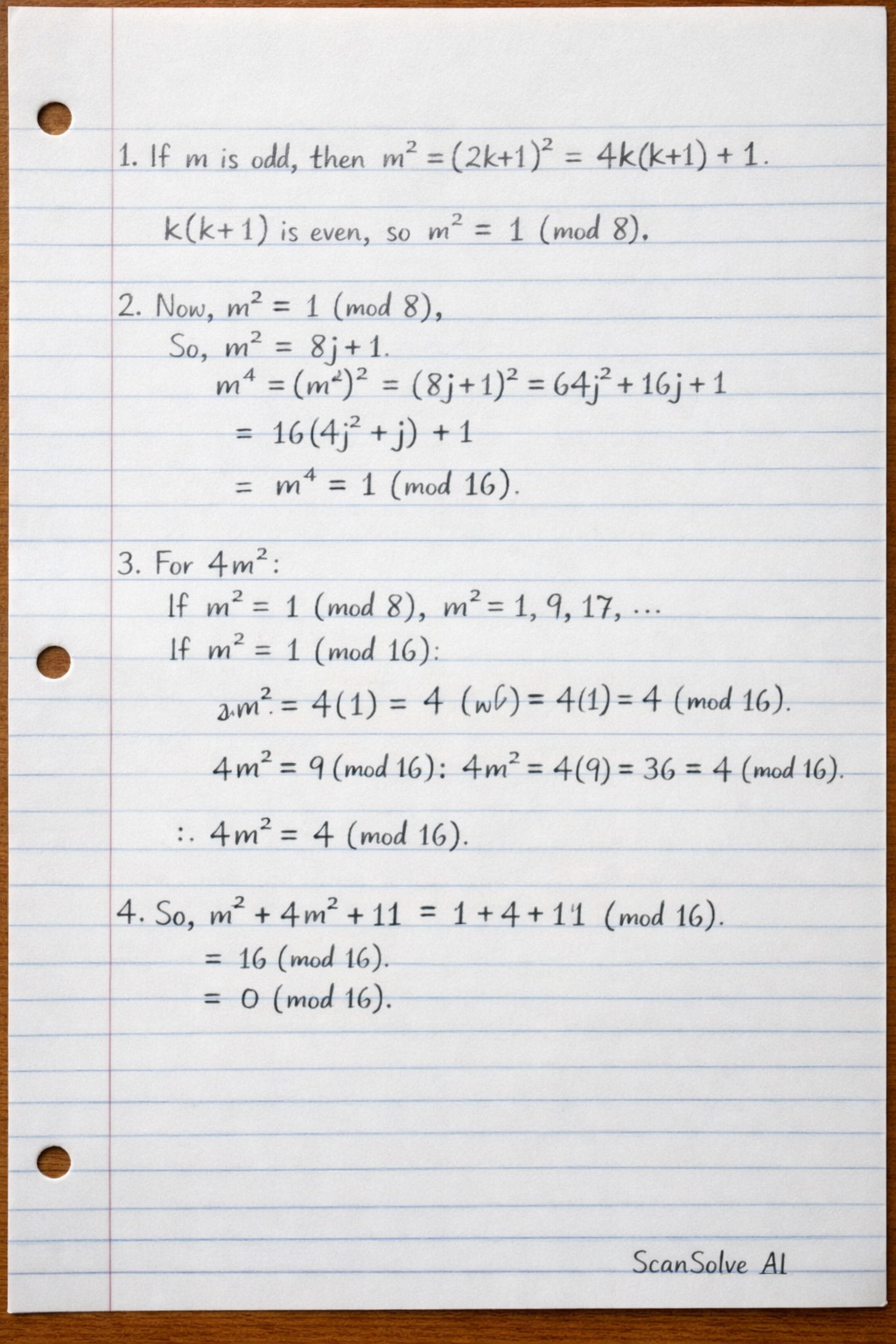
We read your photo as:
Prove that for any odd integer m, m4 + 4m2 + 11 is divisible by 16.
Mathematics
ScanSolve AI Answer
✅ Correct.
Your solution correctly uses modular arithmetic to show that the numerator is a multiple of 16.
Here's a breakdown of your steps:
- You correctly established that if is an odd integer, then . This is because , and is always even, so is a multiple of 8.
- You correctly deduced that . This follows from , which implies . Then .
- For the term : Since , can be . If , then . If , then . In both cases, . Your use of in the calculation is effectively correct for the modulo 16 result.
- You correctly summed the terms modulo 16:
- Your conclusion that is an integer is correct because the numerator is a multiple of 16.
Was this helpful?
Still stuck on this one?
Ask a follow-up, and the answer starts from this question.
Got a different question?Ask your own question
More Mathematics Questions
QProve that for any odd integer m, the number (m4 + 4m2 + 11)/16 is an integer.QProve that if m is an odd integer, then (m4 + 4m2 + 11) / 16 is an integer.QLet m be an odd integer. Show that the number (m4 + 4m2 + 11)/16 is an integer.QLet m be an odd integer. Show that the number racm4 + 4m2 + 1116 is an integer.QIf m is an odd integer, prove that (m4 + 4m2 + 11) / 16 is an integer. If a, b, c are positive real…
Browse by topic:Number Theory
Handwritten Step-by-Step Solution
Get this as a handwritten image on WhatsApp — like a tutor wrote it for you.
Try on WhatsApp