
We read your photo as:
Prove that if m is an odd integer, then (m4 + 4m2 + 11) / 16 is an integer.
Mathematics
ScanSolve AI Answer
Answer
Let be an odd integer. We can write for some integer .
First, find :
Since is always an even number (product of two consecutive integers), let for some integer .
So, .
Next, find :
Let , which is an integer. So, .
Now, substitute and into the given expression:
Factor out 16 from the numerator:
Since and are integers, their sum is also an integer.
Therefore, the number is an integer.
Was this helpful?
Try one yourself
A new problem that tests the same skill.
Still stuck on this one?
Ask a follow-up, and the answer starts from this question.
Got a different question?Ask your own question
More Mathematics Questions
QProve that for any odd integer m, m4 + 4m2 + 11 is divisible by 16.QLet m be an odd integer. Show that the number (m4 + 4m2 + 11)/16 is an integer.QIf m is an odd integer, prove that (m4 + 4m2 + 11) / 16 is an integer. If a, b, c are positive real…QLet m be an odd integer. Show that the number racm4 + 4m2 + 1116 is an integer.
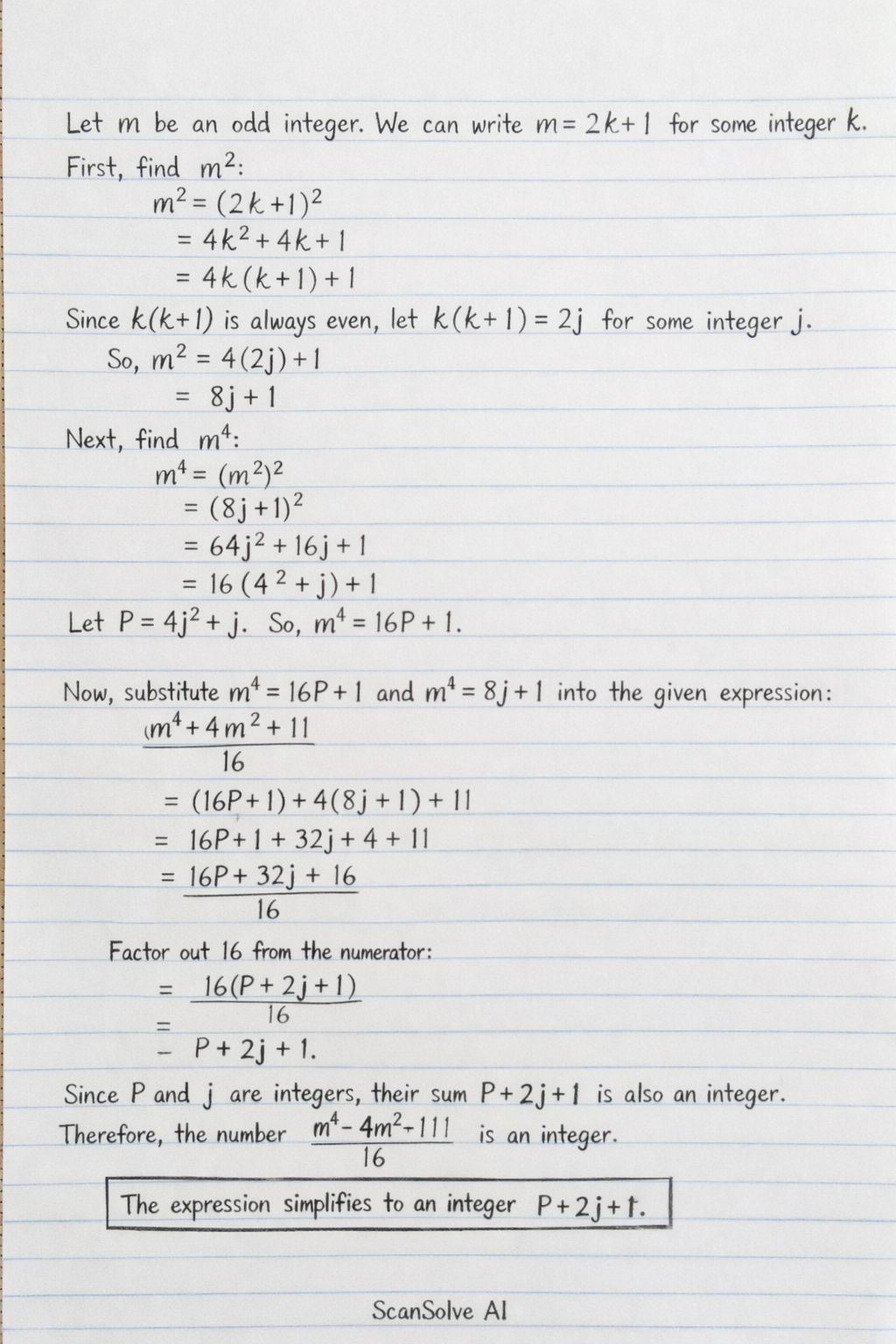
Handwritten Step-by-Step Solution
Get this as a handwritten image on WhatsApp — like a tutor wrote it for you.
Try on WhatsApp