
We read your photo as:
Prove that M is the midpoint of LN, given that LM is a diameter, NP is perpendicular to LP, and R is the midpoint of LP.
ScanSolve AI Answer
Step-by-step solution
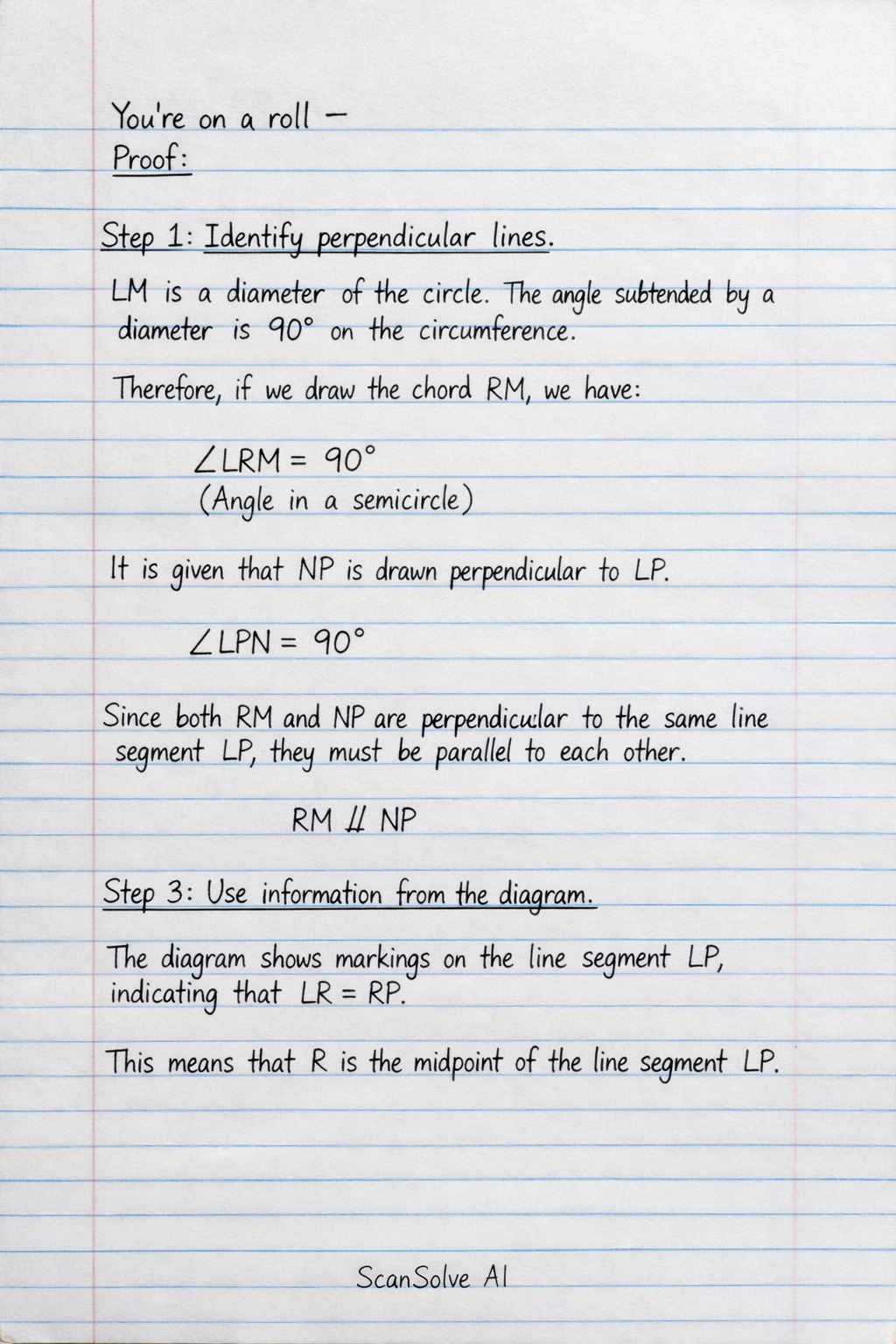
5 stepsProof:
Identify perpendicular lines.
LM is a diameter of the circle. The angle subtended by a diameter at any point on the circumference is .
Therefore, if we draw the chord RM, we have:(Angle in a semicircle)
It is given that NP is drawn perpendicular to LP.
Deduce parallel lines.
Since both RM and NP are perpendicular to the same line segment LP, they must be parallel to each other.
Use information from the diagram.
The diagram shows markings on the line segment LP, indicating that .
This means that R is the midpoint of the line segment LP.Apply the converse of the Midpoint Theorem.
Consider .
- R is the midpoint of side LP (from Step 3).
- RM is a line segment drawn from R, parallel to side NP (from Step 2), and it intersects side LN at M. According to the converse of the Midpoint Theorem, if a line passes through the midpoint of one side of a triangle and is parallel to another side, then it bisects the third side. Therefore, M must be the midpoint of the line segment LN.
Conclude the proof.
If M is the midpoint of LN, then the length of LM is equal to the length of MN.
This completes the proof.
Still stuck on this one?
Ask a follow-up, and the answer starts from this question.
More Mathematics Questions
Handwritten Step-by-Step Solution
Get this as a handwritten image on WhatsApp — like a tutor wrote it for you.
Try on WhatsApp