
We read your photo as:
Prove that n! yper extge 2ⁿ-1 for all n yper extge 1.
ScanSolve AI Answer
Step-by-step solution
4 stepsHere is the solution to the problem.
Question 10: Prove that for all .
We will prove this by mathematical induction.
Let be the statement "".
Base Case ().
For , we check if is true.
Left Hand Side (LHS): .
Right Hand Side (RHS): .
Since , the statement is true.Inductive Hypothesis.
Assume that is true for some positive integer .
This means we assume .Inductive Step.
We need to prove that is true, i.e., , which simplifies to .
Consider the Left Hand Side of :By the definition of factorial, .
From our inductive hypothesis, we know that .
Substitute this into the expression:Now, we need to show that .
We know that .
So, we need to show that .
Since is a positive value for , we can divide both sides of the inequality by without changing the direction of the inequality:Since is a positive integer and , it follows that , so .
This inequality is true for all .
Therefore, we have shown that .
Thus, .
This proves that is true.Conclusion.
By the principle of mathematical induction, the statement is true for all positive integers .
Still stuck on this one?
Ask a follow-up, and the answer starts from this question.
More Mathematics Questions
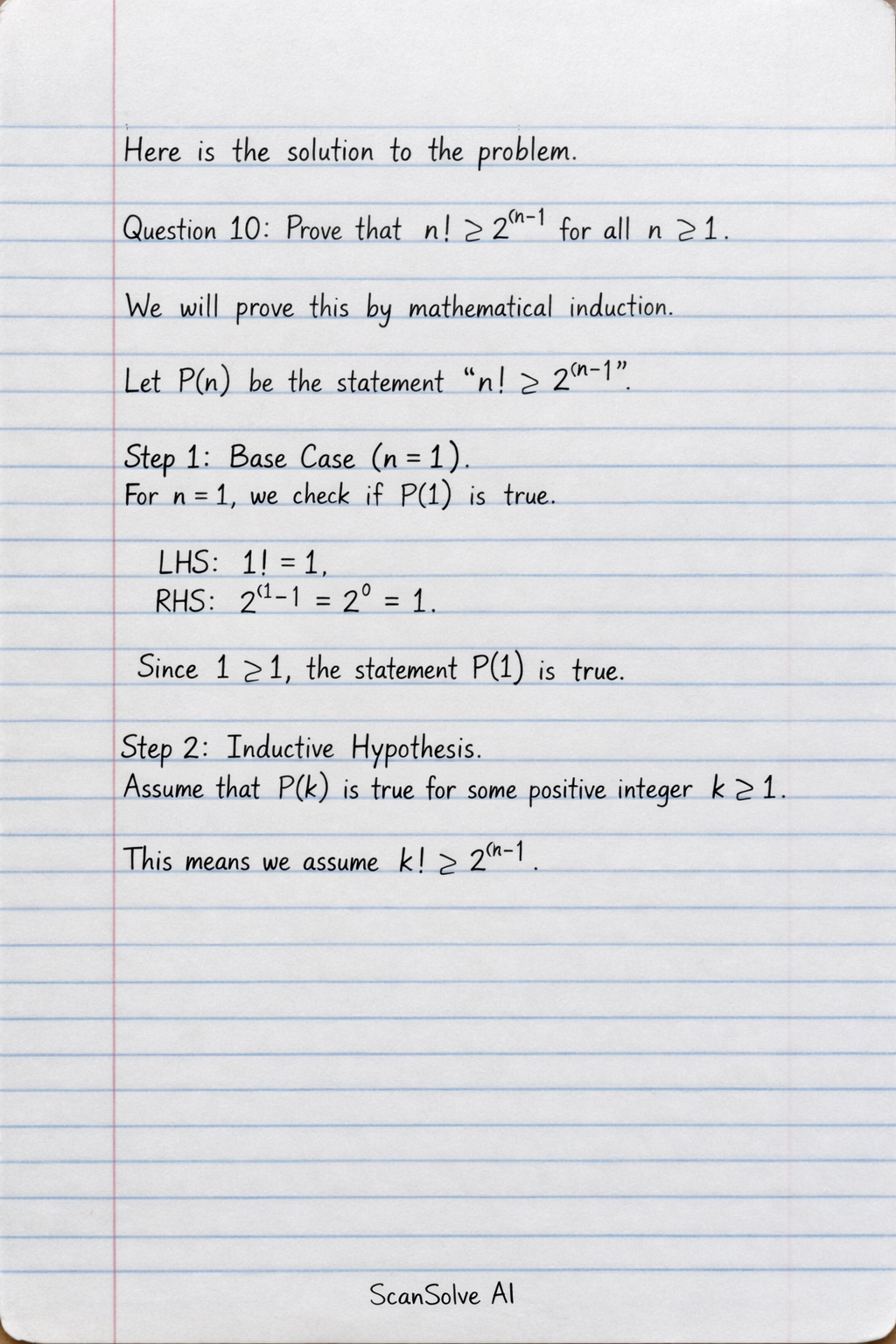
Handwritten Step-by-Step Solution
Get this as a handwritten image on WhatsApp — like a tutor wrote it for you.
Try on WhatsApp