We read your photo as:

Prove that (sin(90-θ) cos(90-θ) + tan(90-θ)) / (cos(90-θ) sin(90-θ) + cot(90-θ)) = cosec θ

Mathematics

ScanSolve AI Answer

Answer

Shown:

(sin(90-θ) cos(90-θ) + tan(90-θ)) / (cos(90-θ) sin(90-θ) + cot(90-θ)) = cosec θ

Step-by-step solution

7 steps

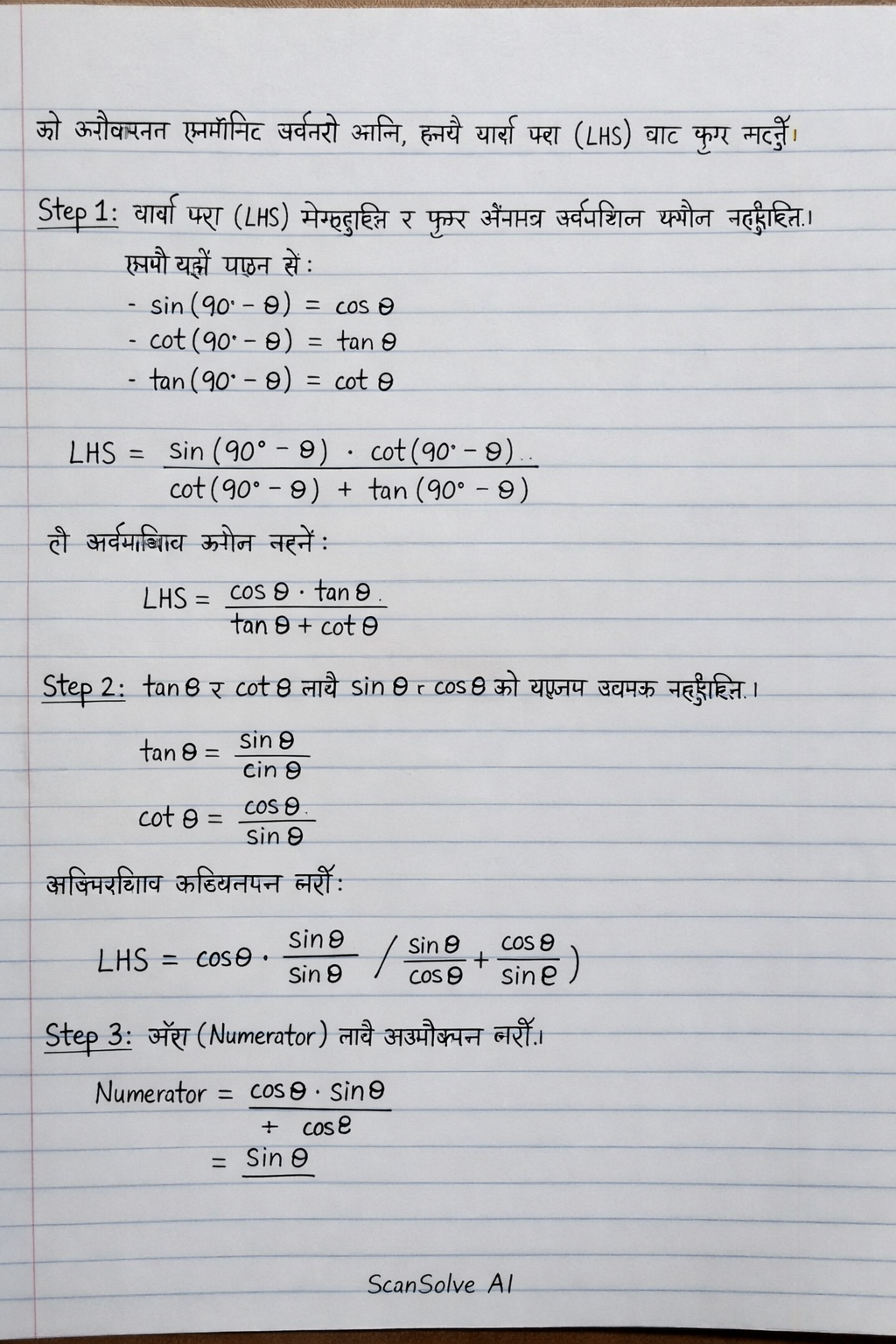
यो समीकरण प्रमाणित गर्नको लागि, हामी बायाँ पक्ष (LHS) बाट सुरु गर्छौं।

  1. बायाँ पक्ष (LHS) लेख्नुहोस् र पूरक कोणका सर्वसमिका (complementary angle identities) प्रयोग गर्नुहोस्।

    हामीलाई थाहा छ:

    • sin⁡(90∘−θ)=cos⁡θ\sin(90^\circ - \theta) = \cos\theta
    • cot⁡(90∘−θ)=tan⁡θ\cot(90^\circ - \theta) = \tan\theta
    • tan⁡(90∘−θ)=cot⁡θ\tan(90^\circ - \theta) = \cot\theta
    LHS=sin⁡(90∘−θ)⋅cot⁡(90∘−θ)cot⁡(90∘−θ)+tan⁡(90∘−θ)\text{LHS} = \frac{\sin(90^\circ - \theta) \cdot \cot(90^\circ - \theta)}{\cot(90^\circ - \theta) + \tan(90^\circ - \theta)}

    यी सर्वसमिका प्रयोग गर्दा:

    LHS=cos⁡θ⋅tan⁡θtan⁡θ+cot⁡θ\text{LHS} = \frac{\cos\theta \cdot \tan\theta}{\tan\theta + \cot\theta}
  2. tan⁡θ\tan\theta र cot⁡θ\cot\theta लाई sin⁡θ\sin\theta र cos⁡θ\cos\theta को रूपमा व्यक्त गर्नुहोस्।

    tan⁡θ=sin⁡θcos⁡θ\tan\theta = \frac{\sin\theta}{\cos\theta} cot⁡θ=cos⁡θsin⁡θ\cot\theta = \frac{\cos\theta}{\sin\theta}

    अभिव्यक्तिमा प्रतिस्थापन गर्नुहोस्:

    LHS=cos⁡θ⋅sin⁡θcos⁡θsin⁡θcos⁡θ+cos⁡θsin⁡θ\text{LHS} = \frac{\cos\theta \cdot \frac{\sin\theta}{\cos\theta}}{\frac{\sin\theta}{\cos\theta} + \frac{\cos\theta}{\sin\theta}}
  3. अंश (numerator) लाई सरलीकरण गर्नुहोस्।

    Numerator=cos⁡θ⋅sin⁡θcos⁡θ=sin⁡θ\text{Numerator} = \cos\theta \cdot \frac{\sin\theta}{\cos\theta} = \sin\theta
  4. हर (denominator) लाई सरलीकरण गर्नुहोस्।

    Denominator=sin⁡θcos⁡θ+cos⁡θsin⁡θ\text{Denominator} = \frac{\sin\theta}{\cos\theta} + \frac{\cos\theta}{\sin\theta}

    साझा हर (common denominator) sin⁡θcos⁡θ\sin\theta \cos\theta लिएर:

    Denominator=sin⁡2θ+cos⁡2θsin⁡θcos⁡θ\text{Denominator} = \frac{\sin^2\theta + \cos^2\theta}{\sin\theta \cos\theta}

    पाइथागोरसको सर्वसमिका (Pythagorean identity) sin⁡2θ+cos⁡2θ=1\sin^2\theta + \cos^2\theta = 1 प्रयोग गर्दा:

    Denominator=1sin⁡θcos⁡θ\text{Denominator} = \frac{1}{\sin\theta \cos\theta}
  5. सरलीकृत अंश र हरलाई मूल भिन्नमा राख्नुहोस्।

    LHS=sin⁡θ1sin⁡θcos⁡θ\text{LHS} = \frac{\sin\theta}{\frac{1}{\sin\theta \cos\theta}}
  6. जटिल भिन्नलाई सरलीकरण गर्नुहोस्।

    LHS=sin⁡θ⋅(sin⁡θcos⁡θ)\text{LHS} = \sin\theta \cdot (\sin\theta \cos\theta) LHS=sin⁡2θcos⁡θ\text{LHS} = \sin^2\theta \cos\theta
  7. बायाँ पक्ष (LHS) लाई दायाँ पक्ष (RHS) सँग तुलना गर्नुहोस्।

    हामीले LHS लाई sin⁡2θcos⁡θ\sin^2\theta \cos\theta मा सरलीकरण गर्यौं।
    दिइएको दायाँ पक्ष (RHS) cos⁡2θ\cos^2\theta हो।
    सामान्यतया, sin⁡2θcos⁡θ\sin^2\theta \cos\theta सबै θ\theta मानहरूको लागि cos⁡2θ\cos^2\theta बराबर हुँदैन (यसको लागि sin⁡2θ=cos⁡θ\sin^2\theta = \cos\theta हुनुपर्छ, जुन एक सामान्य सर्वसमिका होइन)।
    तसर्थ, दिइएको समीकरण एक सामान्य सर्वसमिका होइन।

    सरलीकृत बायाँ पक्ष हो:

    sin⁡2θcos⁡θ\boxed{\sin^2\theta \cos\theta}

    यो दिएको दायाँ पक्ष cos⁡2θ\cos^2\theta सँग मेल खाँदैन।

Was this helpful?

Still stuck on this one?

Ask a follow-up, and the answer starts from this question.

Got a different question?Ask your own question
Handwritten step-by-step solution preview

Handwritten Step-by-Step Solution

Get this as a handwritten image on WhatsApp — like a tutor wrote it for you.

Try on WhatsApp