
We read your photo as:
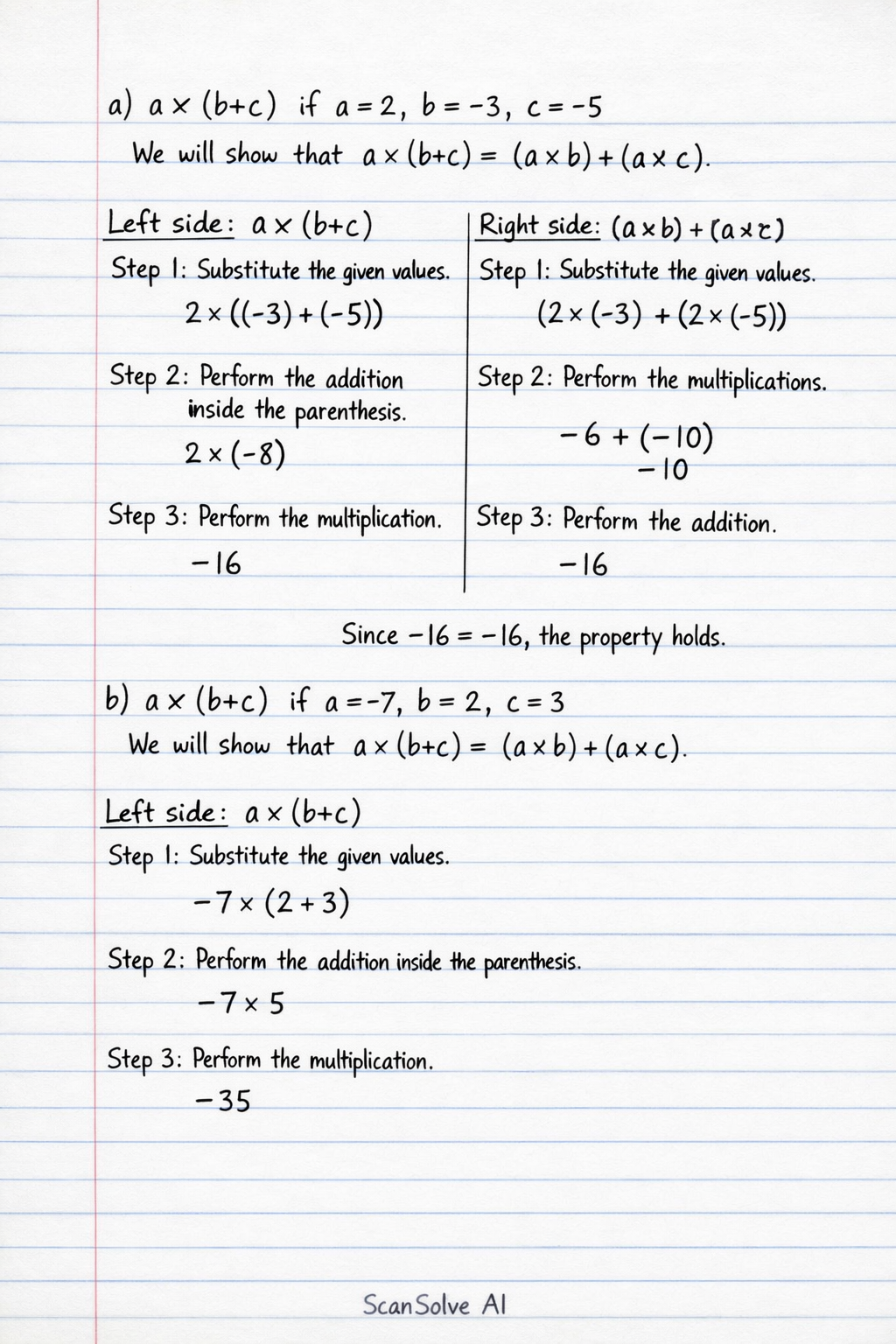
Show that the distributive property of multiplication over addition holds true for the given values: a (b + c) = (a b) + (a * c)
Mathematics
ScanSolve AI Answer
Answers
2 partsStep-by-step solution
31 stepshere are the calculations:
Part a· 6 steps
if
We will show that .
Left side:
Substitute the given values.
Perform the addition inside the parenthesis.
Perform the multiplication.
Right side:
Substitute the given values.
Perform the multiplications.
Perform the addition.
Since , the property holds.
Part b· 6 steps
if
We will show that .
Left side:
Substitute the given values.
Perform the addition inside the parenthesis.
Perform the multiplication.
Right side:
Substitute the given values.
Perform the multiplications.
Perform the addition.
Since , the property holds.
Part c· 6 steps
if
We will show that .
Left side:
Substitute the given values.
Perform the addition inside the parenthesis.
Perform the multiplication.
Right side:
Substitute the given values.
Perform the multiplications.
Perform the addition.
Since , the property holds.
Part d-22
if
Substitute the given values into the expression.
Perform the multiplication.
Perform the additions from left to right.
Perform the final addition.
Part e· 6 steps
if
We will show that .
Left side:
Substitute the given values.
Perform the addition inside the parenthesis.
Perform the multiplication.
Right side:
Substitute the given values.
Perform the multiplications.
Perform the addition.
Since , the property holds.
Part f-7
if
Substitute the given values into the expression.
Perform the multiplications.
Perform the addition.
Was this helpful?
Try one yourself
A new problem that tests the same skill.
Still stuck on this one?
Ask a follow-up, and the answer starts from this question.
Got a different question?Ask your own question
More Mathematics Questions
QGiven a=10, b=200, and c=3000, verify the commutative and associative properties for addition and…QShow that | a.b c | | a2 b3 c3 | | a3 b2 c2 | = abc(a-b)(b-c)(c-a)QApply the associative property of addition to solve for the final value in the following problems…QSimplify the following expressions using the commutative and associative properties of addition.QGiven matrices A, B, and C, verify the associative property of matrix addition: (A+B)+C = A+(B+C).
Handwritten Step-by-Step Solution
Get this as a handwritten image on WhatsApp — like a tutor wrote it for you.
Try on WhatsApp