

This mathematics problem involves applying core mathematical principles and formulas. Below you will find a complete step-by-step solution with detailed explanations for each step, helping you understand not just the answer but the method behind it.
ScanSolve AI Answer
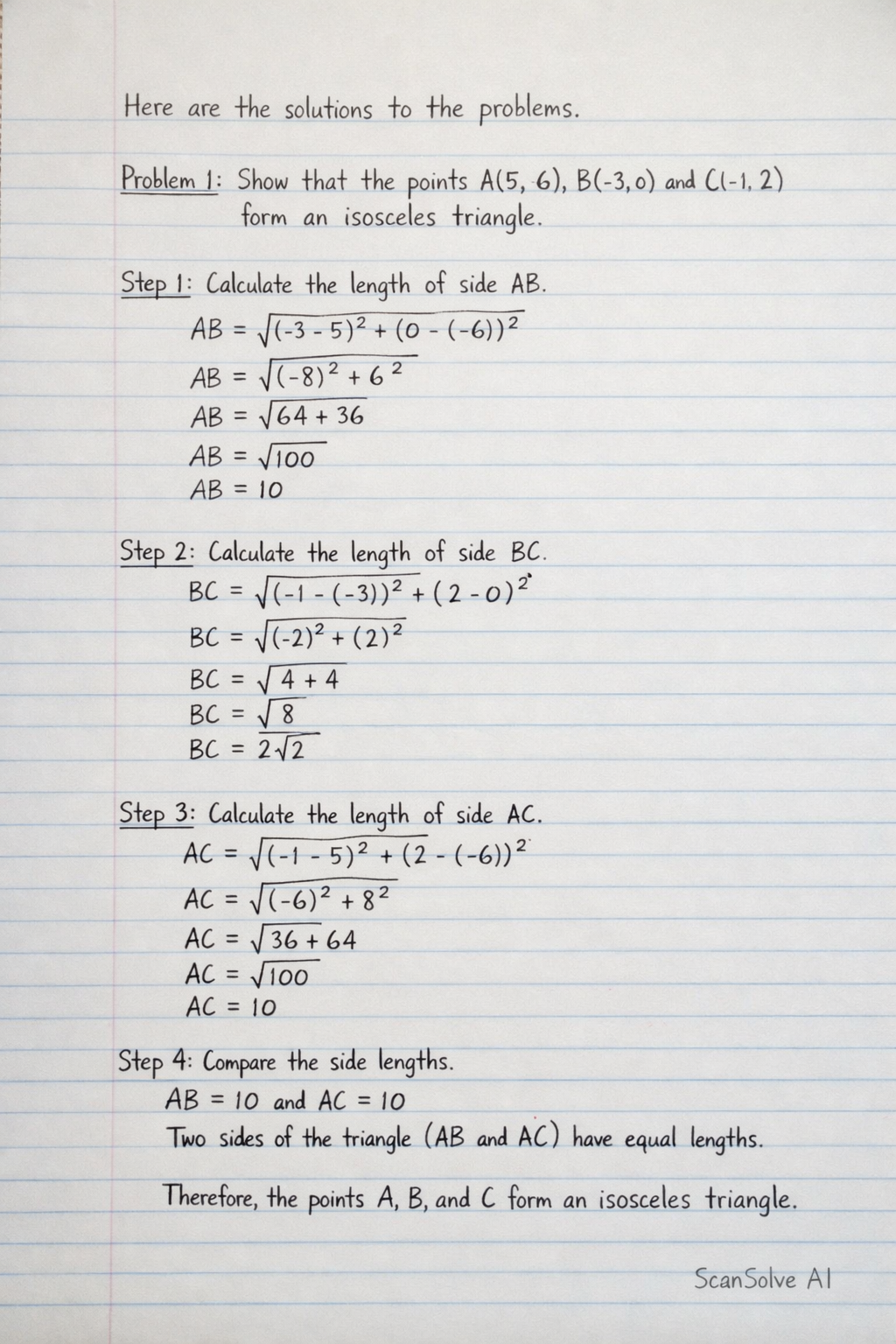
Here are the solutions to the problems. Problem 1: Show that the points A(5, -6), B(-3, 0), and C(-1, 2) form an isosceles triangle. To show that the triangle is isosceles, we need to calculate the lengths of its sides using the distance formula d = sqrt((x_2 - x_1)^2 + (y_2 - y_1)^2). Step 1: Calculate the length of side AB. AB = sqrt((-3 - 5)^2 + (0 - (-6))^2) AB = sqrt((-8)^2 + (6)^2) AB = sqrt(64 + 36) AB = sqrt(100) AB = 10 Step 2: Calculate the length of side BC. BC = sqrt((-1 - (-3))^2 + (2 - 0)^2) BC = sqrt((2)^2 + (2)^2) BC = sqrt(4 + 4) BC = sqrt(8) BC = 2sqrt(2) Step 3: Calculate the length of side AC. AC = sqrt((-1 - 5)^2 + (2 - (-6))^2) AC = sqrt((-6)^2 + (8)^2) AC = sqrt(36 + 64) AC = sqrt(100) AC = 10 Step 4: Compare the side lengths. Since AB = 10 and AC = 10, two sides of the triangle (AB and AC) have equal lengths. Therefore, the points A, B, and C form an isosceles triangle. Problem 2: Show that the points A(-1, 2), B(3, 4), and C(2, -4) form a right-angled triangle and find its area. To show it's a right-angled triangle, we will use the Pythagorean theorem by calculating the square of the lengths of all sides. The area will be calculated using the formula for a right-angled triangle. Step 1: Calculate the square of the length of side AB. AB^2 = (3 - (-1))^2 + (4 - 2)^2 AB^2 = (4)^2 + (2)^2 AB^2 = 16 + 4 AB^2 = 20 Step 2: Calculate the square of the length of side BC. BC^2 = (2 - 3)^2 + (-4 - 4)^2 BC^2 = (-1)^2 + (-8)^2 BC^2 = 1 + 64 BC^2 = 65 Step 3: Calculate the square of the length of side AC. AC^2 = (2 - (-1))^2 + (-4 - 2)^2 AC^2 = (3)^2 + (-6)^2 AC^2 = 9 + 36 AC^2 = 45 Step 4: Check if the Pythagorean theorem holds. The longest side is BC, so we check if AB^2 + AC^2 = BC^2. 20 + 45 = 65 65 = 65 Since AB^2 + AC^2 = BC^2, the triangle ABC is a right-angled triangle with the right angle at A. Step 5: Calculate the area of the triangle. For a right-angled triangle, the area is (1)/(2) × base × height. The base and height are the two sides forming the right angle, which are AB and AC. Area = (1)/(2) × AB × AC Area = (1)/(2) × sqrt(20) × sqrt(45) Area = (1)/(2) × sqrt(20 × 45) Area = (1)/(2) × sqrt(900) Area = (1)/(2) × 30 Area = 15 The area of the triangle is 15 square units. Last free one today — make it count tomorrow, or type /upgrade for unlimited.