
We read your photo as:
Prove that triangle ADC is congruent to triangle ABC (use two different methods). 2. Show that AC bisects DCB.
ScanSolve AI Answer
Answer
Step-by-step solution
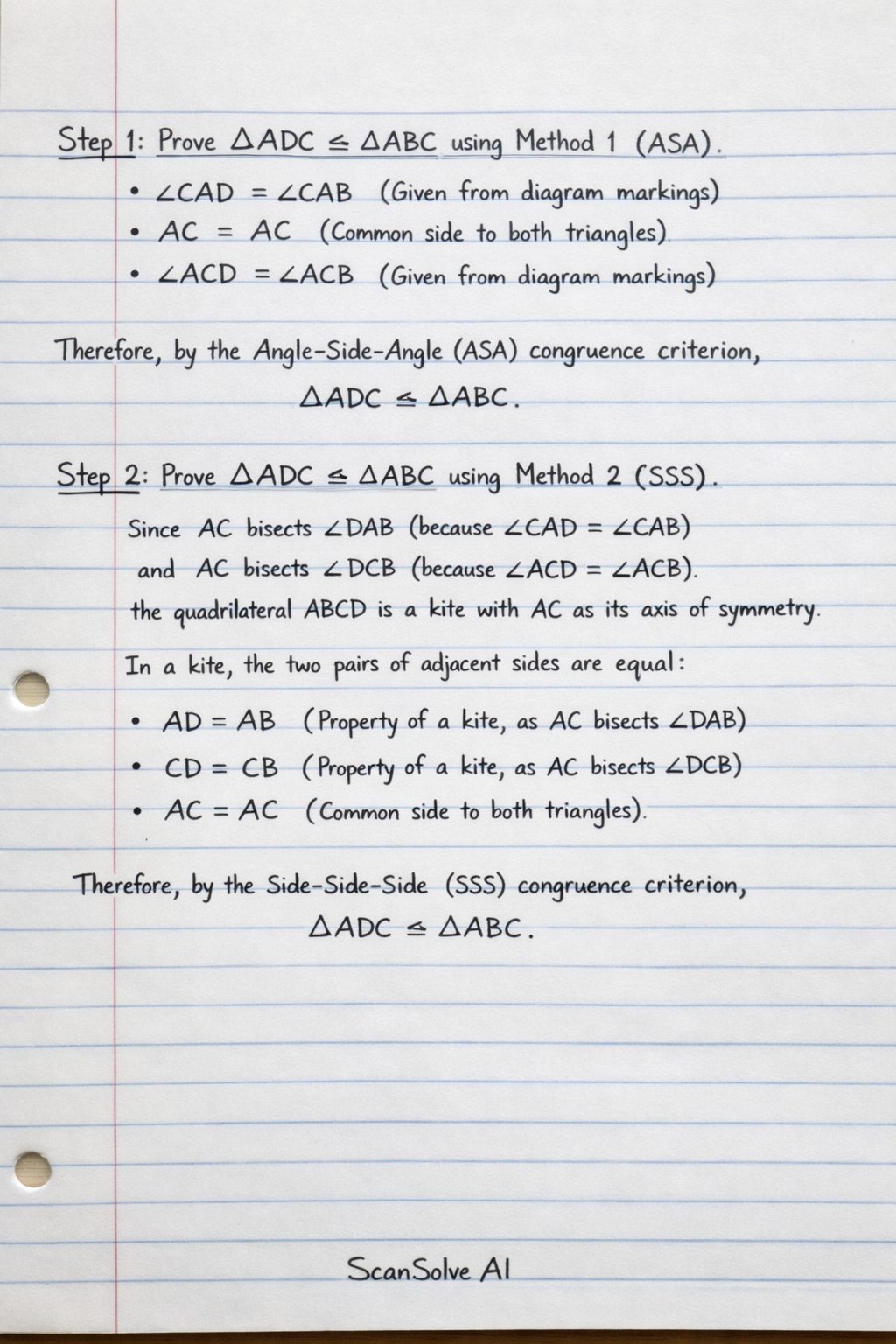
3 stepsProve using Method 1 (ASA).
From the diagram markings, we are given that (marked as and ) and (marked as and ).
- (Given from diagram markings)
- (Common side to both triangles)
- (Given from diagram markings) Therefore, by the Angle-Side-Angle (ASA) congruence criterion, .
Prove using Method 2 (SSS).
Since AC bisects (because ) and AC bisects (because ), the quadrilateral ABCD is a kite with AC as its axis of symmetry. In a kite, the two pairs of adjacent sides are equal.
- (Property of a kite, as AC bisects )
- (Property of a kite, as AC bisects )
- (Common side to both triangles) Therefore, by the Side-Side-Side (SSS) congruence criterion, .
Show that AC bisects .
From Step 1 or Step 2, we have proven that .
By the property of congruent triangles, corresponding parts are equal (CPCTC).
Therefore, the corresponding angles and must be equal.
Since , the line segment AC divides into two equal angles.
Thus, AC bisects .The question labeled "c)" provides information about an isosceles trapezium and a rectangle but does not pose a question to be solved.
Try one yourself
A new problem that tests the same skill.
Still stuck on this one?
Ask a follow-up, and the answer starts from this question.
More Mathematics Questions
Handwritten Step-by-Step Solution
Get this as a handwritten image on WhatsApp — like a tutor wrote it for you.
Try on WhatsApp