
We read your photo as:
Show that the series sum_r=0^infinity (1)/(4^r) 2rtheta is a convergent geometric progression.
Mathematics
ScanSolve AI Answer
Here's the solution for question 6b:
Part (i)
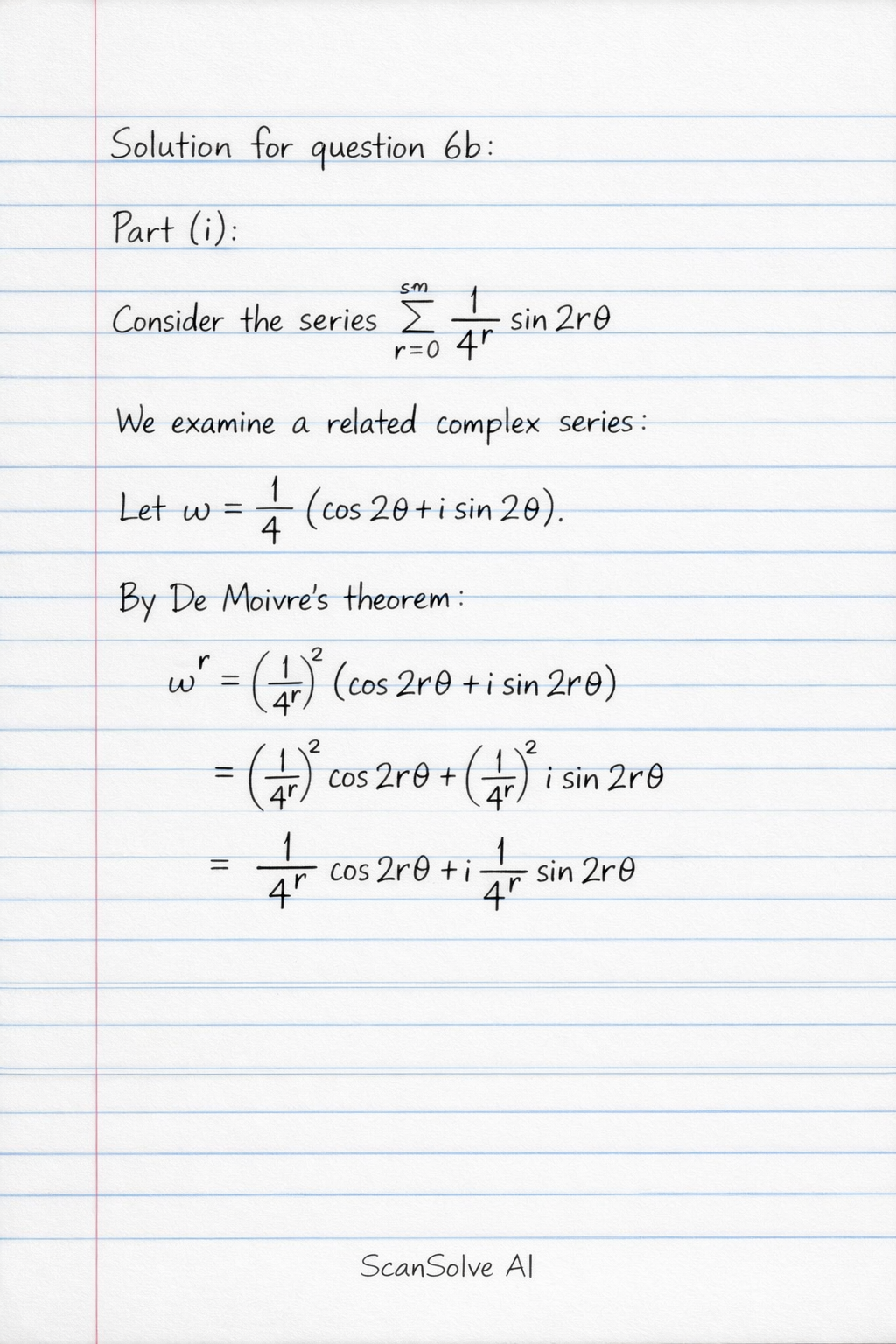
To show that the series is a convergent geometric progression, we consider a related complex geometric series.
Let .
By De Moivre's theorem, $w^r = \left(\frac{1}{4}\right)^r (\cos 2r\theta + i\sin 2r\theta) = \frac{1}{4^r} \cos 2r\theta + i \frac{1}{4^r} \sin 2
Was this helpful?
Still stuck on this one?
Ask a follow-up, and the answer starts from this question.
Got a different question?Ask your own question
More Mathematics Questions
QSolve the infinite geometric series equation sum_r=1^infinity (m)/(2^r-1) = 10 for m.QCalculate the sum of the series sum_r=−18 (2r+3).QHow do you find the sum of a geometric series?QWhat is the 4th term of the summation sum_r=36 (2r+3)?QConsider the geometric series with first term −4 and common ratio −1/2. (a) Write the general term…
Browse by topic:Pre-Calculus
Handwritten Step-by-Step Solution
Get this as a handwritten image on WhatsApp — like a tutor wrote it for you.
Try on WhatsApp