The 1^st and 6^th terms of a G.P are 153 and 17/27. Find the sum of the first four terms.
|Mathematics
The 1^st and 6^th terms of a G.P are 153 and 17/27. Find the sum of the first four terms.
ScanSolve AI Answer
Answer
3680
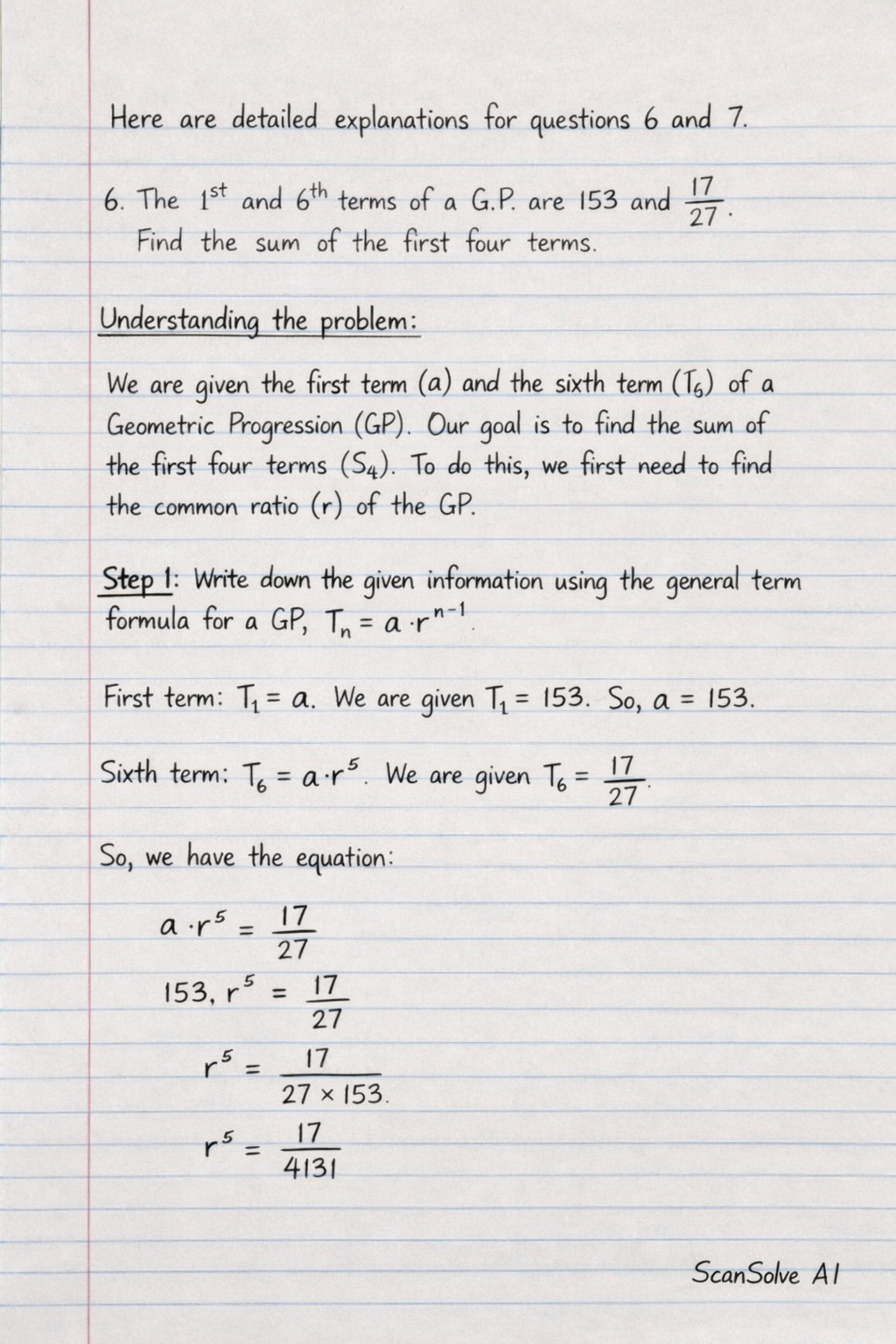
Here are detailed explanations for questions 6 and 7.
6. The 1st and 6th terms of a G.P are 153 and 17/27. Find the sum of the first four terms.
Understanding the problem: We are given the first term (a) and the sixth term (T6) of a Geometric Progression (GP). Our goal is to find the sum of the first four terms (S4). To do this, we first need to find the common ratio (r) of the GP.
Step 1: Write down the given information using the general term formula for a GP, Tn=a⋅rn−1.
The first term is T1=a. We are given T1=153. So, a=153.
The sixth term is T6=a⋅r6−1=a⋅r5. We are given T6=2717.
So, we have the equation:
a⋅r5=2717
Step 2: Find the common ratio (r).
Substitute the value of a=153 into the equation from Step 1:
153⋅r5=2717
To isolate r5, divide both sides by 153:
r5=27×15317
We can simplify the fraction. Notice that 153=9×17.
r5=27×(9×17)17
Cancel out the 17 from the numerator and denominator:
r5=27×91
Express the denominators as powers of 3: 27=33 and 9=32.
r5=33×321
Combine the powers of 3 in the denominator:
r5=33+21r5=351
Since r5=(31)5, we can conclude that:
r=31
Step 3: Find the sum of the first four terms (S4).
The formula for the sum of the first n terms of a GP is Sn=1−ra(1−rn). We use this form because ∣r∣=31<1.
We have a=153, r=31, and we want to find S4, so n=4.
Substitute these values into the formula:
S4=1−31153(1−(31)4)
First, calculate (31)4:
(31)4=3414=811
Next, calculate the denominator 1−31:
1−31=33−31=32
Now substitute these back into the S4 formula:
S4=32153(1−811)
Calculate the term in the parenthesis:
1−811=8181−811=8180
Substitute this back:
S4=32153(8180)
To simplify, we can multiply by the reciprocal of the denominator:
S4=153×8180×23
Now, perform the multiplication and simplification:
S4=81×2153×80×3
We can simplify by dividing common factors. For example, 81=3×27, and 153=3×51=9×17.
S4=(9×9)×2(9×17)×(2×40)×3
Cancel out common factors (9 and 2):
S4=917×40×3
Further simplify by dividing 3 from the numerator and 9 from the denominator:
S4=317×40×1S4=3680
The sum of the first four terms is 3680.
7. If T2=35 and T4=875 respectively. Find the first and fifth terms.
Understanding the problem: We are given the second term (T2) and the fourth term (T4) of a Geometric Progression (GP). We need to find the first term (a) and the fifth term (T5). We will use the general term formula Tn=a⋅rn−1 to set up equations and solve for a and r.
Step 1: Write down the given information using the general term formula.
For the second term (n=2):
T2=a⋅r2−1=a⋅r=35(Equation 1)
For the fourth term (n=4):
T4=a⋅r4−1=a⋅r3=875(Equation 2)
Step 2: Find the common ratio (r).
To find r, we can divide Equation 2 by Equation 1. This eliminates a:
a⋅ra⋅r3=35875
Simplify both sides:
r3−1=35875r2=25
To solve for r, take the square root of both sides. Remember that a square root can be positive or negative:
r=±25r=±5
This means there are two possible values for the common ratio, r=5 and r=−5. We need to find the first and fifth terms for each case.
Step 3: Find the first term (a) and the fifth term (T5) for each possible value of r.
Case 1: When r=5
Substitute r=5 into Equation 1 (a⋅r=35):
a⋅5=35
Divide by 5 to find a:
a=535a=7
So, the first term is T1=a=7.
Now, find the fifth term (T5) using Tn=a⋅rn−1 with a=7, r=5, and n=5:
T5=a⋅r5−1=a⋅r4T5=7⋅(5)4
Calculate 54: 5×5×5×5=25×25=625.
T5=7⋅625T5=4375
Case 2: When r=−5
Substitute r=−5 into Equation 1 (a⋅r=35):
a⋅(−5)=35
Divide by -5 to find a:
a=−535a=−7
So, the first term is T1=a=−7.
Now, find the fifth term (T5) using Tn=a⋅rn−1 with a=−7, r=−5, and n=5:
T5=a⋅r5−1=a⋅r4T5=−7⋅(−5)4
Calculate (−5)4: (−5)×(−5)×(−5)×(−5)=25×25=625. (An even power of a negative number is positive).
T5=−7⋅625T5=−4375
Therefore, there are two possible solutions:
If r=5, the first term is 7 and the fifth term is 4375.
If r=−5, the first term is −7 and the fifth term is −4375.
Was this helpful?
Need help with your own homework?
Get instant step-by-step solutions to any question. Free to start.
This mathematics problem involves applying core mathematical principles and formulas. Below you will find a complete step-by-step solution with detailed explanations for each step, helping you understand not just the answer but the method behind it.
ScanSolve AI Answer
Here are detailed explanations for questions 6 and 7. 6. The 1^st and 6^th terms of a G.P are 153 and 17/27. Find the sum of the first four terms. Understanding the problem: We are given the first term (a) and the sixth term (T_6) of a Geometric Progression (GP). Our goal is to find the sum of the first four terms (S_4). To do this, we first need to find the common ratio (r) of the GP. Step 1: Write down the given information using the general term formula for a GP, T_n = a · r^n-1. The first term is T_1 = a. We are given T_1 = 153. So, a = 153. The sixth term is T_6 = a · r^6-1 = a · r^5. We are given T_6 = (17)/(27). So, we have the equation: a · r^5 = (17)/(27) Step 2: Find the common ratio (r). Substitute the value of a=153 into the equation from Step 1: 153 · r^5 = (17)/(27) To isolate r^5, divide both sides by 153: r^5 = (17)/(27 × 153) We can simplify the fraction. Notice that 153 = 9 × 17. r^5 = (17)/(27 × (9 × 17)) Cancel out the 17 from the numerator and denominator: r^5 = (1)/(27 × 9) Express the denominators as powers of 3: 27 = 3^3 and 9 = 3^2. r^5 = (1)/(3^3 × 3^2) Combine the powers of 3 in the denominator: r^5 = (1)/(3^3+2) r^5 = (1)/(3^5) Since r^5 = ((1)/(3))^5, we can conclude that: r = (1)/(3) Step 3: Find the sum of the first four terms (S_4). The formula for the sum of the first n terms of a GP is S_n = (a(1 - r^n))/(1 - r). We use this form because |r| = |(1)/(3)| < 1. We have a=153, r=(1)/(3), and we want to find S_4, so n=4. Substitute these values into the formula: S_4 = (153 (1 - (1)/(3))^4)1 - (1)/(3) First, calculate ((1)/(3))^4: ((1)/(3))^4 = (1^4)/(3^4) = (1)/(81) Next, calculate the denominator 1 - (1)/(3): 1 - (1)/(3) = (3)/(3) - (1)/(3) = (2)/(3) Now substitute these back into the S_4 formula: S_4 = (153 (1 - 1)/(81))(2)/(3) Calculate the term in the parenthesis: 1 - (1)/(81) = (81)/(81) - (1)/(81) = (80)/(81) Substitute this back: S_4 = (153 (80)/(81))(2)/(3) To simplify, we can multiply by the reciprocal of the denominator: S_4 = 153 × (80)/(81) × (3)/(2) Now, perform the multiplication and simplification: S_4 = (153 × 80 × 3)/(81 × 2) We can simplify by dividing common factors. For example, 81 = 3 × 27, and 153 = 3 × 51 = 9 × 17. S_4 = ((9 × 17) × (2 × 40) × 3)/((9 × 9) × 2) Cancel out common factors (9 and 2): S_4 = (17 × 40 × 3)/(9) Further simplify by dividing 3 from the numerator and 9 from the denominator: S_4 = (17 × 40 × 1)/(3) S_4 = (680)/(3) The sum of the first four terms is (680)/(3). 7. If T_2=35 and T_4=875 respectively. Find the first and fifth terms. Understanding the problem: We are given the second term (T_2) and the fourth term (T_4) of a Geometric Progression (GP). We need to find the first term (a) and the fifth term (T_5). We will use the general term formula T_n = a · r^n-1 to set up equations and solve for a and r. Step 1: Write down the given information using the general term formula. For the second term (n=2): T_2 = a · r^2-1 = a · r = 35 (Equation 1) For the fourth term (n=4): T_4 = a · r^4-1 = a · r^3 = 875 (Equation 2) Step 2: Find the common ratio (r). To find r, we can divide Equation 2 by Equation 1. This eliminates a: (a · r^3)/(a · r) = (875)/(35) Simplify both sides: r^3-1 = (875)/(35) r^2 = 25 To solve for r, take the square root of both sides. Remember that a square root can be positive or negative: r = ± sqrt(25) r = ± 5 This means there are two possible values for the common ratio, r=5 and r=-5. We need to find the first and fifth terms for each case. Step 3: Find the first term (a) and the fifth term (T_5) for each possible value of r. Case 1: When r=5 Substitute r=5 into Equation 1 (a · r = 35): a · 5 = 35 Divide by 5 to find a: a = (35)/(5) a = 7 So, the first term is T_1 = a = 7. Now, find the fifth term (T_5) using T_n = a · r^n-1 with a=7, r=5, and n=5: T_5 = a · r^5-1 = a · r^4 T_5 = 7 · (5)^4 Calculate 5^4: 5 × 5 × 5 × 5 = 25 × 25 = 625. T_5 = 7 · 625 T_5 = 4375 Case 2: When r=-5 Substitute r=-5 into Equation 1 (a · r = 35): a · (-5) = 35 Divide by -5 to find a: a = (35)/(-5) a = -7 So, the first term is T_1 = a = -7. Now, find the fifth term (T_5) using T_n = a · r^n-1 with a=-7, r=-5, and n=5: T_5 = a · r^5-1 = a · r^4 T_5 = -7 · (-5)^4 Calculate (-5)^4: (-5) × (-5) × (-5) × (-5) = 25 × 25 = 625. (An even power of a negative number is positive). T_5 = -7 · 625 T_5 = -4375 Therefore, there are two possible solutions: If r=5, the first term is 7 and the fifth term is 4375. If r=-5, the first term is -7 and the fifth term is -4375.