
We read your photo as:
What is the 16th term of the arithmetic sequence 5,12,19,26,...? What is the difference between the 20th and 15th term of an arithmetic sequence with common difference 5? If the 16th term is 47, what
ScanSolve AI Answer
Answer
110
Step-by-step solution
9 stepsHere are the solutions to the problems:
1. 16th term of the arithmetic sequence 5,12,19,26, ... ... ... is
Identify the first term () and the common difference ().
The first term is .
The common difference is .Use the formula for the term of an arithmetic sequence, .
For the 16th term ():
The correct option is C) 110.
2. What is the difference between the 20th term and 15th term of the arithmetic sequence whose common difference 5?
Identify the common difference ().
The common difference is .
Use the formula for the term, , to find the difference.
The difference between the 20th term and the 15th term is .
Substitute the value of .
The correct option is C) 25.
3. If the 16th term of an arithmetic sequence is 47, what is the sum of the 31st terms?
Write the given information using the formula for the term.
The 16th term is .
Given , so .Use the formula for the sum of the first terms of an arithmetic sequence, .
We need to find the sum of the first 31 terms, .
Substitute the value of from Step 1.
The correct option is A) 1457.
4. (i) Write the sequence of natural numbers which leaves a remainder 1 on division by 4.
(ii) Is this an arithmetic sequence? Why?
i) Step 1: List the natural numbers that leave a remainder of 1 when divided by 4.
These numbers areii) Step 2: Determine if the sequence is an arithmetic sequence and explain why.
Yes, this is an arithmetic sequence. The difference between consecutive terms is constant:
Since the common difference () is constant, it is an arithmetic sequence.5. The Sum of terms from 4th to 10th of an arithmetic sequence is 84,
i) What is the 7th term?
ii) What is the sum of 6th term and 8th term.
i) Step 1: Identify the terms and their sum.
The terms are . There are terms.
The sum of these 7 terms is 84.Use the property that for an arithmetic sequence, the sum of an odd number of terms is the number of terms multiplied by the middle term.
The middle term of these 7 terms is the $\frac{7+1}{2} = 4^{
Try one yourself
A new problem that tests the same skill.
Still stuck on this one?
Ask a follow-up, and the answer starts from this question.
More Mathematics Questions
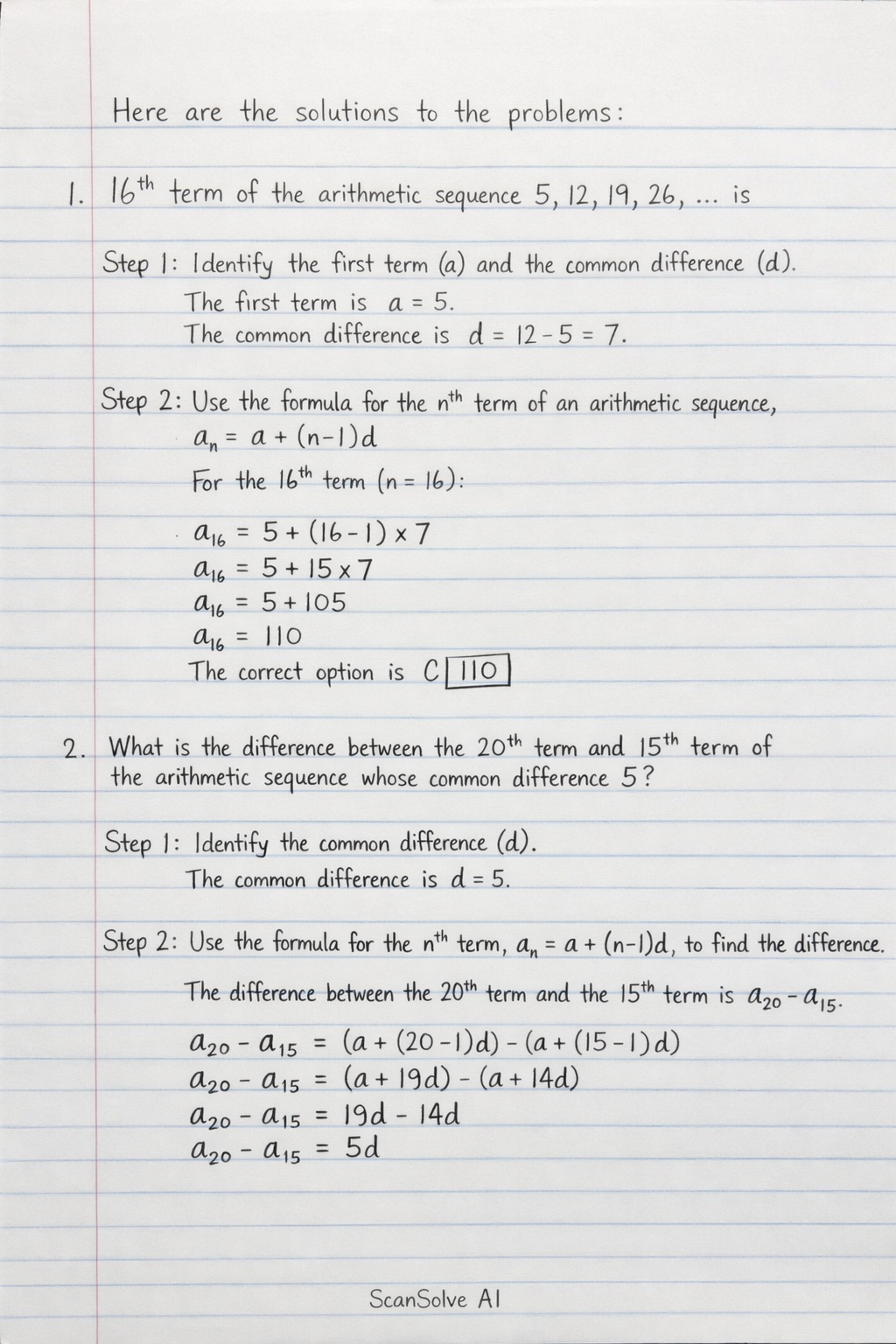
Handwritten Step-by-Step Solution
Get this as a handwritten image on WhatsApp — like a tutor wrote it for you.
Try on WhatsApp