
This mathematics problem involves applying core mathematical principles and formulas. Below you will find a complete step-by-step solution with detailed explanations for each step, helping you understand not just the answer but the method behind it.
ScanSolve AI Answer
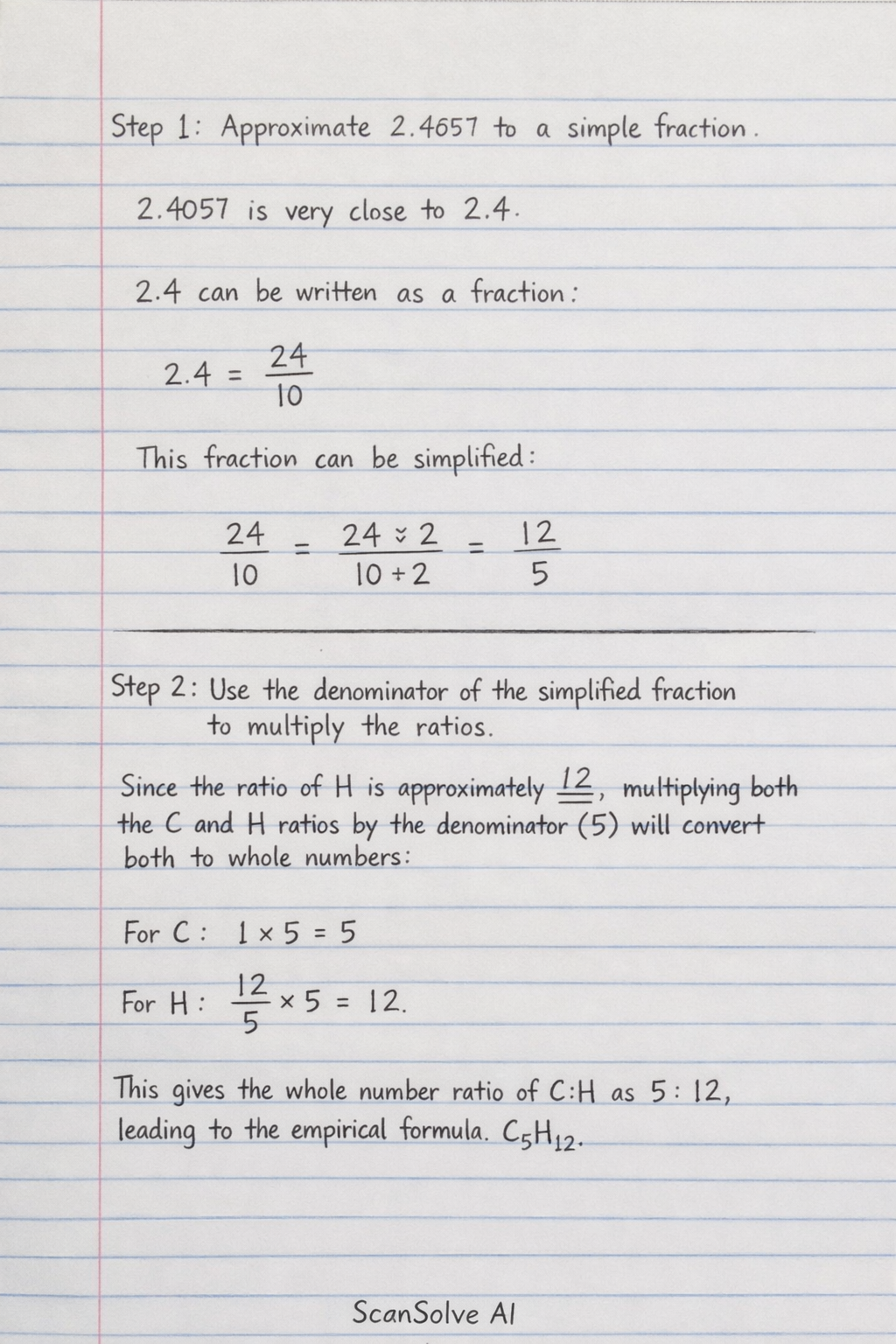
The ratio of H was approximately 2.4057. To get whole numbers for the empirical formula, we need to find the smallest integer that, when multiplied by 2.4057, results in a whole number. Step 1: Approximate 2.4057 to a simple fraction. 2.4057 is very close to 2.4. 2.4 can be written as a fraction: 2.4 = (24)/(10) This fraction can be simplified by dividing both the numerator and the denominator by their greatest common divisor, which is 2: (24)/(10) = (24 ÷ 2)/(10 ÷ 2) = (12)/(5) Step 2: Use the denominator of the simplified fraction to multiply the ratios. Since the ratio of H is approximately (12)/(5), multiplying both the C and H ratios by the denominator (5) will convert both to whole numbers: For C: 1 × 5 = 5 For H: (12)/(5) × 5 = 12 This gives the whole number ratio of C:H as 5:12, leading to the empirical formula C_5 H_12.