
We read your photo as:
What is the area of the shaded regions in the following figures? (1) A rectangle with a triangle removed. (2) A rectangle with a semicircle removed.
ScanSolve AI Answer
Step-by-step solution
27 stepsHere are the areas for each shaded region:
1)
Identify the shapes.
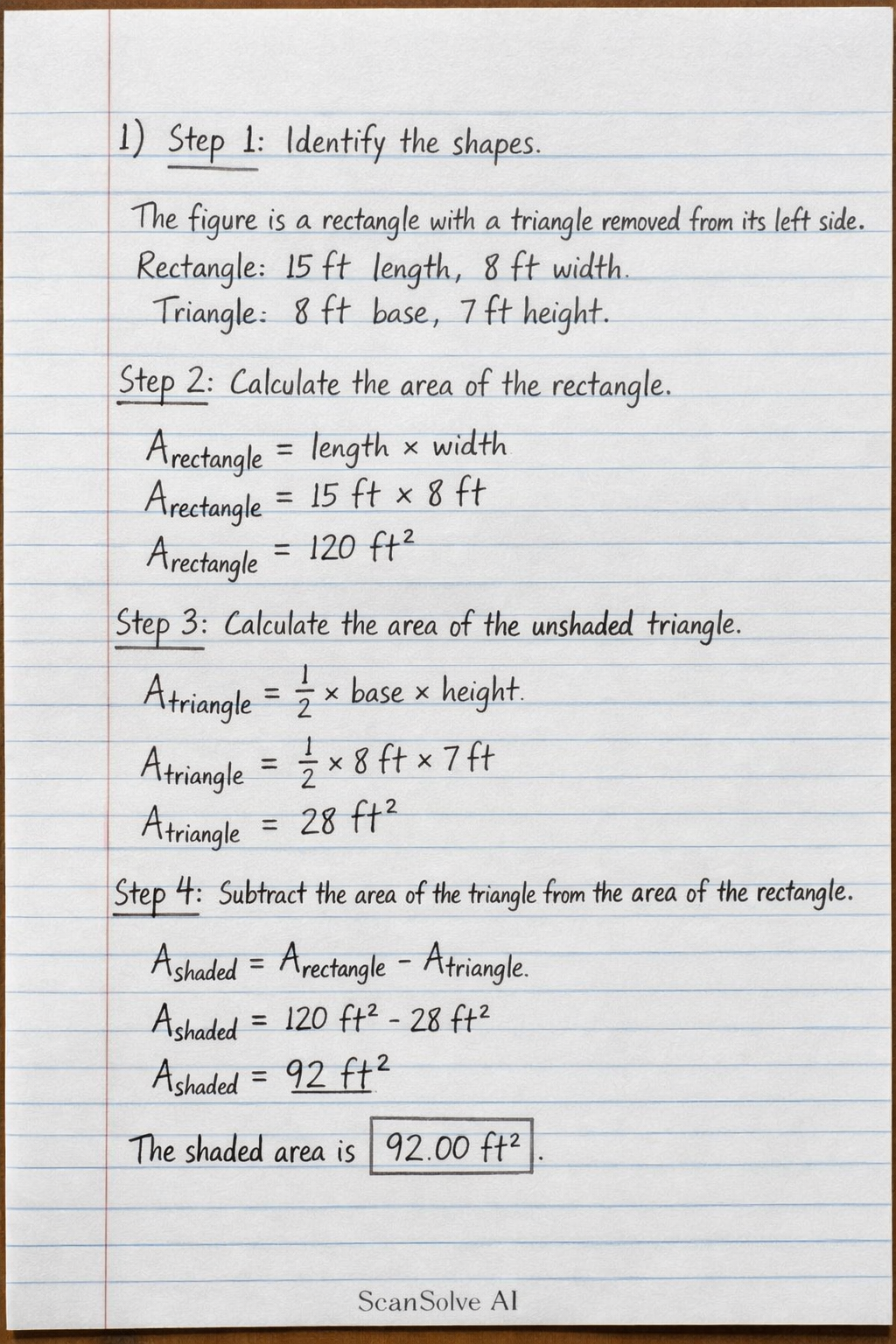
The figure is a rectangle with a triangle removed from its left side.
The rectangle has a length of and a width of .
The triangle has a base of (same as the rectangle's width) and a height of .Calculate the area of the rectangle.
Calculate the area of the unshaded triangle.
Subtract the area of the triangle from the area of the rectangle to find the shaded area.
The shaded area is .
2)
Identify the shapes.
The figure is a rectangle with a semicircle removed from its left side.
The rectangle has a length of and a width of .
The semicircle has a diameter of , so its radius is .Calculate the area of the rectangle.
Calculate the area of the unshaded semicircle.
The area of a full circle is . The area of a semicircle is .
Subtract the area of the semicircle from the area of the rectangle to find the shaded area.
Round to two decimal places.
The shaded area is .
3)
Identify the shapes.
The figure is a circle with a square removed from its center.
The circle has a diameter of , so its radius is .
The square has a side length of .Calculate the area of the circle.
Calculate the area of the unshaded square.
Subtract the area of the square from the area of the circle to find the shaded area.
Round to two decimal places.
The shaded area is .
4)
Identify the shapes.
The figure is a rectangle with a circle removed from its center.
The rectangle has a length of and a width of .
The circle has a diameter of , so its radius is .Calculate the area of the rectangle.
Calculate the area of the unshaded circle.
Subtract the area of the circle from the area of the rectangle to find the shaded area.
Round to two decimal places.
The shaded area is .
5)
Identify the shapes.
The figure is a large triangle with an unshaded trapezoid removed from its base.
The large triangle has a base of and a height of .
The unshaded trapezoid has parallel bases of and , and a height of .Calculate the area of the large triangle.
Calculate the area of the unshaded trapezoid.
Subtract the area of the trapezoid from the area of the large triangle to find the shaded area.
The shaded area is .
6)
Identify the shapes.
The figure is a large square with a smaller square removed from its center.
The large square has a side length of .
The small square has a side length of .Calculate the area of the large square.
Calculate the area of the unshaded small square.
Subtract the area of the small square from the area of the large square to find the shaded area.
The shaded area is .
Still stuck on this one?
Ask a follow-up, and the answer starts from this question.
More Mathematics Questions
Handwritten Step-by-Step Solution
Get this as a handwritten image on WhatsApp — like a tutor wrote it for you.
Try on WhatsApp