
We read your photo as:
The binomial theorem is used to expand expressions of the form: a) (a + b) b) (a + b) c) (a + b)n d) (a - b)2 e) None of the above.
ScanSolve AI Answer
Answer
Step-by-step solution
13 stepsHere are the solutions to the questions:
49. In how many ways can a president, vice-president, secretary, and treasurer be selected from a group of 8 candidates?
Identify this as a permutation problem because the positions (president, vice-president, secretary, treasurer) are distinct, meaning the order of selection matters.
We need to select 4 people from 8 candidates for 4 distinct positions.
Use the permutation formula .
Here, (total candidates) and (positions to fill).
Calculate the value.
- The correct option is e) None of the above. (The calculated answer is 1680, which is not among options a, b, c, d).
50. How many different 7-letter words can be formed using the letters of the word "INSTITUTE"?
List the letters available from "INSTITUTE" and their frequencies.
The word "INSTITUTE" has 9 letters: I (2 times), N (1 time), S (1 time), T (3 times), U (1 time), E (1 time).
We need to form 7-letter words using these letters. This requires considering different cases based on the repetitions of 'I' and 'T'.Case 1: Using three T's, two I's, and two other distinct letters.
- Choose 2 distinct letters from {N, S, U, E}: ways.
- Arrange the 7 letters (T, T, T, I, I, X, Y): ways.
- Total for Case 1: .
Case 2: Using three T's, one I, and three other distinct letters.
- Choose 3 distinct letters from {N, S, U, E}: ways.
- Arrange the 7 letters (T, T, T, I, X, Y, Z): ways.
- Total for Case 2: .
Case 3: Using two T's, two I's, and three other distinct letters.
- Choose 3 distinct letters from {N, S, U, E}: ways.
- Arrange the 7 letters (T, T, I, I, X, Y, Z): ways.
- Total for Case 3: .
Case 4: Using two T's, one I, and four other distinct letters.
- Choose 4 distinct letters from {N, S, U, E}: way.
- Arrange the 7 letters (T, T, I, N, S, U, E): ways.
- Total for Case 4: .
Case 5: Using one T, two I's, and four other distinct letters.
- Choose 4 distinct letters from {N, S, U, E}: way.
- Arrangement: ways.
- Total for Case 5: .
Sum the totals from all cases.
Total number of ways = .
- The correct option is e) None of the above. (The calculated answer is 15960, which is not among options a, b, c, d).
51. The binomial theorem is used to expand expressions of the form:
The binomial theorem provides a formula for expanding algebraic expressions of the form for any non-negative integer .- The correct option is c) .
52. The coefficient of the middle term in the expansion of is given by:
Determine the formula for the middle term's coefficient.
If is an even number, there is one middle term, which is the -th term. Its coefficient is .
If is an odd number, there are two middle terms, the -th and -th terms. Their coefficients are and , which are equal.Compare with the given options.
None of the options (a) , (b) , (c) , or (d) represent the general formula for the coefficient of the middle term(s).
- The correct option is e) None of the above.
53. The expansion of is:
Use the binomial theorem formula .
For :
Calculate the binomial coefficients.
Substitute the coefficients into the expansion.
- The correct option is a) .
54. The binomial coefficient is given by:
The formula for the binomial coefficient is defined as the number of ways to choose elements from a set of elements without regard to the order of selection.- The correct option is d) .
55. The binomial coefficient (7 choose 3) is:
Write the expression using binomial coefficient notation.
(7 choose 3) is .
Use the formula .
Here, and .
Calculate the value.
- The correct option is b) 35.
Try one yourself
A new problem that tests the same skill.
Still stuck on this one?
Ask a follow-up, and the answer starts from this question.
More Mathematics Questions
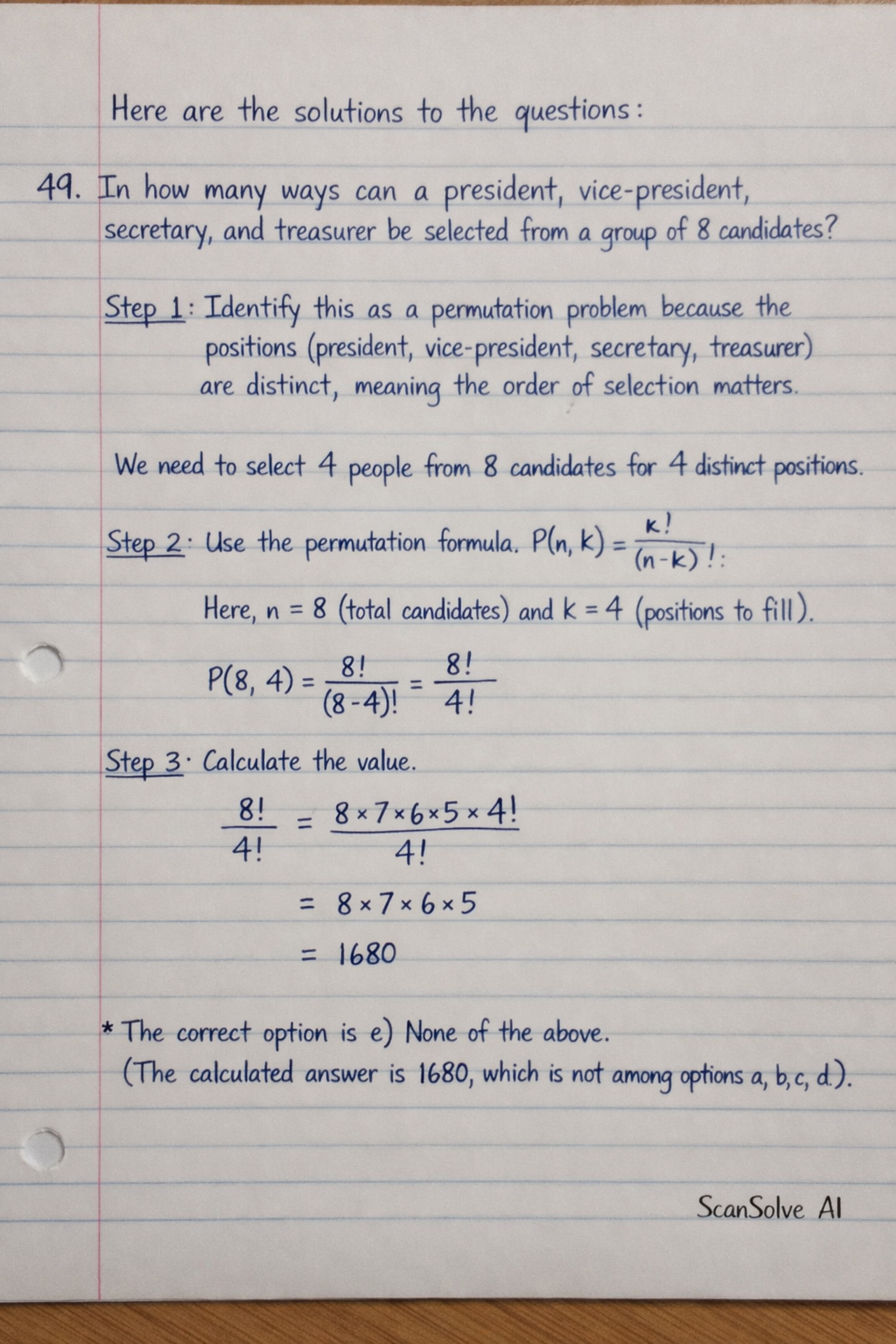
Handwritten Step-by-Step Solution
Get this as a handwritten image on WhatsApp — like a tutor wrote it for you.
Try on WhatsApp