We read your photo as:

What is the capacity of a pail in litres if it's in the shape of a frustum with top diameter 32cm, bottom diameter 24cm, and height 30cm? Also, calculate the determinant of the matrix A = [[3, -1], [4

Mathematics

ScanSolve AI Answer

Answers

2 parts
a

62\frac{\sqrt{6}}{2}

b
1

Step-by-step solution

6 steps

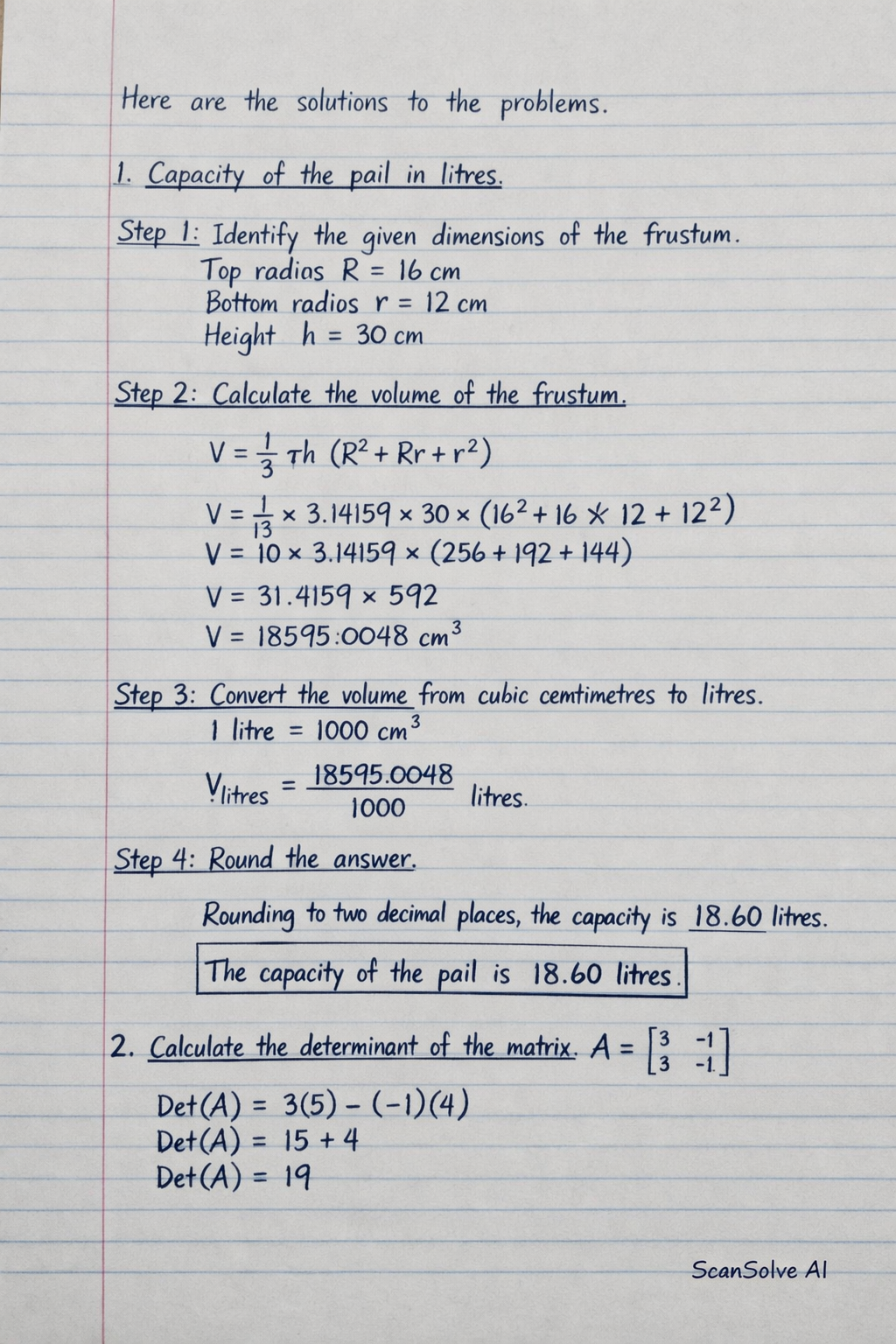
Here are the solutions to the problems.

1. Capacity of the pail in litres

Step 1: Identify the given dimensions of the frustum.
Top diameter =32= 32 cm, so top radius R=322=16R = \frac{32}{2} = 16 cm.
Bottom diameter =24= 24 cm, so bottom radius r=242=12r = \frac{24}{2} = 12 cm.
Height h=30h = 30 cm.

Step 2: Calculate the volume of the frustum.
The formula for the volume of a frustum is V=13πh(R2+Rr+r2)V = \frac{1}{3}\pi h (R^2 + Rr + r^2).
Using π≈3.14159\pi \approx 3.14159:

V=13×3.14159×30×(162+16×12+122)V = \frac{1}{3} \times 3.14159 \times 30 \times (16^2 + 16 \times 12 + 12^2) V=10×3.14159×(256+192+144)V = 10 \times 3.14159 \times (256 + 192 + 144) V=31.4159×(592)V = 31.4159 \times (592) V=18595.0048 cm3V = 18595.0048 \text{ cm}^3

Step 3: Convert the volume from cubic centimeters to litres.
Since 1 litre=1000 cm31 \text{ litre} = 1000 \text{ cm}^3:

Vlitres=18595.00481000V_{\text{litres}} = \frac{18595.0048}{1000} Vlitres=18.5950048 litresV_{\text{litres}} = 18.5950048 \text{ litres}

Step 4: Round the answer.
Rounding to two decimal places, the capacity is 18.60 litres.
The capacity of the pail is 18.60 litres\boxed{18.60 \text{ litres}}.

2. Calculate the determinant of the matrix A=[3−145]A = \begin{bmatrix} 3 & -1 \\ 4 & 5 \end{bmatrix}

Step 1: Recall the formula for the determinant of a 2×22 \times 2 matrix.
For a matrix [abcd]\begin{bmatrix} a & b \\ c & d \end{bmatrix}, the determinant is ad−bcad - bc.

Step 2: Substitute the values from matrix AA.
Here, a=3a=3, b=−1b=-1, c=4c=4, d=5d=5.

det⁡(A)=(3×5)−(−1×4)\det(A) = (3 \times 5) - (-1 \times 4) det⁡(A)=15−(−4)\det(A) = 15 - (-4) det⁡(A)=15+4\det(A) = 15 + 4 det⁡(A)=19\det(A) = 19

The determinant of matrix AA is 19\boxed{19}.

3. Without using table or a calculator Simplify each leaving your answer with rational denominators

Part a· 2 steps

sin⁡45∘tan⁡60∘\sin 45^\circ \tan 60^\circ

  1. Write down the exact values of sin⁡45∘\sin 45^\circ and tan⁡60∘\tan 60^\circ.

    sin⁡45∘=22\sin 45^\circ = \frac{\sqrt{2}}{2} tan⁡60∘=3\tan 60^\circ = \sqrt{3}
  2. Multiply the values.

    sin⁡45∘tan⁡60∘=22×3\sin 45^\circ \tan 60^\circ = \frac{\sqrt{2}}{2} \times \sqrt{3} =2×32= \frac{\sqrt{2} \times \sqrt{3}}{2} =62= \frac{\sqrt{6}}{2}

    The simplified expression is 62\boxed{\frac{\sqrt{6}}{2}}.

Part b1

cos⁡60∘sin⁡30∘+sin⁡60∘cos⁡30∘\cos 60^\circ \sin 30^\circ + \sin 60^\circ \cos 30^\circ

  1. Write down the exact values of each trigonometric function.

    cos⁡60∘=12\cos 60^\circ = \frac{1}{2} sin⁡30∘=12\sin 30^\circ = \frac{1}{2} sin⁡60∘=32\sin 60^\circ = \frac{\sqrt{3}}{2} cos⁡30∘=32\cos 30^\circ = \frac{\sqrt{3}}{2}
  2. Substitute the values into the expression.

    cos⁡60∘sin⁡30∘+sin⁡60∘cos⁡30∘=(12×12)+(32×32)\cos 60^\circ \sin 30^\circ + \sin 60^\circ \cos 30^\circ = \left(\frac{1}{2} \times \frac{1}{2}\right) + \left(\frac{\sqrt{3}}{2} \times \frac{\sqrt{3}}{2}\right)
  3. Perform the multiplications.

    =14+34= \frac{1}{4} + \frac{3}{4}
  4. Add the fractions.

    =1+34= \frac{1+3}{4} =44= \frac{4}{4} =1= 1

    The simplified expression is 1\boxed{1}.

Was this helpful?

Try one yourself

A new problem that tests the same skill.

Still stuck on this one?

Ask a follow-up, and the answer starts from this question.

Got a different question?Ask your own question
Handwritten step-by-step solution preview

Handwritten Step-by-Step Solution

Get this as a handwritten image on WhatsApp — like a tutor wrote it for you.

Try on WhatsApp