The coefficient of x cube in the expansion of (3+az)^6 is 160 find the value of the constant a, hence find the coefficient of x cube in the expansion of (3+ ax)^6(1-2x)
This mathematics problem involves applying core mathematical principles and formulas. Below you will find a complete step-by-step solution with detailed explanations for each step, helping you understand not just the answer but the method behind it.
ScanSolve AI Answer
Here's a step-by-step solution to the problem. I will assume that 'z' in the first part of the question is a typo and should be 'x', consistent with the second part of the question.
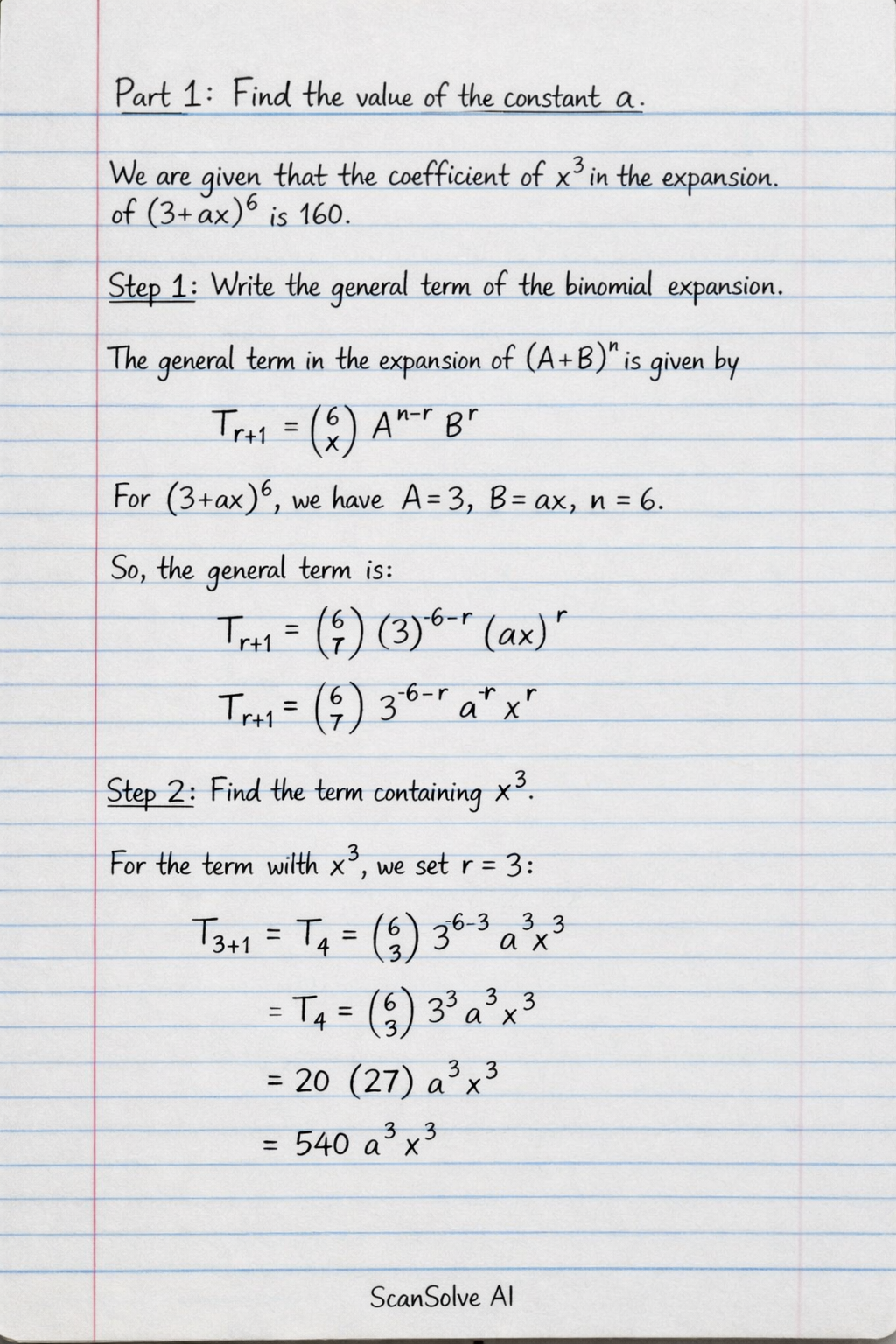
Part 1: Find the value of the constant $a$.
We are given that the coefficient of $x^3$ in the expansion of $(3+ax)^6$ is 160.
Step 1: Write the general term of the binomial expansion.
The general term in the expansion of $(A+B)^n$ is given by $T_{r+1} = \binom{n}{r} A^{n-r} B^r$.
For $(3+ax)^6$, we have $A=3$, $B=ax$, and $n=6$.
So, the general term is:
$$ T_{r+1} = \binom{6}{r} (3)^{6-r} (ax)^r $$
$$ T_{r+1} = \binom{6}{r} 3^{6-r} a^r x^r $$
Step 2: Find the term containing $x^3$.
For the term with $x^3$, we set $r=3$:
$$ T_{3+1} = T_4 = \binom{6}{3} 3^{6-3} a^3 x^3 $$
$$ T_4 = \binom{6}{3} 3^3 a^3 x^3 $$
Step 3: Calculate the binomial coefficient and simplify.
$$ \binom{6}{3} = \frac{6!}{3!(6-3)!} = \frac{6 \times 5 \times 4}{3 \times 2 \times 1} = 20 $$
$$ 3^3 = 27 $$
Substitute these values back into the expression for $T_4$:
$$ T_4 = 20 \times 27 \times a^3 x^3 $$
$$ T_4 = 540 a^3 x^3 $$
The coefficient of $x^3$ is $540a^3$.
Step 4: Solve for $a$.
We are given that the coefficient of $x^3$ is 160:
$$ 540 a^3 = 160 $$
$$ a^3 = \frac{160}{540} $$
$$ a^3 = \frac{16}{54} $$
$$ a^3 = \frac{8}{27} $$
Take the cube root of both sides:
$$ a = \sqrt[3]{\frac{8}{27}} $$
$$ a = \frac{2}{3} $$
The value of the constant $a$ is $\boxed{\frac{2}{3}}$.
Part 2: Find the coefficient of $x^3$ in the expansion of $(3+ax)^6(1-2x)$.
Now we use the value $a=\frac{2}{3}$. The expression becomes $(3+\frac{2}{3}x)^6(1-2x)$.
Step 1: Expand $(3+\frac{2}{3}x)^6$ up to the $x^3$ term.
We need the coefficients of $x^0$, $x^1$, $x^2$, and $x^3$ from $(3+\frac{2}{3}x)^6$.
Using the general term $T_{r+1} = \binom{6}{r} 3^{6-r} (\frac{2}{3}x)^r = \binom{6}{r} 3^{6-r} (\frac{2}{3})^r x^r$:
Coefficient of $x^0$ (constant term, $r=0$):
$$ \binom{6}{0} 3^6 (\frac{2}{3})^0 = 1 \times 729 \times 1 = 729 $$
Coefficient of $x^1$ ($r=1$):
$$ \binom{6}{1} 3^5 (\frac{2}{3})^1 = 6 \times 243 \times \frac{2}{3} = 6 \times 81 \times 2 = 972 $$
Coefficient of $x^2$ ($r=2$):
$$ \binom{6}{2} 3^4 (\frac{2}{3})^2 = 15 \times 81 \times \frac{4}{9} = 15 \times 9 \times 4 = 540 $$
Coefficient of $x^3$ ($r=3$):
$$ \binom{6}{3} 3^3 (\frac{2}{3})^3 = 20 \times 27 \times \frac{8}{27} = 20 \times 8 = 160 $$
So, $(3+\frac{2}{3}x)^6 = 729 + 972x + 540x^2 + 160x^3 + \dots$
Step 2: Multiply the expansion by $(1-2x)$ and identify $x^3$ terms.
We need the coefficient of $x^3$ in $(729 + 972x + 540x^2 + 160x^3 + \dots)(1-2x)$.
To get an $x^3$ term, we can multiply:
The $x^3$ term from the first bracket by the constant term from the second bracket:
$(160x^3) \times (1) = 160x^3$
The $x^2$ term from the first bracket by the $x$ term from the second bracket:
$(540x^2) \times (-2x) = -1080x^3$
Step 3: Sum the coefficients of the $x^3$ terms.
The total coefficient of $x^3$ is the sum of these contributions:
$$ 160 + (-1080) = 160 - 1080 = -920 $$
The coefficient of $x^3$ in the
The coefficient of x cube in the expansion of (3+az)^6 is 160 find the value of the constant a, hence find the coefficient of x cube in the expansion of (3+ ax)^6(1-2x)
|Mathematics
ScanSolve AI Answer
Here's a step-by-step solution to the problem. I will assume that 'z' in the first part of the question is a typo and should be 'x', consistent with the second part of the question.
Part 1: Find the value of the constant a.
We are given that the coefficient of x3 in the expansion of (3+ax)6 is 160.
Step 1: Write the general term of the binomial expansion.
The general term in the expansion of (A+B)n is given by Tr+1=(rn)An−rBr.
For (3+ax)6, we have A=3, B=ax, and n=6.
So, the general term is:
Tr+1=(r6)(3)6−r(ax)rTr+1=(r6)36−rarxr
Step 2: Find the term containing x3.
For the term with x3, we set r=3:
T3+1=T4=(36)36−3a3x3T4=(36)33a3x3
Step 3: Calculate the binomial coefficient and simplify.
(36)=3!(6−3)!6!=3×2×16×5×4=2033=27
Substitute these values back into the expression for T4:
T4=20×27×a3x3T4=540a3x3
The coefficient of x3 is 540a3.
Step 4: Solve for a.
We are given that the coefficient of x3 is 160:
540a3=160a3=540160a3=5416a3=278
Take the cube root of both sides:
a=3278a=32
The value of the constant a is 32.
Part 2: Find the coefficient of x3 in the expansion of (3+ax)6(1−2x).
Now we use the value a=32. The expression becomes (3+32x)6(1−2x).
Step 1: Expand (3+32x)6 up to the x3 term.
We need the coefficients of x0, x1, x2, and x3 from (3+32x)6.
Using the general term Tr+1=(r6)36−r(32x)r=(r6)36−r(32)rxr:
Coefficient of x0 (constant term, r=0):(06)36(32)0=1×729×1=729
Coefficient of x1 (r=1):(16)35(32)1=6×243×32=6×81×2=972
Coefficient of x2 (r=2):(26)34(32)2=15×81×94=15×9×4=540
Coefficient of x3 (r=3):(36)33(32)3=20×27×278=20×8=160
So, (3+32x)6=729+972x+540x2+160x3+…
Step 2: Multiply the expansion by (1−2x) and identify x3 terms.
We need the coefficient of x3 in (729+972x+540x2+160x3+…)(1−2x).
To get an x3 term, we can multiply:
The x3 term from the first bracket by the constant term from the second bracket:
(160x3)×(1)=160x3
The x2 term from the first bracket by the x term from the second bracket:
(540x2)×(−2x)=−1080x3
Step 3: Sum the coefficients of the x3 terms.
The total coefficient of x3 is the sum of these contributions:
160+(−1080)=160−1080=−920
The coefficient of x3 in the
Need help with your own homework?
Get instant step-by-step solutions to any question. Free to start.